
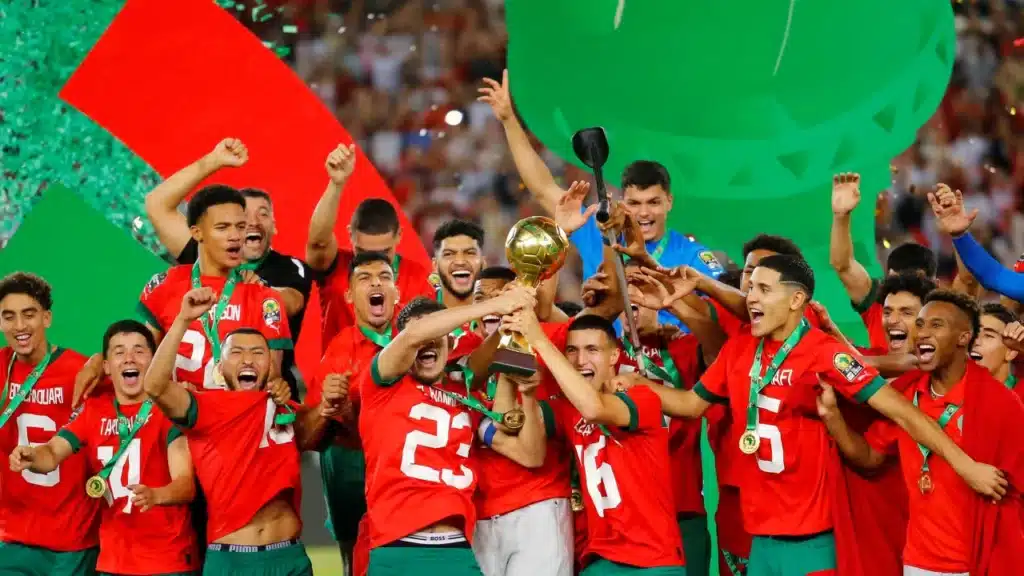
Why Morocco Are Now AFCON 2025 Champions: The CAF Decision That Overturned Senegal’s Final Win
African football has rarely seen a title decided like this. Morocco are now officially the 2025 Africa Cup of Nations champions after the CAF Appeal Board ruled on March 17, 2026 that Senegal had forfeited the final, turning the original 1-0 extra-time result into a 3-0 awarded win for Morocco. This was not a routine disciplinary footnote. It was a competition-defining decision that changed the official champion nearly two months after the match itself.
To understand why this matters, you have to separate refereeing controversy from competition law. The final itself, played in Rabat on January 18, 2026, was refereed by Jean-Jacques Ndala. Late in stoppage time, Morocco were awarded a penalty after a VAR review following a foul on Brahim Diaz by Senegal defender El Hadji Malick Diouf. Senegal’s players then left the field in protest before eventually returning; Morocco missed the penalty, and Senegal later won 1-0 after extra time through Pape Gueye.
That is the first key analytical point: CAF did not later crown Morocco because Brahim Diaz should have scored the penalty, or because the original football result was re-refereed. The appeal-board ruling was about what happened after the penalty was awarded. CAF’s own statement says Senegal’s conduct fell within Articles 82 and 84 of the AFCON regulations and that the final must be recorded as a forfeit, with the result entered as 3-0 for Morocco.
This is why a lot of fan discussion will miss the real issue. People will argue about whether the late penalty was harsh, whether Morocco were emotional, whether Senegal returned, and whether the game still continued to a legal finish. But the decisive legal question was narrower: did Senegal’s walk-off amount to conduct that triggered forfeit rules under the competition regulations? CAF’s Appeal Board said yes. And once that answer becomes yes, the match is no longer judged only by what happened in extra time. It is judged by the rules governing abandonment, refusal, and conduct that places the match outside normal sporting continuation.
That also explains why this story is bigger than a normal “bad VAR call” headline. If this had remained only about the foul on Diaz, the debate would still live in the usual football grey zone: some would call it a clear tug, others would call it tournament pressure, and everyone would post freeze-frames. But once a team leaves the pitch in protest during the decisive phase of a final, the issue stops being only interpretive. It becomes institutional. CAF had already punished both federations after the chaos, and on January 28 its disciplinary board had even rejected Morocco’s original protest about the result. Then Morocco appealed, and the Appeal Board reversed the bigger sporting outcome on March 17.
That chronology matters because it shows this was not an impulsive public-relations reaction. It moved through CAF’s own process. First came sanctions. Then came appeal. Then came the appeal-board ruling that the protest was upheld and the match must be recorded as a Senegal forfeit. Reuters reported that the key trigger was Senegal’s players leaving the field for more than 10 minutes in protest of the penalty.
From a pure referee-analysis perspective, there is another important takeaway. Jean-Jacques Ndala’s late penalty decision is not the same thing as CAF’s final title decision. Those two debates should not be blended. A referee can make a big call late in a match. Players can disagree. But the structure of elite competition depends on one basic line never being crossed: teams do not get to suspend the match as leverage against a decision they dislike. Once that line is crossed, governing bodies have to protect the authority of the competition itself. That is why this ruling will be defended inside officiating circles even by people who still debate the original penalty.
There is also a football truth here that will make this ruling feel brutal to Senegal. They did eventually come back out. Morocco did miss the penalty. Senegal then scored and celebrated what looked like a valid title win. On the pitch, the trophy was won one way. In the regulations, it was later lost another way. That is exactly why this decision feels unprecedented and why it will remain one of the most controversial AFCON rulings in modern memory. Reuters described it as a formal stripping of Senegal’s title, while CAF’s Appeal Board language leaves no ambiguity about the official record.
The Var Verdict:
Morocco are now AFCON 2025 champions because CAF judged the final to be a forfeit case, not because the match was simply re-scored by opinion. The decisive act was not Morocco’s missed penalty. It was Senegal’s walk-off in protest during the defining phase of the final. On a football level, people will still argue. On a regulatory level, CAF has made the result clear: Morocco 3-0 Senegal, awarded.

0 Comments
Join the conversation with respect. Comments are moderated and must follow our community rules.
Want to join the discussion?
Please log in or create an account to comment and reply. This keeps the conversation cleaner and safer.