

The Chelsea vs Arsenal Women hair-pull controversy gave an already tense Champions League quarter-final its defining flashpoint. Chelsea won the second leg 1-0 through Sjoeke Nüsken deep into stoppage time, but Arsenal still went through 3-2 on aggregate. The result, though, was quickly overshadowed by the late incident involving Katie McCabe and Alyssa Thompson, and by the question that followed it: should VAR have stepped in?
Quick Verdict
My verdict is that this was reviewable by VAR and that a red-card check would have been supportable. The harder part is the final threshold. Based on the available footage described by multiple reports, the action looks serious enough to raise a violent-conduct question. What I would stop short of saying, without every angle and the full VAR feed, is that the non-red was unquestionably indefensible. The better wording is: possible missed red-card review, not a protocol impossibility.
What happened
The incident came in the final seconds as Chelsea chased the goal that would have taken the tie to extra time. AP reported that the replay shown afterward by Sonia Bompastor captured McCabe pulling back Thompson’s hair as the Chelsea forward broke ahead. Bompastor, furious on the sideline, confronted Danish referee Frida Klarlund and was sent off. Chelsea’s coach later said Thompson was left crying after the incident.
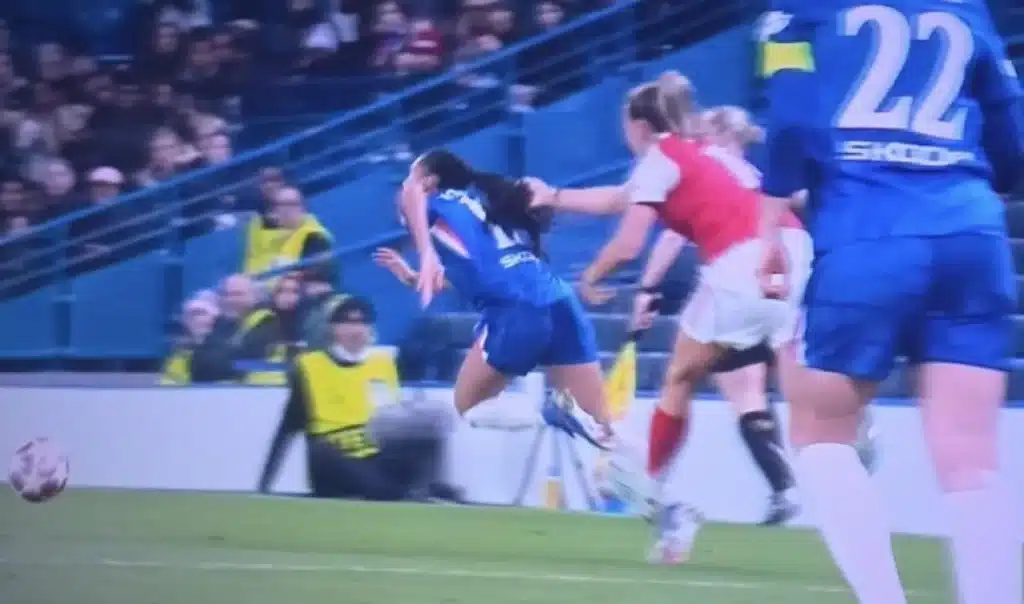
That timing matters. This was not some detached scuffle in a dead moment of the game. It happened right at the point where Chelsea were trying to force a final opening in a tie that still had life after Nüsken’s stoppage-time goal. Arsenal held on, but the controversy instantly became the talking point.
The referee decision
On the field, McCabe was not sent off, and Chelsea’s anger then spilled into the technical area, where Bompastor ended up dismissed. Chelsea’s own match report described the hair pull as having gone unpunished, while Reuters also framed it as an incident from which McCabe escaped punishment.
That leaves two separate refereeing questions. The first is the player incident itself. The second is Bompastor’s dismissal. On the second point, the law is much more straightforward: repeated or excessive dissent from a team official can lead to caution and then dismissal, and a second caution is a sending-off offence. Whatever one thinks of Chelsea’s anger, the red card to the coach is easier to support in law than the no-red outcome in the original incident.
Why VAR could intervene
This is the key point, because some post-match reactions blurred it. If the action was merely seen as ordinary holding or a low-level off-the-ball nuisance, VAR could not upgrade that into a yellow-card review. But if the action amounted to violent conduct, then VAR absolutely could intervene, because violent conduct sits squarely inside the standard direct-red review category.
So the problem here was not that the protocol tied everyone’s hands. The protocol allowed intervention if the video officials believed there was clear evidence of violent conduct. The real issue is whether the footage met that threshold strongly enough for a recommendation.
Law context
Hair-pulling is not written as a separate named offence in the Laws of the Game. That is why these situations live in interpretation. Law 12 says a direct free kick is awarded if a player holds an opponent, and it says a player is sent off for violent conduct when they use or attempt to use excessive force or brutality against an opponent while not challenging for the ball.
That distinction matters. A minor grab in a duel might stay in the holding or unsporting-behaviour lane. A deliberate off-the-ball yank, especially one aimed at hair rather than shirt and with enough force to check an opponent’s movement, moves much closer to violent conduct territory. That is why these incidents are so contentious: the law gives a framework, but the footage has to answer the question of force, intent and brutality. This is an inference based on IFAB’s Law 12 wording.
Was this red-card territory?
On balance, I think it was red-card territory. Not automatic, not beyond debate, but certainly in that territory. The available reporting says McCabe pulled Thompson’s hair as Thompson broke forward, and AP noted that hair-pulling can be treated as violent conduct and cited recent examples where players were sent off for similar acts. McCabe later said she had been reaching for the shirt, not intending to pull hair. That explanation is relevant, but it does not settle the matter on its own.
The reason I would not call it an open-and-shut miscarriage is that VAR is not there to punish what might have happened; it is there to correct what the footage clearly shows. Without all angles, I cannot honestly say whether the video team had a definitive, broadcast-quality view that removed all doubt over intent and force. But from the evidence publicly described, this looked much closer to a missed violent-conduct check than to a routine non-event.
Impact on the match
The practical impact was obvious even if Arsenal still advanced. Chelsea had just cut the aggregate deficit and were throwing bodies forward. A red card in those final moments would not guarantee the equaliser, but it could have changed the last phase of the tie and the emotional tone around it completely. Instead, Arsenal survived the chaos, Chelsea went out, and the refereeing debate rolled straight into the post-match coverage.
Final verdict
The balanced verdict is this: Chelsea had a legitimate complaint, and this incident was within VAR’s reach. If the officials judged that McCabe deliberately and forcefully pulled Thompson’s hair off the ball, then a red-card intervention would have been fully supportable under Law 12’s violent-conduct framework. If they did not feel the footage was conclusive enough, the non-intervention becomes more understandable, but still unsatisfying. Either way, this was not one of those moments where people should shrug and say “VAR couldn’t do anything.” It could. The real question is whether it should have acted more decisively.
FAQ
Could VAR review the McCabe-Thompson incident?
Yes. If the action was considered potential violent conduct, it fell inside a standard VAR direct-red review.
Is hair-pulling automatically a red card?
No. The Laws do not list hair-pulling as a separate automatic offence. It has to be judged through Law 12, usually as either holding or violent conduct depending on force, nature and context.
Why was Sonia Bompastor sent off?
Because team officials can be cautioned for dissent and sent off after a second caution or for more aggressive misconduct. Reports from the match say Bompastor was dismissed after protesting the incident from the sideline.
Did the incident decide the tie?
Not by itself. Arsenal were still the team that advanced 3-2 on aggregate, but the incident came in the decisive closing seconds and could have changed the final phase if it had produced a red card.
What is the fairest verdict on the incident?
The fairest verdict is that it was a credible missed red-card review, not a case where protocol made intervention impossible.

0 Comments
Join the conversation with respect. Comments are moderated and must follow our community rules.
Want to join the discussion?
Please log in or create an account to comment and reply. This keeps the conversation cleaner and safer.