
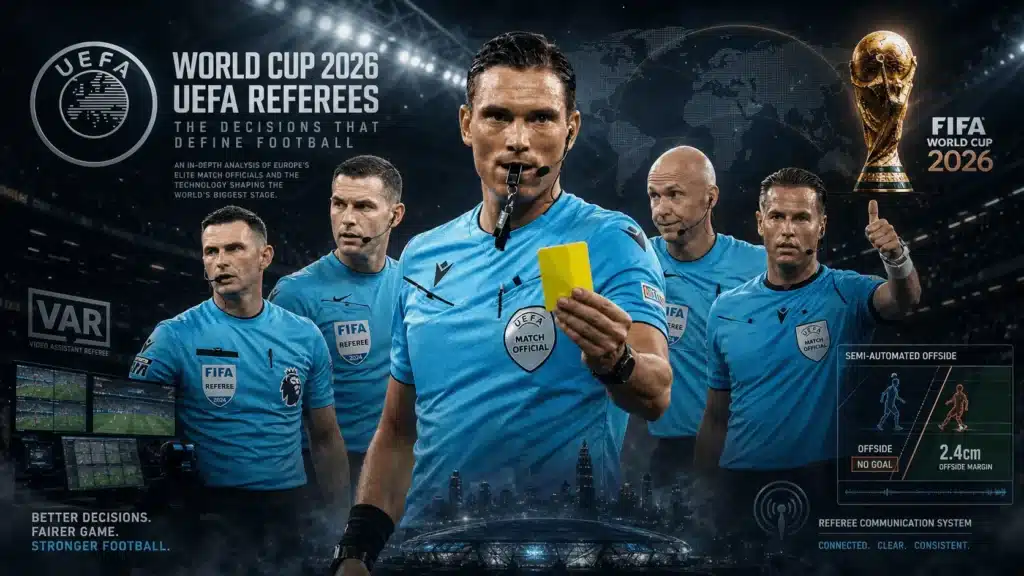
World Cup 2026 UEFA Referees: Europe Sends Experience, Controversy and Serious VAR Pressure
The World Cup 2026 UEFA referees list is one of the most interesting referee groups FIFA has ever taken to a World Cup. It is not just a collection of safe names. It includes World Cup final referees, Champions League final referees, Premier League officials, rising UEFA talents, and several referees whose biggest decisions have already divided football.
FIFA announced 52 referees, 88 assistant referees and 30 video match officials for the 2026 World Cup, selected from all six confederations. FIFA said the selection process was based on its “quality first” principle, with candidates monitored across FIFA tournaments, domestic matches and international competitions over a three-year period.
The UEFA referee list includes: Espen Eskås, Alejandro Hernández Hernández, István Kovács, François Letexier, Danny Makkelie, Szymon Marciniak, Maurizio Mariani, Glenn Nyberg, Michael Oliver, João Pinheiro, Sandro Schärer, Anthony Taylor, Clément Turpin, Slavko Vinčić and Felix Zwayer. FIFA’s official PDF confirms these names among the appointed World Cup 2026 referees.
This is not an official FIFA ranking. This is The VAR Verdict’s editorial rating, based on experience, match control, VAR pressure, major appointments, and the level of controversy each referee carries into the tournament.
Quick Verdict
Safest elite names: Szymon Marciniak, Clément Turpin, François Letexier, Slavko Vinčić.
Highest controversy risk: Danny Makkelie, Michael Oliver, Anthony Taylor, Felix Zwayer, Sandro Schärer.
Most interesting rising profiles: João Pinheiro, Glenn Nyberg, Espen Eskås.
Biggest World Cup pressure case: Felix Zwayer, because his past will follow him into every major appointment.
Overall verdict: UEFA has sent a powerful group, but not a quiet one. This World Cup will not only test referees on the pitch. It will test VAR communication, handball interpretation, dissent control and public trust.
World Cup 2026 UEFA Referees: Editorial Rating Table
| Referee | Country | Editorial Rating | Profile | Main Risk |
|---|---|---|---|---|
| Szymon Marciniak | Poland | 9.5/10 | Elite final referee | Very high expectations |
| François Letexier | France | 9/10 | Modern elite, calm profile | Young for such pressure |
| Clément Turpin | France | 8.8/10 | Established UEFA final referee | Can feel too technical |
| Slavko Vinčić | Slovenia | 8.7/10 | Big-final trusted | Needs strong early control |
| Michael Oliver | England | 8.5/10 | Strong, brave decision-maker | Penalty controversy follows him |
| Anthony Taylor | England | 8.3/10 | Big-game experience | Card control and emotional matches |
| Danny Makkelie | Netherlands | 8/10 | Elite UEFA profile | VAR/penalty decisions attract debate |
| István Kovács | Romania | 8/10 | High-ceiling, strong authority | Red-card threshold |
| Felix Zwayer | Germany | 7.8/10 | Experienced, UEFA-backed | Public trust narrative |
| João Pinheiro | Portugal | 7.6/10 | Rising European official | Biggest stage still ahead |
| Sandro Schärer | Switzerland | 7.5/10 | Solid UEFA operator | Handball controversy |
| Glenn Nyberg | Sweden | 7.3/10 | Rising, allows flow | Big penalty-area moments |
| Maurizio Mariani | Italy | 7.2/10 | Experienced Serie A profile | Recent domestic criticism |
| Alejandro Hernández Hernández | Spain | 7/10 | Heavy VAR/domestic experience | Spanish controversy baggage |
| Espen Eskås | Norway | 6.8/10 | Newer global name | World Cup profile jump |
Law Context: Why VAR Will Define This Referee Group
This World Cup will be played under enormous technological attention. FIFA says goal-line technology, an advanced version of semi-automated offside technology and connected ball technology will be used at the 2026 tournament. FIFA also says fans will see new referee-perspective technology for the first time in World Cup history.
But technology does not remove judgment.
IFAB’s VAR protocol still says VAR may assist only for a “clear and obvious error” or a “serious missed incident” in key categories such as goal/no goal, penalty/no penalty and direct red cards. The original decision should not be changed unless the review clearly shows that level of error.
That is why this UEFA group is so fascinating. Many of these referees are not controversial because they do not know the Laws. They are controversial because modern football often turns subjective decisions into slow-motion trials.
1. Szymon Marciniak — The Gold Standard
Country: Poland
Editorial rating: 9.5/10
Best profile: Final referee, command presence, calm under chaos.
Marciniak enters World Cup 2026 as the most decorated UEFA referee on the list. FIFA appointed him for the 2022 World Cup final between Argentina and France, and UEFA appointed him for the 2023 Champions League final between Manchester City and Inter.
That combination gives him something almost no referee has: proven authority in the two biggest finals in football.
Top matches:
2022 World Cup final, 2023 Champions League final, 2023 FIFA Club World Cup final.
Most debatable area:
Marciniak’s biggest risk is not a famous wrong decision. It is expectation. When a referee has handled the World Cup final well, every later performance is judged against that standard.
Verdict: The strongest UEFA referee going to World Cup 2026.
2. François Letexier — The Modern Elite Referee
Country: France
Editorial rating: 9/10
Best profile: Calm, athletic, modern game management.
Letexier’s rise has been rapid. UEFA appointed him to referee the Euro 2024 final between Spain and England, making him one of the youngest major-final referees in modern European football. Reuters reported that Letexier had already handled 65 UEFA matches before that final appointment.
He represents the new UEFA referee model: physically sharp, less theatrical, comfortable with fast transitions and modern pressing football.
Top matches:
Euro 2024 final, Champions League knockout matches, UEFA major tournament fixtures.
Most debatable area:
His World Cup test is experience under non-European pressure. A World Cup knockout match with South American, African or CONCACAF intensity can feel very different from a controlled UEFA final.
Verdict: One of the safest appointments for a semi-final or final if his tournament starts well.
3. Clément Turpin — The Established Technician
Country: France
Editorial rating: 8.8/10
Best profile: Technical accuracy, European final experience.
Turpin is one of UEFA’s most trusted referees. UEFA appointed him for the 2022 Champions League final between Liverpool and Real Madrid, after he had already refereed the 2021 Europa League final.
He is not the loudest referee. He is more of a procedural official: structured, calm, and rarely chaotic.
Top matches:
2022 Champions League final, 2021 Europa League final, major UEFA knockout games.
Most debatable area:
Turpin can sometimes feel too law-book strict for matches that need personality and emotional control. At a World Cup, that matters.
Verdict: High trust, low drama, final-stage capable.
4. Slavko Vinčić — The Big-Final Safe Choice
Country: Slovenia
Editorial rating: 8.7/10
Best profile: Trusted by UEFA for major finals.
Vinčić refereed the 2024 Champions League final between Borussia Dortmund and Real Madrid. UEFA also notes that he had previously refereed the 2022 Europa League final between Eintracht Frankfurt and Rangers.
That is a serious CV. UEFA clearly trusts him in high-pressure finals.
Top matches:
2024 Champions League final, 2022 Europa League final, major Champions League knockout matches.
Most debatable area:
Vinčić’s biggest challenge is tempo. In World Cup games with emotional benches and fast transitions, he must set his line early.
Verdict: A very strong knockout-stage referee.
5. Michael Oliver — Brave, Experienced, Always Watched
Country: England
Editorial rating: 8.5/10
Best profile: Big personality, brave penalty calls, strong authority.
Oliver is one of the most respected English officials, but he carries one of the most famous Champions League controversies of the last decade: Real Madrid vs Juventus in 2018. He awarded Real Madrid a stoppage-time penalty and sent off Gianluigi Buffon for his protests. PGMOL later condemned the abuse directed at Oliver and his wife after the match.
That incident still defines how many fans see Oliver: courageous to some, too decisive to others.
Top matches:
Major Premier League fixtures, UEFA knockout matches, Euro and World Cup-level appointments.
Most debatable decision:
Real Madrid vs Juventus, 2018 — stoppage-time penalty and Buffon red card.
Our verdict on that decision: Supportable in law, brutal in optics. The kind of call only a referee with real conviction makes.
Verdict: Excellent referee, but always one major penalty away from becoming the headline.
6. Anthony Taylor — High-Level Experience, High Emotional Heat
Country: England
Editorial rating: 8.3/10
Best profile: Big-game experience, strong fitness, Premier League intensity.
Taylor has refereed huge European matches, but his most famous recent final was Roma vs Sevilla in the 2023 Europa League final. Reuters reported that the match featured 14 yellow cards, the most ever in a Europa League game, and that Taylor and his family were later abused by Roma supporters at Budapest Airport.
That match was not just a referee story. It became a wider football culture story about abuse, dissent and how managers influence fan reaction.
Top matches:
Europa League final, Premier League title-race matches, UEFA knockout games.
Most debatable area:
Taylor can control difficult games, but his matches sometimes become card-heavy because he is prepared to punish repeated dissent and confrontation.
Verdict: Strong World Cup option, but better for physical matches than emotionally explosive ones.
7. Danny Makkelie — Elite Reputation, Penalty Controversy Magnet
Country: Netherlands
Editorial rating: 8/10
Best profile: UEFA elite referee, strong presence, major tournament experience.
Makkelie is trusted by UEFA, but several major decisions have followed him. At Euro 2020, he awarded England the controversial extra-time penalty against Denmark after Raheem Sterling went down; UEFA’s referee chief Roberto Rosetti later defended the decision.
More recently, Makkelie was at the centre of the Arsenal vs Atlético Madrid first-leg controversy in the 2025/26 Champions League semi-final. Reuters reported that he initially awarded Arsenal a penalty for contact on Eberechi Eze, then overturned it after a VAR review, leaving Mikel Arteta furious.
Top matches:
Euro semi-final, Champions League knockout matches, UEFA elite appointments.
Most debatable decisions:
England vs Denmark penalty, Arsenal vs Atlético penalty overturn.
Our verdict: Makkelie is a strong referee, but his penalty threshold can create debate because he is not afraid to make or change big calls.
Verdict: Elite-level, but World Cup VAR communication must be clean around him.
8. István Kovács — Authority, Red Cards and the PSG-Barcelona Storm
Country: Romania
Editorial rating: 8/10
Best profile: Strong personality, clear authority, high ceiling.
Kovács has become one of UEFA’s most trusted officials. Reuters reported that UEFA appointed him for the 2025 Champions League final between PSG and Inter, after previous major appointments including the 2022 Conference League final and the 2024 Europa League final.
But his biggest controversy remains Barcelona vs PSG in 2024. Xavi was furious after Kovács sent off Ronald Araújo in the Champions League quarter-final second leg, with Reuters reporting that Barcelona felt the red card changed the tie.
Top matches:
2025 Champions League final, 2024 Europa League final, 2022 Conference League final.
Most debatable decision:
Araújo red card, Barcelona vs PSG.
Our verdict: Supportable if the foul denied an obvious goalscoring opportunity, but massive in impact. This was a classic example of a decision that can be correct in law and still destroy a team’s emotional control.
Verdict: Very strong, but his red-card threshold will be watched closely.
9. Felix Zwayer — The Appointment Everyone Will Talk About
Country: Germany
Editorial rating: 7.8/10
Best profile: Experienced UEFA referee with strong backing from the authorities.
Zwayer is the most politically sensitive UEFA referee on the list. UEFA backed him for the Euro 2024 semi-final between England and the Netherlands despite renewed attention on Jude Bellingham’s past comments about Zwayer’s earlier six-month ban linked to the German match-fixing scandal.
This does not mean Zwayer cannot referee at the highest level. UEFA’s continued appointments show institutional trust. But at a World Cup, perception matters.
Top matches:
Euro 2024 semi-final, Champions League knockout matches, Bundesliga classics.
Most debatable issue:
Not one current match decision, but trust and public perception.
Verdict: Capable referee, but FIFA must appoint him carefully. Any controversial decision involving England, Germany or a Bellingham storyline would become explosive.
10. João Pinheiro — The Rising Portuguese Name
Country: Portugal
Editorial rating: 7.6/10
Best profile: Modern, athletic, rising UEFA profile.
Pinheiro is one of the newer high-profile names in this group. UEFA appointed him to referee the 2025 Super Cup between PSG and Tottenham, and UEFA’s match page also confirms him as the referee for that final.
He has also been trusted with major Champions League knockout pressure, including Bayern vs PSG in the 2025/26 semi-final second leg.
Top matches:
2025 UEFA Super Cup, Champions League knockout matches.
Most debatable area:
He is still building the same public authority that Marciniak, Turpin or Oliver already have. At the World Cup, that matters when players test him early.
Verdict: A strong rising referee. Group-stage and round-of-16 appointments could define how far he goes.
11. Sandro Schärer — Solid Referee, Fresh Handball Debate
Country: Switzerland
Editorial rating: 7.5/10
Best profile: Reliable UEFA operator, calm personality.
Schärer’s World Cup build-up now includes a very fresh controversy: PSG vs Bayern in the 2025/26 Champions League semi-final first leg. AS reported that he awarded PSG a penalty after VAR intervention for an Alphonso Davies handball, with the ball appearing to hit Davies before striking his arm.
This is exactly the kind of incident that World Cup referees must handle well. IFAB says a handball offence can occur when a player’s hand or arm makes the body unnaturally bigger, but the arm position must be judged in relation to the player’s body movement.
Top matches:
Champions League knockout fixtures, UEFA international appointments.
Most debatable decision:
Alphonso Davies handball, PSG vs Bayern.
Our verdict: Harsh but supportable if the arm was judged to make the body bigger. Still, the deflection makes it a poor “football feel” decision.
Verdict: Good referee, but World Cup handball decisions around him will be watched.
12. Glenn Nyberg — The “Kid’s Mistake” Referee
Country: Sweden
Editorial rating: 7.3/10
Best profile: Lets games flow, physically suited to high-tempo matches.
Nyberg’s major recent controversy came in Arsenal vs Bayern Munich in 2024. Thomas Tuchel criticised him for not awarding Bayern a penalty after Gabriel handled the ball following a goal-kick restart, with ESPN reporting Tuchel’s anger over the explanation that it was a “kid’s mistake.”
That incident is important because it was not about whether the ball touched the hand. It was about whether the referee wanted to apply the law strictly in a strange situation.
Top matches:
Champions League quarter-finals, UEFA club fixtures.
Most debatable decision:
Gabriel handball/non-penalty, Arsenal vs Bayern.
Our verdict: In pure law terms, Bayern had a strong argument. In match-management terms, Nyberg tried to avoid a bizarre technical penalty. That is understandable, but dangerous at World Cup level.
Verdict: Good profile, but FIFA will want absolute clarity from him on unusual penalty-area incidents.
13. Maurizio Mariani — Experience With Recent Domestic Noise
Country: Italy
Editorial rating: 7.2/10
Best profile: Experienced Serie A referee, tactically aware.
Mariani is not as globally famous as Orsato was, but he brings heavy Italian domestic experience. The concern is recent criticism. Goal reported in 2025 that Mariani was stood down after serious errors in Napoli vs Inter, including a controversial penalty and a missed handball claim.
That does not disqualify a referee. Every elite official has difficult nights. But it does show why World Cup appointments must be based on current form, not reputation alone.
Top matches:
Serie A high-profile matches, UEFA club fixtures, international qualifiers.
Most debatable area:
Penalty and handball consistency.
Verdict: Solid referee, but not one of UEFA’s obvious final candidates.
14. Alejandro Hernández Hernández — Spain’s VAR-Heavy Profile
Country: Spain
Editorial rating: 7/10
Best profile: Huge domestic experience, used to pressure and VAR-heavy matches.
Hernández Hernández is one of the most interesting names because Spanish refereeing carries a unique level of pressure. Spanish media has repeatedly framed him around controversial domestic matches, especially in games involving Barcelona and Real Madrid. ARA described VAR as becoming his “worst enemy” in a controversial Clásico context.
That does not mean he is a poor referee. It means he arrives with baggage from one of football’s most toxic referee environments.
Top matches:
La Liga Clásicos, UEFA fixtures, high-pressure Spanish domestic games.
Most debatable area:
VAR communication and consistency in penalty-area decisions.
Verdict: Experienced, but World Cup audiences will judge him quickly if a VAR review becomes confusing.
15. Espen Eskås — The Low-Noise Wildcard
Country: Norway
Editorial rating: 6.8/10
Best profile: Emerging UEFA official with lower global controversy.
Eskås is the least globally famous UEFA name on this list, which can be an advantage. He does not arrive with the same public baggage as Oliver, Makkelie, Taylor or Zwayer.
But the World Cup is a different test. A referee can be excellent in UEFA development structures and still find a World Cup match difficult because of crowd size, global scrutiny and different football cultures.
Top matches:
UEFA club and international appointments.
Most debatable area:
Not a famous controversy — the question is profile, not scandal.
Verdict: A good group-stage candidate with upside. His first appointment will tell us a lot.
Most Debatable UEFA Referee Decisions to Watch Before World Cup 2026
1. Danny Makkelie — Arsenal vs Atlético penalty overturn
A penalty was awarded, then overturned after VAR. The core issue is VAR threshold: if contact exists and the referee gives it live, was it really a clear and obvious error?
2. Sandro Schärer — Davies handball, PSG vs Bayern
A strict handball interpretation, but visually harsh because the ball appeared to deflect before hitting the arm.
3. Michael Oliver — Real Madrid vs Juventus penalty
Supportable in law, but one of the most dramatic penalty decisions in modern Champions League history.
4. István Kovács — Araújo red card vs PSG
A massive decision that changed the tie. It was not automatically wrong, but it was decisive enough to define the match.
5. Glenn Nyberg — Gabriel “kid’s mistake” non-penalty
A rare incident where game management and strict law application collided.
6. Anthony Taylor — Roma vs Sevilla control
The controversy became about more than one decision: cards, stoppage time, dissent, Mourinho’s reaction and post-match abuse.
7. Felix Zwayer — Trust narrative
Zwayer’s biggest World Cup issue is not a fresh mistake, but whether players and fans accept him in the biggest matches.
Which UEFA Referees Are Most Likely to Get the Biggest World Cup Matches?
Final Candidates
Szymon Marciniak is the strongest referee in the group, but FIFA may avoid giving him back-to-back World Cup finals unless he is clearly the best performer again.
François Letexier looks like a serious final candidate if FIFA wants a younger modern referee with recent major-final experience.
Clément Turpin and Slavko Vinčić are safe knockout-stage options because UEFA has already trusted them with Champions League finals.
Semi-Final or Quarter-Final Candidates
Michael Oliver, Anthony Taylor, Danny Makkelie, István Kovács and Felix Zwayer all have the experience for major knockout appointments. The difference will be tournament form and political context.
Group-Stage/Round-of-16 Watchlist
João Pinheiro, Sandro Schärer, Glenn Nyberg, Maurizio Mariani, Alejandro Hernández Hernández and Espen Eskås may start with group-stage matches. A strong first performance could push one of them into a bigger knockout game.
Final Verdict
The World Cup 2026 UEFA referees group is strong, experienced and full of storylines. FIFA has selected elite final referees, trusted UEFA names and rising officials who could become the next generation of global referees.
But the pressure is obvious.
The 2026 World Cup will have more teams, more matches, more technology and more scrutiny than any previous tournament. Referees will not only need to be correct. They will need to be clear. They will need to explain the game through their decisions. And above all, VAR must not become a tool for re-refereeing subjective football.
Marciniak is the safest name. Letexier is the most exciting modern profile. Oliver and Taylor bring authority but also controversy. Makkelie, Schärer and Nyberg will be watched closely on penalty and handball calls. Zwayer carries the heaviest trust narrative.
The verdict: UEFA has sent a powerful referee team to World Cup 2026 — but the tournament will expose any official who confuses technical correctness with football credibility.

0 Comments
Join the conversation with respect. Comments are moderated and must follow our community rules.
Want to join the discussion?
Please log in or create an account to comment and reply. This keeps the conversation cleaner and safer.