
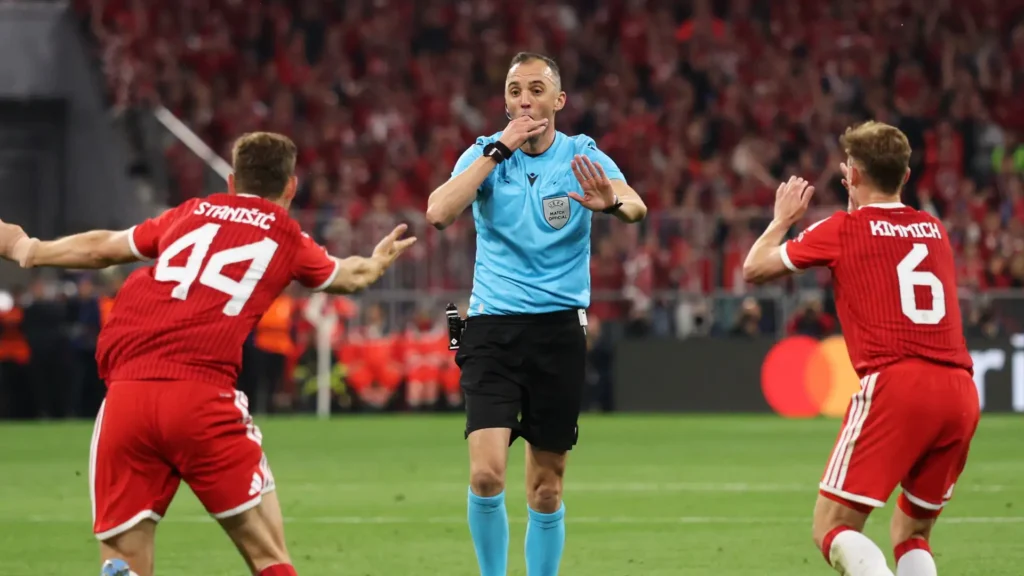
The Champions League semi-final between Bayern Munich and PSG was always expected to be played under enormous pressure. What many did not expect was that the biggest discussion after the match would revolve around the officiating team led by João Pinheiro.
The Portuguese referee, together with VAR referee Dennis Higler, now faces heavy criticism after two key handball incidents involving Nuno Mendes created major controversy throughout the football world.
The debate is not simply about one isolated moment. It is also about UEFA’s decision to appoint a referee who, despite clear talent and potential, still lacks the same elite-level résumé as some of Europe’s most experienced Champions League officials.
Quick Verdict
The non-penalty decision is debatable, but there is a strong argument that Nuno Mendes artificially enlarged his body position inside the penalty area.
The bigger criticism may actually belong to VAR referee Dennis Higler for not recommending an on-field review.
The possible second yellow card incident is also highly controversial because modern UEFA interpretations often punish stopping attacking situations with arm contact, especially when a player is already booked.
Overall, the match never completely lost control, but the officiating decisions left serious doubts in a semi-final that demanded absolute clarity and authority.
Why UEFA’s Appointment Is Being Questioned
João Pinheiro is considered one of Portugal’s rising referees and UEFA clearly sees him as part of the next generation of elite officials.
However, appointing him to Bayern vs PSG immediately raised eyebrows across Europe.
Compared to referees such as Szymon Marciniak, Clément Turpin, Slavko Vinčić, Michael Oliver or Danny Makkelie, Pinheiro’s experience at the very highest Champions League knockout level remains relatively limited.
This was not a low-pressure knockout game. It was one of the biggest matches of the European season involving two clubs with enormous expectations, elite attacking quality, and constant pressure on officials.
When UEFA appoints a referee to a semi-final, they are not only selecting technical quality. They are selecting personality, authority, experience, and the ability to manage chaos under extreme pressure.
That is why the first-half controversies immediately intensified the scrutiny around the appointment itself.
The First Major Incident: Possible Bayern Penalty
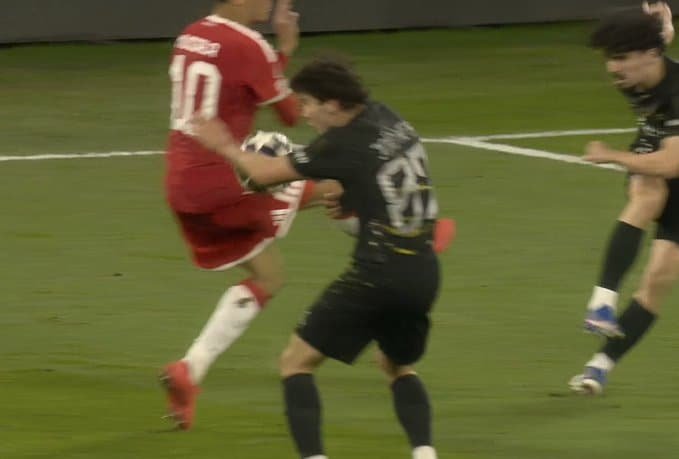
The most debated moment arrived when the ball struck Nuno Mendes inside the penalty area after a close-range situation.
João Pinheiro immediately allowed play to continue, and VAR referee Dennis Higler did not send him to the monitor for an on-field review.
This is where the debate becomes extremely interesting from a law perspective.
What the IFAB Law Actually Says
The modern IFAB handball law explains that not every ball-to-hand contact is automatically an offence, especially after a deflection or close-distance situation.
However, the key part of the law is this:
A handball offence can still occur if the player “artificially enlarges their body.”
That phrase is central to the controversy.
From several replay angles, there is a legitimate argument that Nuno Mendes’ arm position increased the space occupied by his body. Even if the ball arrived quickly, the arm was not entirely in a natural silhouette position.
This is exactly why many expected VAR to intervene.
Why VAR Should Probably Have Recommended a Review
One important misunderstanding among fans is that VAR is not there to re-referee every contact. VAR intervenes only for clear and obvious errors.
But semi-finals require a different level of management and communication.
This incident was controversial enough, subjective enough, and important enough that many observers expected Dennis Higler to advise João Pinheiro to conduct an on-field review.
A monitor review would not automatically mean a penalty had to be awarded. But it would have allowed the referee to reassess:
- arm position
- body enlargement
- reaction time
- movement toward the ball
- overall impact on play
Instead, the decision remained entirely with the original on-field call.
That choice significantly increased frustration from Bayern players, staff, and supporters.
The Second Incident: Possible Second Yellow Card
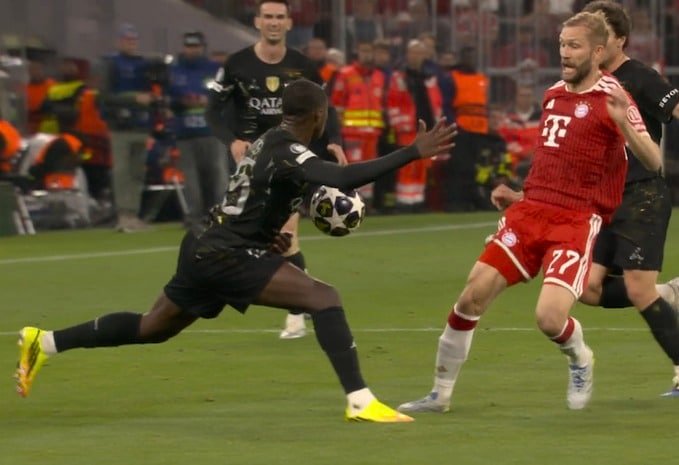
The controversy became even bigger because Nuno Mendes was already on a yellow card during another debated handball moment.
Many believed the PSG defender should have received a second yellow card for stopping a dangerous attacking situation with arm contact.
This situation is slightly different from the penalty appeal because disciplinary decisions involve additional interpretation regarding:
- intent
- tactical impact
- stopping an attack
- natural movement
João Pinheiro again chose not to punish the action with a second caution.
Technically, referees are often more conservative with second yellow cards in elite matches unless the offence is absolutely clear.
However, consistency becomes the major issue.
If the arm position contributed to illegally stopping the ball or interrupting an attacking phase, then UEFA observers will likely review whether stronger disciplinary action should have been taken.
Dennis Higler’s Role Cannot Be Ignored
Much of the criticism online focused immediately on João Pinheiro, but the VAR room also carries major responsibility.
Dennis Higler is an experienced UEFA VAR official. His job is not simply to support the referee — it is to protect the match from major mistakes.
When controversial situations involving possible penalties and possible dismissals occur in a Champions League semi-final, the expectation is that the VAR team provides maximum assistance and clarity.
The absence of an on-field review became almost as controversial as the decision itself.
Law Context
According to IFAB Law 12:
- Not every accidental handball is an offence
- Deflections and close-distance situations matter
- But a player can still be penalized if they “artificially enlarge” their body
- Arm position remains one of the most important factors
- VAR may intervene for clear and obvious missed penalties
This is why the Bayern vs PSG incident sits in a grey area that naturally creates division among refereeing analysts.
Final Verdict
This was not an easy match to referee, and not every controversial decision automatically becomes a clear mistake.
But in matches of this magnitude, perception and confidence matter enormously.
João Pinheiro’s performance will likely divide opinion. Some will defend the decisions as supportable within the modern interpretation of the handball law. Others will argue that Bayern were denied both a penalty and a potential numerical advantage.
The strongest criticism may ultimately focus on VAR management.
Because even if one believes the final decision was correct, many will still ask the same question:
Why was the referee never sent to the monitor to take a second look?

0 Comments
Join the conversation with respect. Comments are moderated and must follow our community rules.
Want to join the discussion?
Please log in or create an account to comment and reply. This keeps the conversation cleaner and safer.