
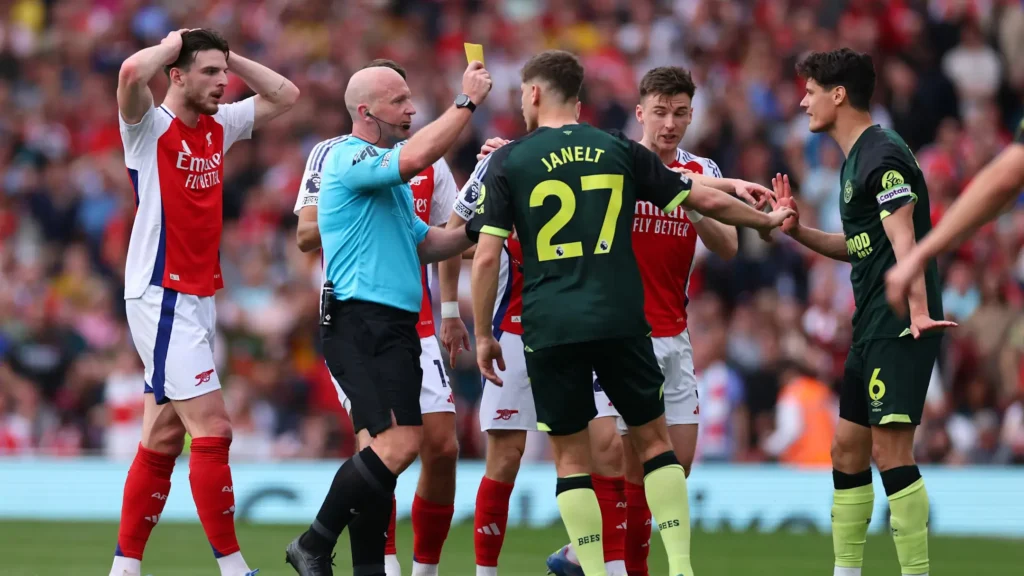
A wrong refereeing call does not end with the final whistle. In modern football, one missed offside, one soft red card, or one unchecked foul can change far more than a single moment. It can affect points, suspensions, public trust, and even the way competitions change their rules. That is why the biggest referee controversies are never just about one decision. They are about consequences.
The first truth many fans do not like hearing is this: the result usually stands. UEFA’s disciplinary regulations state that decisions taken by the referee on the field of play are final and may not be reviewed by disciplinary bodies, except in limited situations involving the disciplinary consequences of an obvious error such as mistaken identity. In other words, football can admit a mistake without giving the points back.
That is where the real damage begins. A wrong call can reshape the emotional and competitive direction of a match, but the law is built to protect finality. Football would rather preserve the authority of the referee and the integrity of the competition schedule than reopen finished games every time a controversy explodes. That keeps order, but it also leaves clubs and supporters with a familiar frustration: the apology may come, yet the scoreline remains.
VAR was supposed to reduce those moments, but it is not a tool for re-refereeing every incident. Under IFAB protocol, VAR can only intervene for goals, penalties, straight red cards, and mistaken identity, and only when there is a “clear and obvious error” or a “serious missed incident.” Once play has restarted, the referee generally cannot go back and review the moment, except in very narrow cases such as mistaken identity or certain sending-off offences.
Few examples explain that better than Luis Díaz’s wrongly disallowed goal for Liverpool against Tottenham. PGMOL openly admitted that a “significant human error” had occurred and said the goal should have stood. But after play restarted, the officials concluded that the VAR protocol did not allow intervention at that point. Later, PGMOL published the audio, admitted standards had fallen short, and introduced follow-up measures including a new communication protocol, AVAR confirmation, and further VAR training.
So what can be changed after a wrong decision? Usually, it is not the result but the disciplinary fallout. In the FA’s rules, a club and player can make a wrongful-dismissal claim if they can show the referee made an obvious error in sending a player off. But even that safety valve has limits: it generally does not apply to second-yellow dismissals, and the original sending-off remains on the record even when the disciplinary consequence is challenged.
This is why bad officiating can leave a longer shadow than fans first realize. A team may lose a match and keep the defeat. A player may miss games before a debate cools down. A manager may spend days answering questions about one incident instead of football. And the officials themselves do not escape consequences either: errors can trigger internal review, retraining, public explanation, and reduced trust in the entire refereeing system. The game moves on quickly, but the fallout rarely does.
There is another layer too: the reaction to the mistake can create fresh punishment. This month, Leeds manager Daniel Farke received a one-match suspension and an £8,000 fine after confronting match officials, while Rodri was fined £80,000 and warned after post-match comments that the FA said questioned the integrity or neutrality of officials. In other words, even when frustration feels understandable, football’s disciplinary system still protects the authority of referees very aggressively.
That helps explain why IFAB has moved harder toward referee protection. The “only the captain” guidelines, effective from July 1, 2025, say that only one player from each team, usually the captain, should approach the referee in major situations, and dissent by word or action is cautionable. IFAB says this matters not only for fairness and respect, but also for the image of the game and even the recruitment and retention of referees.
Football is also trying to become more transparent. In the 2025/26 Laws material, IFAB notes that competitions now have the option of letting referees announce and explain final decisions after a VAR review or lengthy check. That will not erase controversy, but it may reduce the feeling that supporters are watching decisions arrive from a black box.
The modern truth is simple: a wrong referee decision is never just one wrong whistle. It can change a match, affect a ban, shape headlines, trigger fines, force rule tweaks, and deepen the debate about whether football has found the right balance between authority and accountability. That is why every major officiating mistake matters long after the moment itself has passed.

[…] demands FIFA release VAR audio following one of the most controversial refereeing moments of the 2026 FIFA World Cup. The Croatian […]