
Daylight Offside Is Here: Good for Football or a Step Too Far?
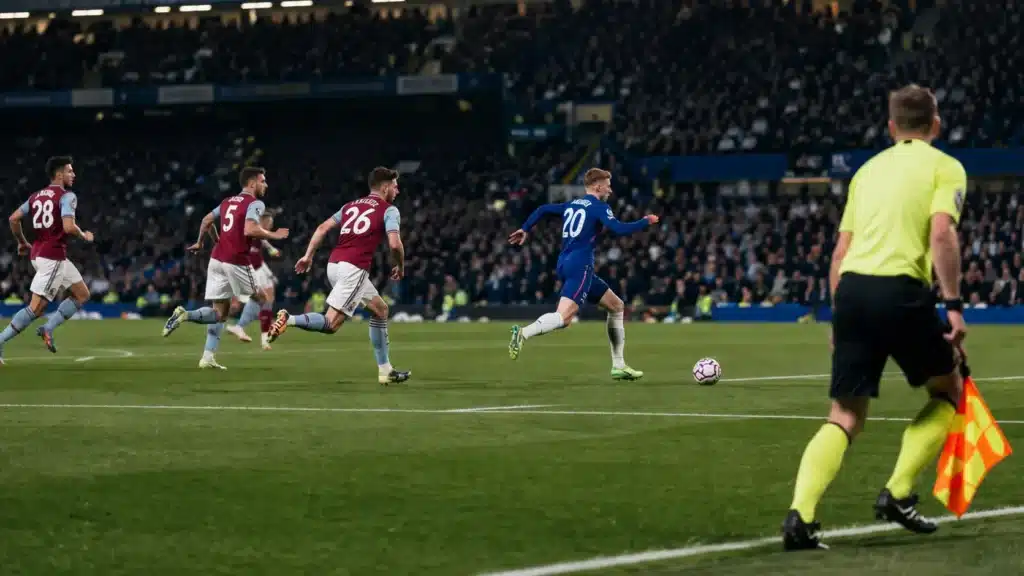
The offside debate is no longer theoretical. Football has now moved from conference-room discussion to a live professional test. The Canadian Premier League opened its 2026 season with FIFA and IFAB-backed trials of the so-called “daylight offside” rule, a change designed to give attackers more freedom and make offside decisions easier to understand.
At its heart, the idea is simple. Under the current Law 11 wording, a player can be offside if any scoring part of the body is beyond the second-last defender. Under the alternative trial, a player is only offside if the head, body and feet are wholly beyond that defender. In other words, if any legal scoring part is still level, the attacker stays onside. That is a major philosophical shift, not a cosmetic tweak.
And that is why this matters. This is not just a refereeing story. It is a story about what football wants to be.
What fans could gain from daylight offside
The strongest argument in favour of the trial is that it attacks one of the game’s most frustrating modern problems: the feeling that football has become too obsessed with microscopic geometry.
For years, supporters have watched goals ruled out because of a shoulder, a toe, or a fraction of a boot beyond a defensive line. Even when those decisions are technically correct under the current wording, they often feel wrong in football terms. The attacker has not gained a dramatic unfair advantage. Yet the goal disappears, the celebration dies, and the match is interrupted by a process that can feel more forensic than sporting.
Daylight offside is an attempt to restore common sense. It would reward attacking intent, encourage forward runs, and reduce the number of goals erased by marginal body-part measurements. For fans, that could mean more natural celebrations, less waiting, and a clearer understanding of why a decision has been given.
There is also a visibility argument here. Football’s leaders have openly framed the trial as a way to create a “clearer visual threshold” and to improve flow. That is important, because one of VAR’s biggest problems has never been only accuracy. It has been trust. If ordinary viewers cannot understand where the line is, confidence drops fast.
Why the idea is not risk-free
But this is where the debate gets serious.
A rule that gives attackers more room does not automatically create better football. It could also change defensive behaviour in ways that are less attractive than supporters imagine.
If defenders feel they can no longer hold a high line safely, many teams may respond by dropping deeper. Centre-backs may become more conservative. Full-backs may be less aggressive stepping up. Coaches may decide that the risk of leaving “daylight” is too high. If that happens, the game could gain a few extra onside runs but lose some of its pressing intensity and compactness higher up the pitch.
That is the biggest concern. A law designed to help attacking football could, in some systems, encourage more cautious defending instead. Reuters reported that critics in Europe have already raised exactly that fear.
There is another uncomfortable truth too: changing the law does not automatically solve bad review experiences.
In the CPL opener, the first major review under the new setup reportedly took more than five minutes, although it was not centered on an offside decision and came within the new Football Video Support system rather than full VAR. That is still revealing. It tells us that football’s delay problem is not only about where the offside line is drawn. It is also about process, communication, and the speed of review itself.
So daylight offside should not be sold as a miracle cure. It may solve one kind of frustration while leaving others in place.
Our verdict
Our view is that this is a good trial and a necessary trial — but not yet a guaranteed good law.
Football has reached the point where marginal offside decisions are damaging the emotional experience of the game. Too many goals feel temporary. Too many celebrations feel cautious. Too many debates are about frame selection and body outlines instead of football. On that point, the sport is right to experiment.
But experimentation must remain honest.
If the data from this trial shows more attacking fluidity, fewer absurdly marginal disallowed goals, and a simpler message for fans, then the case for broader adoption will grow quickly. If, however, the rule mainly pushes defensive lines deeper and replaces one grey area with another, football should be brave enough to say no.
That is the correct approach: test it properly, measure it rigorously, and resist the urge to declare victory too early.
Right now, our verdict is this: daylight offside has the potential to be good for football because it puts the spirit of attacking play back into the conversation. But it will only be truly good if it improves the game without punishing defensive ambition or creating a new layer of confusion.
That is why this trial matters so much. It is not deciding only where offside begins. It is deciding what balance football wants between precision and freedom.
Conclusion
The current offside law, especially in the VAR era, has often felt too harsh on attackers and too detached from what fans instinctively see as an unfair advantage. Daylight offside is a serious attempt to fix that.
It deserves an open-minded hearing.
But it also deserves a hard-headed review, because football should not rewrite one of its most fundamental laws just to escape the embarrassment of millimetre decisions. It should do it only if the new version genuinely makes the sport clearer, fairer, and better to watch.
For now, the trial is a smart step. The final verdict should depend on the evidence.