
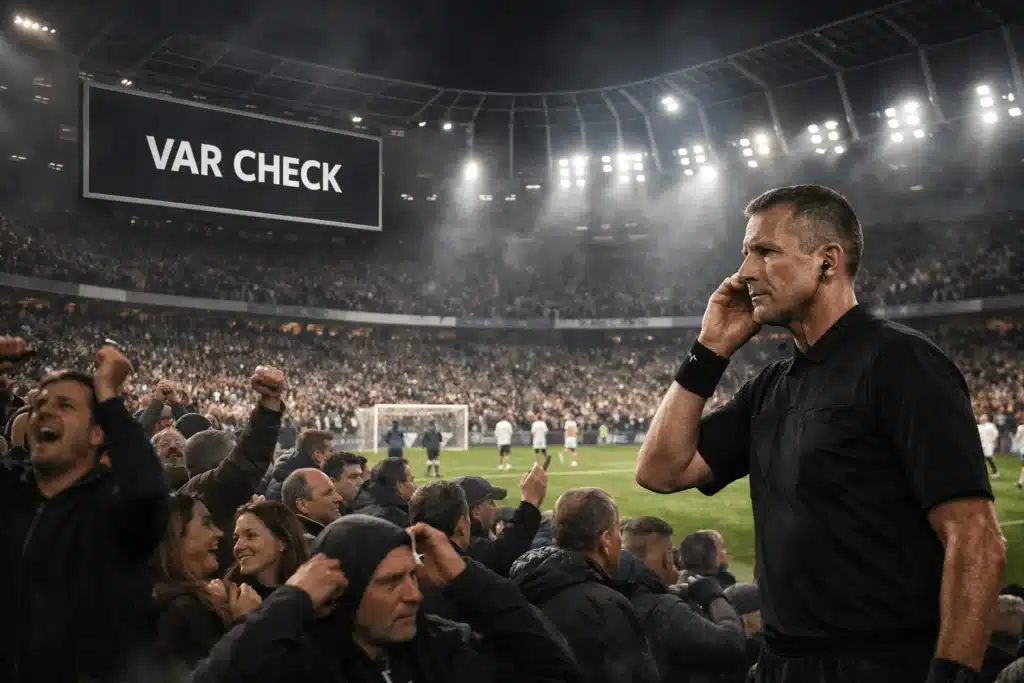
A fresh Football Supporters’ Association survey has landed with numbers the Premier League cannot easily brush aside. Among almost 8,000 fans of top-flight clubs, 75.7% said they do not support the use of VAR, while 91.7% said it has removed the spontaneous joy of goal celebrations. The survey ran from February 26 to March 23, and more than 6,000 respondents had experienced a VAR decision inside a stadium this season.
That matters, because this is not just online noise or post-match social media anger. The FSA says the majority of respondents are regular matchgoers, with 50.3% typically attending more than 15 home games in a season and 59.9% going to at least one away game. In other words, these are not distant observers complaining from the sofa. These are supporters living the Premier League product in real time, week after week.
And that is what makes this survey more serious than another round of anti-VAR shouting. The key complaint is not really about technology in isolation. It is about what the current version of VAR has done to the live experience of football.
That distinction is important. Fans are not rejecting every form of officiating technology. The same FSA survey found that 93% still support goal-line technology. A majority, 58%, want to keep in-stadium referee announcements, and 47.2% said they would support a challenge system that limits VAR interventions per game. What supporters appear to be saying is not “no technology at all,” but “not this version, not in this form, and not at this emotional cost.”
That should be the real headline for the Premier League and PGMOL. The issue is no longer whether VAR can correct decisions. Of course it can. The league’s response to the survey was predictable and, to a point, fair: the Premier League said VAR leads to more accurate outcomes, with around 100 correct overturns per season, and argued that its high threshold for intervention makes it less intrusive than in other European competitions, including the Champions League. The league also insisted its own research suggests supporters are broadly in favour of keeping VAR, so long as it is improved.
That defence cannot simply be dismissed. Accuracy matters. Wrongly awarded goals, missed red cards and bad penalty decisions carry huge sporting and financial consequences. Any honest analysis has to admit that point.
But football is not a spreadsheet, and that is where the Premier League’s institutional defence still feels incomplete. A system can improve accuracy and still lose the argument with the people paying to watch the game live. When supporters say the biggest loss is the spontaneous release of a goal, that is not a side issue. That is football’s central emotional currency.
This is why the latest numbers feel more damaging than previous waves of criticism. They do not suggest ordinary frustration with individual calls. They suggest a widening belief that VAR, in its current form, has changed the texture of the sport in a way many supporters never accepted. The wait, the uncertainty, the pause before celebration, the sense that every big moment arrives with an asterisk — that is the part the league still has not solved.
There is also another reason this story matters now. The wider direction of football governance is not towards removing VAR. It is moving towards refining it and, in some cases, expanding it. IFAB approved changes in February that widen the VAR protocol to include clearly incorrect second yellow situations, mistaken identity, and, where competitions allow it, clearly incorrect corner-kick decisions if the check can be completed immediately. That means the authorities are still looking for ways to develop VAR, not step back from it.
That creates a clear tension. Fans are telling the game they already feel overburdened by intervention, while lawmakers are still exploring new areas for review. Even if those additions are narrowly framed, the optics are obvious: the public mood is asking for restraint, while the system continues to search for controlled expansion.
For The VAR Verdict, that is the real takeaway from this survey. This is not just a complaint about one weekend, one club or one referee. It is evidence that the matchgoing audience still has not bought into the broader trade-off. Supporters can see the logic of correcting clear mistakes. What many still reject is the feeling that football’s best moments now arrive with hesitation.
My verdict is simple: the Premier League can still defend VAR on accuracy, but it is losing on trust, emotion and matchday experience. And once a competition starts losing on those fronts, repeating that the numbers are better is not enough.
The smarter response is not to pretend the debate has been settled. It is to accept that the current model still lacks public legitimacy. That means faster reviews, tighter intervention thresholds, clearer communication, and serious discussion about more limited, more accountable use. The survey itself points toward that middle ground. Fans overwhelmingly back goal-line technology, many still want in-stadium explanations, and nearly half are open to a challenge-based system.
So yes, the Premier League can point to correct overturns. But this survey is a reminder that supporters are judging VAR by more than technical success. They are judging it by how football feels. Right now, that remains the strongest argument against the way VAR is being used.

0 Comments
Join the conversation with respect. Comments are moderated and must follow our community rules.
Want to join the discussion?
Please log in or create an account to comment and reply. This keeps the conversation cleaner and safer.