
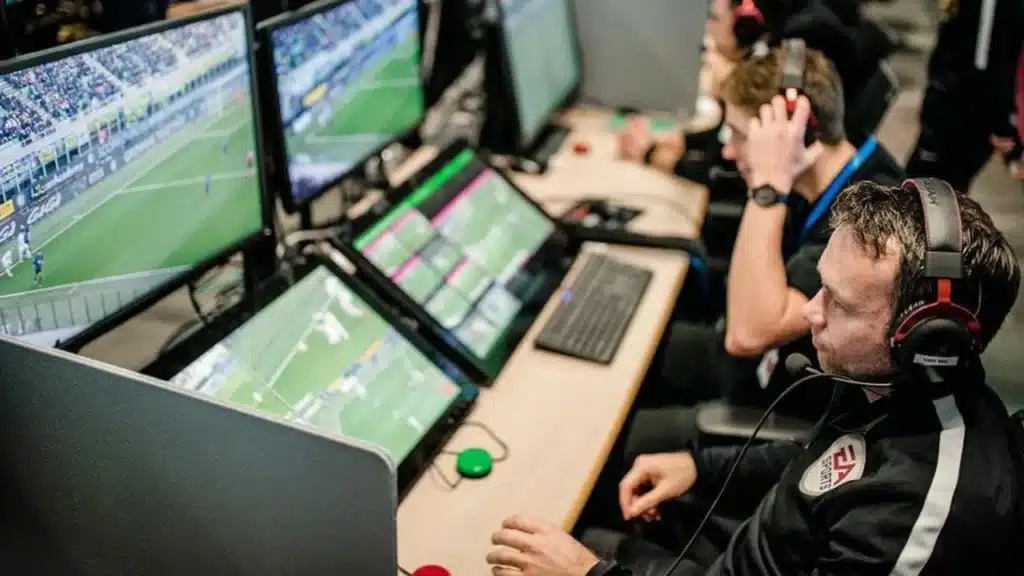
UEFA is not preparing to kill VAR. It is preparing to tame it. Reports on Thursday suggest European football’s governing body wants to keep the system, but use it with a lower level of interference in the tiny, forensic moments that have drained emotion out of too many big nights. That direction fits with Roberto Rosetti’s recent public messaging, where UEFA’s refereeing chief warned that VAR risks becoming too “microscopic” and drifting away from its original purpose: correcting clear and obvious mistakes.
That distinction matters. For years, the problem has not simply been VAR itself, but the way different competitions interpret the same protocol. One league allows more contact. Another takes a stricter handball line. A third is willing to freeze-frame incidents until football looks more like a courtroom than a sport. Rosetti himself has argued that Europe must speak “one technical language,” especially on subjective decisions, because inconsistent interpretation is one of the fastest ways to destroy trust in officiating.
The reported UEFA plan is therefore less about expanding technology and more about redefining discipline around it. According to The Independent, UEFA wants to streamline the process in the Champions League and other competitions, reduce marginal interventions, and hold talks with the major European leagues after the 2026 World Cup to push toward a more unified approach. That is not the same as abolishing VAR. It is closer to a reset: keep the safety net, but stop turning every borderline touch into a laboratory exercise.
One of the most interesting parts of the discussion concerns corner kicks. IFAB has already approved a protocol adjustment allowing competitions to let VAR review a clearly incorrectly awarded corner, but only if the review can be completed immediately and without delaying the restart. The reported UEFA position follows that same logic. In other words, if the error is obvious and fixable in seconds, intervene. If the game has to sit and wait while officials search for microscopic proof, leave it alone. That is a sensible threshold and, frankly, the kind of common-sense line football has needed for a long time.
The timing is not accidental. UEFA has already been pushing harder on communication and transparency. This week, it launched a dedicated Champions League VAR technical explanations page, publishing selected explanations for major decisions from the knockout rounds. That move does not solve every refereeing argument, but it does show UEFA understands that modern officiating cannot just be correct; it also has to be explainable. Fans will accept controversial calls more readily when the process is visible, consistent and quick.
There is also a competitive angle here. The Independent reported that, as of mid-February, the Premier League averaged 0.15 on-field VAR reviews per game, compared with 0.36 in the Champions League. Whether those figures tell the full story or not, they underline the perception problem. Europe’s premier club competition is supposed to feel elite, decisive and fast. When it begins to feel slower and more over-officiated than domestic football, criticism becomes inevitable.
So what would good reform actually look like? First, fewer interventions in subjective grey areas unless the error is truly obvious. Second, quicker decision windows on factual matters such as corners, where the answer must come before play restarts or not at all. Third, more alignment across leagues on handball, contact thresholds and intervention standards. That is the real prize here. Not a louder VAR. A clearer one.
And that is why this story matters for the Champions League. The competition does not need more drama created by the technology around the match. It needs the match to remain the main event. UEFA appears to understand that now. The challenge is whether it can turn that understanding into a system that is faster, more consistent and less intrusive when the next knockout controversy arrives.
The verdict: UEFA seems to be moving toward the right idea. The future is not more VAR or no VAR. It is better VAR — quicker, narrower and far less obsessed with microscopic detail.

0 Comments
Join the conversation with respect. Comments are moderated and must follow our community rules.
Want to join the discussion?
Please log in or create an account to comment and reply. This keeps the conversation cleaner and safer.