
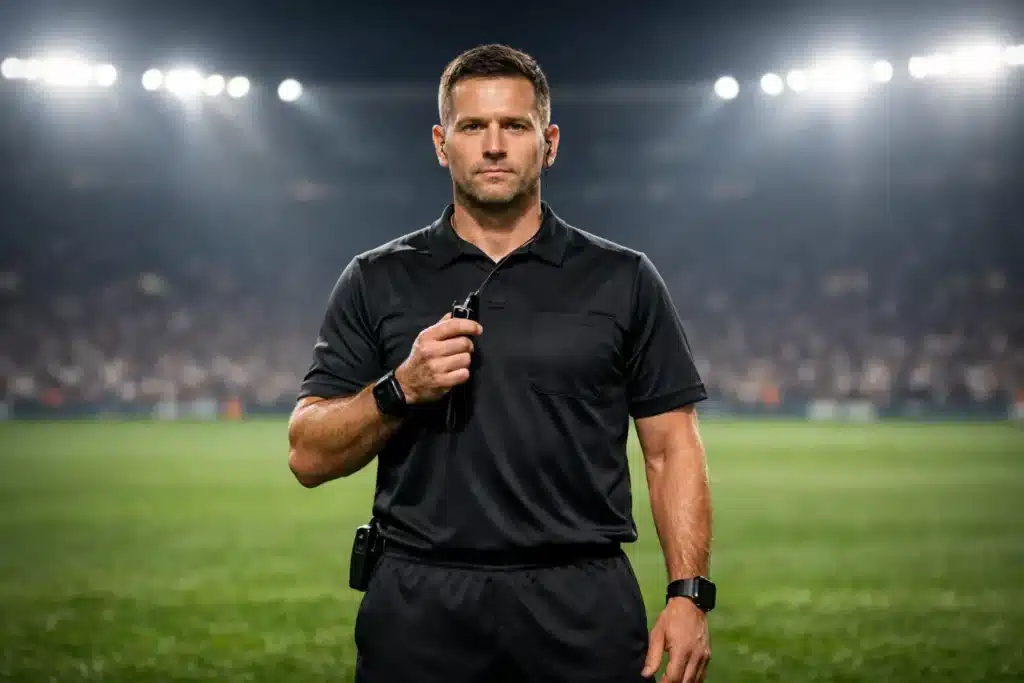
Not every referee begins under stadium lights.
Most start on small local pitches, with a whistle in one hand, a notebook in the other, and a game moving much faster than they expected. That is the real beginning of a refereeing career. Before the badges, appointments, and bigger matches, there is a first course, a first decision, and a first moment when the referee has to control a match with confidence.
For many fans, referees simply appear at the top level. But in reality, officiating has a clear development route. The exact age rules, course names, safeguarding checks, and registration steps can differ from one country to another, yet the structure is broadly the same: learn the Laws of the Game, get certified through your federation, officiate local matches, build experience, improve fitness and decision-making, and earn promotion step by step.
The first step is learning the game from a referee’s view
A player sees football differently from a referee.
Players focus on their team, their role, and the next action. A referee must see everything: challenges, offside support, dissent, advantage, game temperature, player safety, and match control. That is why the journey usually starts with an official referee course run by a national association, county FA, state association, or local referees’ body.
Official beginner courses typically include study of the Laws of the Game, practical training, and education on match management. In some systems, new referees also complete safeguarding or compliance modules before receiving assignments.
This is where a future referee learns that officiating is not just about blowing for fouls. It is about reading the tempo of the match, understanding player behavior, applying the law with consistency, and preventing chaos before it begins.
You do not start with elite matches — you start with local football
That is one of the most important truths in refereeing.
No one becomes a top-level match official overnight. After the first course, referees usually begin in grassroots football, youth football, school competitions, amateur matches, or entry-level local leagues. These are the real classrooms of officiating.
This stage matters because every early match teaches something different. One game teaches positioning. Another teaches calm communication. Another teaches how quickly a match can become emotional after one controversial challenge. These lessons cannot be learned from a book alone.
Referee development pathways published by football associations show that progression is built through performance, experience, education, and continued assessment over time rather than instant advancement.
The Laws of the Game are the foundation
Every referee must know the Laws of the Game, but knowing the law is only the beginning.
The real test is application.
A referee must understand when contact is careless, reckless, or excessive. They must know when handball is punishable and when it is not. They must manage restarts, delays, dissent, and tactical fouls. They must also apply advantage properly, recognize SPA and DOGSO situations, and make decisions under pressure.
That is why serious referee education never really stops. FIFA emphasizes ongoing referee education and development, while national bodies continue to provide learning resources, pathway support, and further courses after the beginner stage.
Fitness matters more than many people think
A referee cannot officiate well if they are constantly behind play.
Modern football is faster, transitions are sharper, and decision windows are smaller. Even at lower levels, referees need mobility, acceleration, stamina, and concentration. Positioning often decides whether a key call is trusted or questioned.
As referees move higher, physical standards become more demanding. Promotion toward stronger competitions is not only about technical knowledge. It is also about performance, commitment, fitness, and consistency.
This is one reason elite referees are athletes in their own right. Good officiating is not passive. It requires movement, focus, repeat effort, and strong recovery between intense phases of play.
Communication is one of the hidden skills of top referees
Fans often judge referees only by final decisions.
But strong refereeing is also built on communication.
The best referees know when to speak, when to warn, when to calm players, and when to take firm disciplinary action. They use body language well. They sell decisions with confidence. They avoid unnecessary confrontation, but they also establish authority early.
New referees often discover that managing people is as important as managing law. Coaches, players, substitutes, and spectators all create pressure. The referee who stays composed under that pressure gains credibility very quickly.
Joining a referee community helps development
Many successful referees improve faster because they do not develop alone.
Referees’ associations, local referee groups, mentors, coaches, and assessors can all accelerate learning. These structures often provide training sessions, meetings, feedback, appointments, and development support.
That support matters. After a difficult match, a new referee may need guidance on positioning, foul recognition, or discipline management. Honest feedback is one of the fastest ways to improve.
How promotion usually works
While each country has its own structure, the ladder is usually similar in principle.
A referee begins at grassroots level, completes official training, gains match experience, and is then observed or assessed for possible progression. Referees who perform well, stay committed, improve fitness, and handle more difficult games can move toward higher categories and stronger competitions. At the top end, international nomination depends on federation processes and FIFA criteria.
This is why patience matters.
A referee career is built in layers. First local credibility. Then consistency. Then bigger games. Then pressure matches. Then, for a small number, the professional pathway.
Can refereeing become a real career?
Yes — but not for everyone immediately.
For many, refereeing starts as a part-time role connected to local football. For others, it becomes a serious pathway into semi-professional or professional officiating. The difference is usually made by long-term consistency, availability, physical preparation, match control, and the ability to keep improving year after year.
Refereeing can also open doors beyond the whistle itself: assistant refereeing, futsal officiating, coaching referees, instructing, assessing, and working inside referee development systems.
The hardest part is often the beginning
The early stage is where many people quit.
Why? Because the first matches can be uncomfortable. Decisions are questioned. Positioning is imperfect. Confidence is tested. Some games feel easy, then the next one suddenly feels chaotic.
But that is also the phase where real referees are made.
Every experienced official once had a first awkward match. Every elite referee once had to learn how to control a game, handle dissent, and recover from a mistake. Progress in officiating is not about being perfect from the start. It is about improving faster than frustration can stop you.
So, how can someone become a referee?
The short answer is this:
Start with your national or local football association. Enroll in an official beginner referee course. Study the Laws of the Game seriously. Get registered through the correct pathway in your country. Accept local match appointments. Stay fit. Ask for feedback. Keep learning. And treat every small game as preparation for a bigger one.
Because that is how refereeing really works.
Not in one leap, but one match at a time.
Final verdict
Referees are not created by one exam or one badge. They are built through education, repetition, pressure, and discipline.
Anyone can admire elite referees on television. But the people who truly enter the profession are the ones willing to begin at the bottom, learn the game deeply, and keep showing up when the job gets difficult.
That is the path.
And every top referee once started exactly there.

0 Comments
Join the conversation with respect. Comments are moderated and must follow our community rules.
Want to join the discussion?
Please log in or create an account to comment and reply. This keeps the conversation cleaner and safer.