
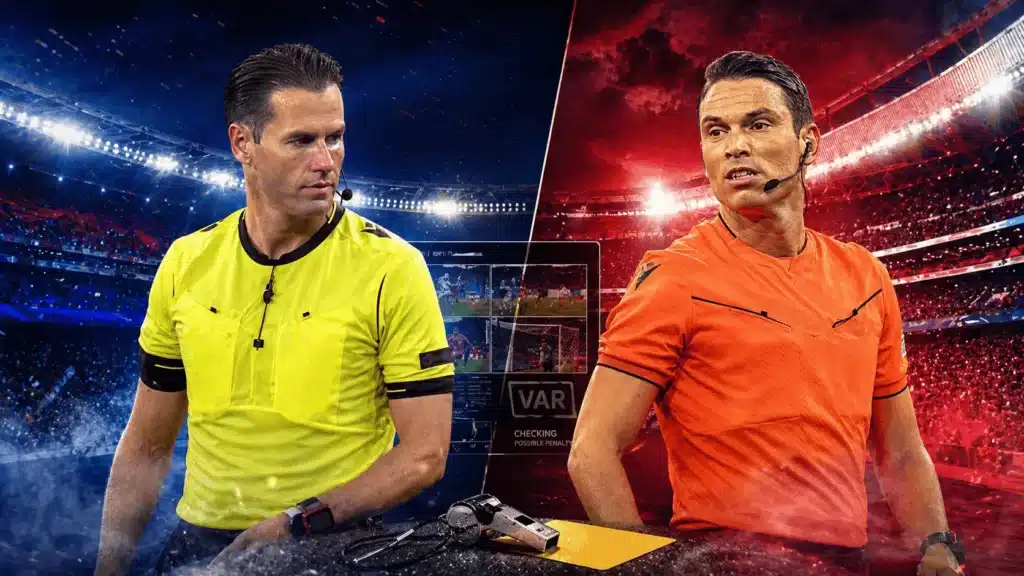
UEFA has confirmed the Champions League semi-final first leg referees, and this is not just a routine appointments story. At this stage of the competition, the referee is not background noise. One penalty threshold, one delayed flag, one VAR intervention — or one VAR non-intervention — can change the entire direction of a semi-final.
For the first legs, Sandro Schärer will referee Paris Saint-Germain vs Bayern Munich, while Danny Makkelie will take charge of Atlético Madrid vs Arsenal. UEFA’s official appointments page lists Schärer for Paris vs Bayern on Tuesday 28 April and Makkelie for Atlético vs Arsenal on Wednesday 29 April.
Quick Verdict
These are strong but very different appointments.
Schärer’s selection for PSG vs Bayern is the more eye-catching one. It is a major Champions League semi-final, and the Swiss official arrives with recent high-level trust from UEFA, but also with past controversy around French clubs and a debated penalty in Lille vs Dortmund.
Makkelie for Atlético vs Arsenal feels more predictable. He is one of UEFA’s most experienced referees, familiar with knockout pressure, Atlético’s intensity and Arsenal’s European rhythm. The risk is not experience. The risk is game temperature.
Champions League Semi-Final First Leg Referees: Full Appointments
PSG vs Bayern Munich
Match: Paris Saint-Germain vs Bayern Munich
Date: Tuesday, 28 April 2026
Venue: Parc des Princes, Paris
Referee: Sandro Schärer, Switzerland
Assistant Referee 1: Ángel Nevado Rodríguez, Spain
Assistant Referee 2: Guadalupe Porras Ayuso, Spain
Fourth Official: Jesús Gil Manzano, Spain
VAR: Carlos del Cerro Grande, Spain
AVAR: Guillermo Cuadra Fernández, Spain
The full officiating team has been reported by specialist referee appointment sources, with Schärer supported by a largely Spanish team around him.
Atlético Madrid vs Arsenal
Match: Atlético Madrid vs Arsenal
Date: Wednesday, 29 April 2026
Venue: Metropolitano Stadium, Madrid
Referee: Danny Makkelie, Netherlands
Assistant Referee 1: Hessel Steegstra, Netherlands
Assistant Referee 2: Jan de Vries, Netherlands
Fourth Official: Serdar Gözübüyük, Netherlands
VAR: Dennis Higler, Netherlands
AVAR: Pol van Boekel, Netherlands
Makkelie will work with a fully Dutch on-field and video team, a setup that usually helps communication speed and consistency between referee, assistants and VAR.
PSG vs Bayern Referee: Sandro Schärer Profile and Current Season Statistics
Schärer is 37 and has been a FIFA international referee since 2015. AS notes that this will be his first Champions League semi-final, after a season in which UEFA has clearly trusted him with major assignments.
In the 2025/26 Champions League referee statistics listed by Transfermarkt, Schärer has handled 2 matches, showing 4 yellow cards, with no second yellows, no straight reds and 2 penalties recorded in the competition table.
That penalty number is important. It does not automatically mean Schärer is “card happy” or “penalty happy,” but it tells us his threshold in the box will matter. PSG and Bayern both attack aggressively through wide areas and half-spaces. In this kind of match, the biggest danger for the referee is not one obvious decision — it is the borderline contact that looks different in slow motion than it does at match speed.
Schärer with PSG and Bayern: Team History
Schärer has already refereed PSG this season. He was in charge of PSG’s 4-0 win over Atalanta in the league phase, according to AS.
For Bayern, the appointment carries a different memory. AS reports that Schärer handled Bayern’s 1-2 home defeat against Inter in last season’s Champions League quarter-final.
That does not prove anything about the coming match. Referee history should never be treated like superstition. But it matters for perception. Semi-finals are played under pressure, and players remember the officials who have been involved in painful European nights.
The Schärer Controversy: Lille vs Dortmund Still Follows Him
The main controversy connected to Schärer came in Lille vs Borussia Dortmund in March 2025.
Blue News described the key moment as a controversial penalty awarded to Dortmund, with referee expert Pascal Erlachner saying he would have let play continue. The report also noted that VAR did not intervene, even though the television images did not clearly prove strong contact.
That is the exact kind of situation that defines modern VAR debate.
Was the penalty soft? Yes, by the reaction of many observers.
Was it clearly and obviously wrong? That is harder to prove.
Could VAR intervene? Only if the replay evidence showed a clear error.
This is where supporters often misunderstand the protocol. A referee can make a harsh decision that VAR still cannot overturn. VAR is not there to re-referee every subjective contact decision.
Why VAR Could or Could Not Intervene
Under the IFAB VAR protocol, VAR can only assist for a clear and obvious error or a serious missed incident in four categories: goal/no goal, penalty/no penalty, direct red card, and mistaken identity. The referee’s original decision should not be changed unless the video clearly shows the error.
So for PSG vs Bayern, if Schärer gives a penalty for contact that exists but is light, VAR may stay out. If there is no contact, contact outside the box, or an attacking foul before the incident, VAR has a stronger reason to intervene.
That distinction is crucial. VAR is not about whether a decision is popular. It is about whether the decision is clearly wrong under the available footage.
Law Context
For Schärer, the key law area will be Law 12: Fouls and Misconduct, especially careless or reckless contact inside the penalty area. The practical question is simple: does the defender trip, charge, push or hold the attacker in a way that unfairly impacts the opponent?
The second key area is the VAR protocol. Subjective penalty decisions require a high threshold. If there is contact and the referee has a clear view, VAR usually needs very strong evidence to recommend an on-field review.
Atlético Madrid vs Arsenal Referee: Danny Makkelie Profile and Current Season Statistics
Danny Makkelie is the more familiar name. He is 43, vastly experienced, and has been active at the top UEFA level for years. AS reports that he has refereed Atlético Madrid seven times, including their famous Champions League comeback against Liverpool in 2019/20. His most recent Atlético match was against Slavia Prague in November 2024.
Makkelie has also refereed Arsenal four times, with the most recent being Arsenal’s 2-0 win over Bayer Leverkusen in the current Champions League round of 16.
In the 2025/26 Champions League referee table, Transfermarkt lists Makkelie with 7 matches, 16 yellow cards, 1 second yellow, 0 straight reds and 4 penalties.
That profile suggests a referee who generally manages matches without overloading them with cards, but who is not reluctant to give penalties when he sees enough. For Atlético vs Arsenal, that balance will be tested.
Why Makkelie Fits Atlético vs Arsenal
This match has a very different refereeing problem from PSG vs Bayern.
PSG vs Bayern is likely to be fast, transitional and technically explosive. Atlético vs Arsenal may be more tactical, more physical and more emotionally loaded. Atlético are experts at turning a match into a sequence of duels, restarts, pressure moments and crowd-driven tension. Arsenal, meanwhile, will want rhythm, clean build-up and protection for technical players between the lines.
Makkelie’s job will be to identify the first 15 minutes correctly. If he lets too much go, the game may become unnecessarily aggressive. If he whistles every minor contact, Atlético will slow the tempo and Arsenal may become frustrated. The best version of Makkelie is firm early, calm with dissent, and selective with cards.
Any Wrong Decisions or Controversies Around Makkelie?
The strongest current-season debate involving Makkelie and Arsenal came across the two-legged Arsenal vs Bayer Leverkusen tie.
In the first leg, Arsenal equalised through a late Kai Havertz penalty after a VAR check, with Reuters describing the penalty as coming after Noni Madueke went down late in the match.
Football Insider later published a “ref watch” article after the second leg, claiming Makkelie got three decisions wrong, including an alleged David Raya handball outside the penalty area and other disputed moments. That is not an official UEFA finding, but it shows that his Arsenal match was not free from debate.
Our view: the Leverkusen first-leg penalty is the more relevant reference point for this semi-final because it involved VAR and a decisive penalty incident. If the contact was enough for the referee and VAR did not see a clear error, the decision can be controversial without necessarily being a protocol failure.
Why VAR Could or Could Not Intervene in Atlético vs Arsenal
Makkelie’s VAR, Dennis Higler, can intervene for penalties, goals, direct red cards and mistaken identity. He cannot step in just because Atlético or Arsenal want a second yellow card, a soft midfield foul, a missed corner or a general pattern of physical play reviewed.
That matters because Atlético matches often produce exactly those grey-zone complaints: repeated contact, tactical fouls, blocking, holding, delayed restarts, small confrontations after the whistle.
VAR will not fix match control. That remains the referee’s responsibility.
Law Context
The main legal areas for Atlético vs Arsenal are Law 12 and the VAR protocol.
For fouls, the referee must separate normal contact from careless or reckless challenges. For disciplinary control, he must decide whether a challenge is reckless enough for yellow, or whether it reaches serious foul play for a direct red. But VAR cannot intervene for second yellow cards, even if the missed caution feels important.
That is often the most frustrating part for fans. A missed second yellow may shape a match, but under the current protocol, VAR does not review it.
UEFA’s VAR Direction This Season
UEFA has also been publishing selected technical explanations for VAR decisions in the 2025/26 Champions League. The official page includes examples of penalties awarded, penalties cancelled, goals disallowed, red cards overturned and offside decisions explained.
This is a positive step for transparency, but it also raises expectations. If a semi-final contains a major VAR intervention, supporters will expect a clear explanation, not just the final decision.
Impact on the Semi-Finals
For PSG vs Bayern, the referee’s penalty threshold could be decisive. Both teams have enough speed and technical quality to force defenders into desperate actions. If Schärer is strict in the box, the match may swing on one duel.
For Atlético vs Arsenal, game management may be even more important than VAR. Makkelie must control the emotional rhythm without becoming the story. The danger is not just one penalty or one red card. It is the slow build-up: dissent, tactical fouls, restarts, confrontation and pressure from the crowd.
Both appointments are defensible. Both carry risk. That is normal at this level.
Final Verdict
The Champions League semi-final first leg referees are not controversial appointments by default — but they are high-pressure choices.
Schärer’s PSG vs Bayern assignment is the bolder call. His recent rise in UEFA trust is clear, but the Lille-Dortmund penalty debate shows why his penalty threshold will be watched closely.
Makkelie’s Atlético vs Arsenal appointment is safer on experience, but not easier. He has the profile for the match, yet this is exactly the kind of fixture where match control matters as much as the headline decisions.
The fair verdict before kick-off: UEFA has chosen two capable referees for two very different semi-finals. Now the challenge is simple — strong control, correct VAR discipline, and no decision that becomes bigger than the football.
