
Just one day after the heated controversy surrounding Argentina’s victory over Egypt, FIFA has made another refereeing decision that has divided football fans around the world.
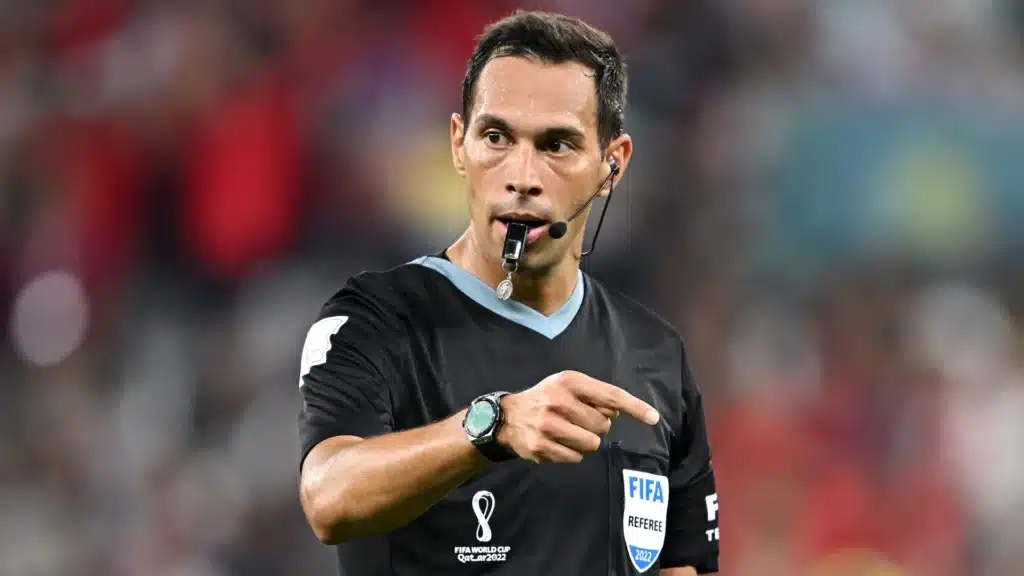
For Thursday’s World Cup quarterfinal between France and Morocco, FIFA has appointed an entirely Argentine on-field refereeing team, led by experienced referee Facundo Tello. The appointment immediately triggered debate across social media, with many supporters questioning whether the timing could have been handled better.
The appointment is completely legal under FIFA regulations. But is it the right decision?
The appointed refereeing team
FIFA has confirmed the following officials for France vs Morocco:
Referee: Facundo Tello (Argentina)
Assistant Referee 1: Juan Pablo Belatti (Argentina)
Assistant Referee 2: Gabriel Chade (Argentina)
Fourth Official: Darío Herrera (Argentina)
Reserve Assistant Referee: Cristian Navarro (Argentina)
For the first time during the 2026 FIFA World Cup, every on-field official comes from the same country.
Why are fans questioning the appointment?
Normally, FIFA appoints referees from countries that are not participating in the match. That condition is satisfied. Argentina are not playing against France or Morocco, so there is no direct conflict of interest. However, the debate is not really about the regulations. It is about perception.
Only hours earlier, Egypt’s players and coaching staff publicly suggested that Argentina benefited from controversial refereeing decisions in their Round of 16 victory. Those accusations quickly spread across international media and social platforms.
Against that background, appointing an entirely Argentine refereeing crew for one of the biggest quarterfinals has inevitably created fresh discussion.
Does FIFA break its own rules?
No.
FIFA‘s appointment policy focuses on neutrality regarding the two competing teams.
Officials are routinely appointed from countries whose national teams remain elsewhere in the competition, provided there is no direct conflict with the match they are officiating.
Because Argentina and France are on opposite sides of the knockout bracket and could only meet in the final, FIFA’s appointment is fully consistent with its regulations.
Why perception matters
Elite referees are expected to remain completely impartial. But modern football is also about public confidence. When supporters already question the integrity of officiating, every appointment is examined more closely than ever. That does not mean Facundo Tello or his team should be judged before the match begins. They have earned their FIFA appointments through years of international performances. Still, FIFA must also consider how its decisions are perceived. Sometimes avoiding unnecessary controversy is just as important as following the regulations.
Can an Argentine referee influence the tournament?
In practical terms, very little. Referees work within a structured system that includes assistant referees, the fourth official, VAR officials, referee observers and FIFA’s Referees Committee. Every major decision is reviewed after the match, and officials are continuously evaluated throughout the tournament. A poor performance could remove a referee from consideration for later appointments. That is why elite officials have every incentive to remain independent.
The bigger issue
This appointment arrives during one of the most scrutinised World Cups in recent memory. The Balogun suspension controversy. The criticism surrounding Raphael Claus. The debate after Argentina vs Egypt. Several disputed VAR decisions. Each story has increased pressure on FIFA’s refereeing department.
Although the appointment of Facundo Tello follows FIFA’s existing policies, many supporters believe the governing body could have reduced unnecessary controversy simply by choosing a referee from another confederation or another neutral nation.
The VAR Verdict
From a refereeing perspective, there is nothing improper about FIFA’s appointment. Facundo Tello is one of South America’s most experienced international referees and fully deserves to officiate a World Cup quarterfinal. The issue is not his quality. The issue is timing.
After several days dominated by refereeing controversy involving Argentina, FIFA should have anticipated the public reaction to appointing an all-Argentine officiating team for one of the tournament’s biggest matches.
The decision does not breach FIFA regulations. But football’s credibility depends not only on fairness itself, but also on the appearance of fairness. That is why this appointment will remain one of the tournament’s biggest talking points even before the first whistle.

0 Comments
Join the conversation with respect. Comments are moderated and must follow our community rules.
Want to join the discussion?
Please log in or create an account to comment and reply. This keeps the conversation cleaner and safer.