
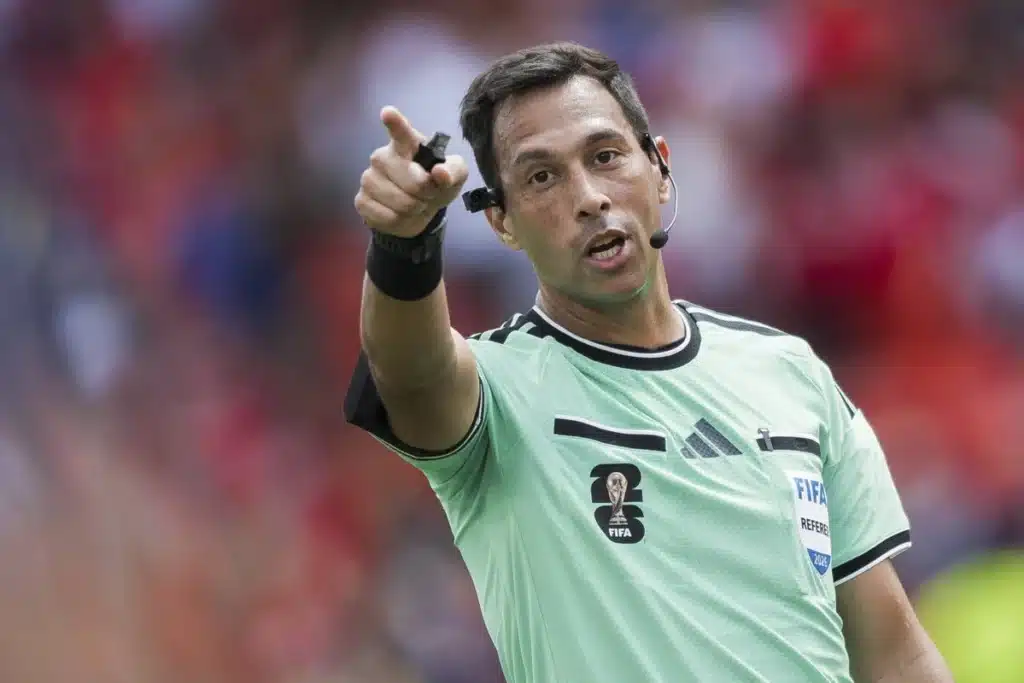
France vs Morocco Referee Analysis: Facundo Tello’s Penalty Decision Divides Opinion
France are into the World Cup semifinals after a controlled 2-0 victory over Morocco, but from an officiating perspective, this match was always going to be about Facundo Tello.
Before kick-off, FIFA’s decision to appoint an all Argentine refereeing team had already created debate. After the Argentina vs Egypt controversy, many supporters questioned the optics of the appointment. That meant every major decision in France vs Morocco was going to be examined in detail. Tello had a difficult task: deliver a clean performance, avoid becoming the story and manage a quarterfinal played under enormous public pressure. For most of the match, he did that well.
The big moment: penalty for France
The main refereeing incident came in the first half when Tello awarded France a penalty after contact inside Morocco’s penalty area. From the referee’s live position, the decision was immediate. Tello pointed to the spot, showing that he had seen enough contact to judge the challenge as a punishable foul. The VAR team then checked the incident for several minutes before confirming the on-field decision. Kylian Mbappé eventually took the penalty, but the long delay clearly added pressure before his miss. Reports also noted criticism from pundits and fans over how long the VAR check took.
Why was Tello not sent to the monitor?
This is the key question. When a referee gives a penalty, VAR does not automatically send him to the screen. The VAR only recommends an on-field review if there is evidence of a clear and obvious error. In this case, the VAR team checked the available angles and decided that Tello’s original decision could be supported. Because they did not find clear proof that the penalty was wrong, they confirmed the decision without sending him to the monitor. That is why the review was long, but there was no on-field review. A long VAR check does not always mean the VAR disagrees with the referee. Sometimes it means the VAR team is checking every angle carefully before confirming a match-changing decision.
Was the penalty correct?
From a refereeing point of view, the penalty was supportable. If the defender makes careless contact that trips or impedes the attacker inside the penalty area, the referee is entitled to award a penalty under Law 12. The important point is whether the contact was enough to affect the attacker’s ability to continue. Tello had a clear view and gave the decision immediately. VAR then confirmed that the call was not clearly wrong.
— Out Of Context Football (@nocontextfooty) July 9, 2026
The VAR Verdict: correct and supportable penalty decision.
The delay was the real problem
The decision itself was not the issue. The process was. A three minute VAR check for a penalty that is eventually confirmed creates frustration for everyone. The attacking team waits. The goalkeeper prepares. The penalty taker loses rhythm. Fans inside the stadium do not fully understand what is happening. This is where FIFA still needs improvement.
If VAR is only checking whether the decision is clearly wrong, the process must be quicker. When the original decision is supportable, the confirmation should not take several minutes unless there is a factual issue such as offside, ball out of play, or mistaken identity. In this case, the long delay made a correct decision feel controversial.
Tello’s overall match control
Outside the penalty incident, Tello managed the match calmly. France controlled long periods of the game and eventually won through second-half goals from Kylian Mbappé and Ousmane Dembélé. Morocco tried to push late, but the match never became chaotic. That was important for Tello. With so much attention on his nationality before the match, he needed a disciplined, low-drama performance. He largely delivered that.
His foul threshold was consistent, he did not overuse cards and he allowed the game to flow when possible.
Did the Argentine appointment affect the match?
No. There is no evidence that Tello’s nationality influenced his decisions. The appointment created debate before kick-off, but the referee must be judged on his performance, not his passport. FIFA’s decision may still be questioned from a public perception point of view, but on the field, Tello handled the match professionally.
Referee Rating
Facundo Tello: 8.1/10
Strong penalty decision, good overall control and no major clear error. The only negative point is the long VAR delay, although that responsibility belongs to the full VAR team rather than Tello alone.
The VAR Verdict
France vs Morocco gave FIFA exactly what it needed after days of refereeing controversy: a quarterfinal without a major officiating scandal.
The penalty decision was correct and supportable. VAR was right not to send Tello to the monitor because there was no clear and obvious error. However, the length of the check was not ideal and made the process look more uncertain than it probably was.
For The VAR Verdict, Facundo Tello passed a difficult test. The appointment was controversial before kick-off, but the performance itself was calm, controlled and technically sound.

0 Comments
Join the conversation with respect. Comments are moderated and must follow our community rules.
Want to join the discussion?
Please log in or create an account to comment and reply. This keeps the conversation cleaner and safer.