
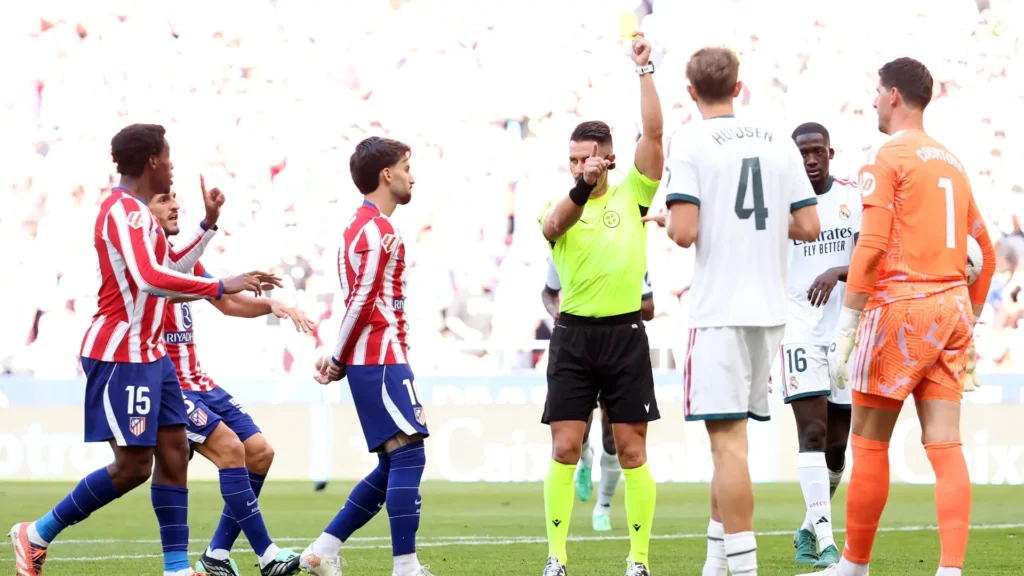
The Atletico Madrid vs Real Madrid referee performance left several legitimate questions after Atlético’s 2-1 derby victory, particularly over two first-half challenges that could have produced direct red cards.
Miguel Ángel Ortiz Arias ultimately sent off Real Madrid defender Dean Huijsen early in the second half, but the most controversial decisions came before the break. Cristian Romero escaped with only a yellow after catching Jude Bellingham high with his studs, while Kang-in Lee received no card at all for a studs-first challenge on Federico Valverde.
The Huijsen decision was different. Despite the understandable frustration around a penalty plus red card, the 2026/27 IFAB Laws support both sanctions because Huijsen denied an obvious goalscoring opportunity by holding Giuliano Simeone rather than attempting to play or challenge for the ball.
Atlético eventually won through Alejandro Grimaldo’s penalty and Jonathan David’s second-half goal, with Antonio Rüdiger pulling one back late for Madrid.
There has not yet been a full published CTA technical review covering every major incident. The conclusions below are therefore The VAR Verdict’s initial assessment, with the reported CTA clarification on the Romero incident identified separately.
Who was the referee and VAR?
The RFEF officially appointed Miguel Ángel Ortiz as referee, with José Antonio Garrido and Alejandro Estévez as assistants.
Álvaro Rodríguez was fourth official, Daniel Jesús Trujillo was VAR and Alejandro Muñiz was AVAR.
The complete team was:
| Role | Official |
|---|---|
| Referee | Miguel Ángel Ortiz Arias |
| Assistant | José Antonio Garrido |
| Assistant | Alejandro Estévez |
| Fourth official | Álvaro Rodríguez |
| VAR | Daniel Jesús Trujillo |
| AVAR | Alejandro Muñiz |
The derby quickly became a major disciplinary test rather than primarily a penalty or offside match.
5′: Should Álex Baena have been booked for his first challenge on Arda Güler?
The warning signs appeared almost immediately.
Baena challenged Güler from behind in the fifth minute, with Ortiz Arias correctly awarding the foul but keeping his cards in his pocket.
Former referee Eduardo Iturralde González considered it a clear yellow-card offence because of the nature of the contact from behind. Contemporary reporting also notes that Güler protested for a card, while Diego Simeone was himself cautioned during the confrontation that followed.
This was important because Baena was involved in another strong challenge on Güler only around 13 minutes later.
The VAR Verdict: ⚠️ Yellow card should probably have been shown
This was not a red-card incident.
But for match control and disciplinary consistency, Ortiz Arias appears to have set his threshold too high at the beginning of an already heated derby.
A caution would have been the stronger decision.
VAR had no role here because an ordinary missed yellow card is not a reviewable VAR offence.
18′: Baena challenges Güler again
The second Baena-Güler clash makes the first decision more significant.
Reporting from Spain describes another hard Baena challenge in the 18th minute. Refereeing analysts argued it was another cautionable offence.
If Ortiz Arias had cautioned Baena for the first challenge, this second offence could therefore have created a potential second-yellow situation.
But there is an important VAR distinction.
Under the updated 2026/27 protocol, VAR can intervene when a second yellow that has actually been shown is clearly incorrect and results in a red card.
VAR still cannot intervene because the referee simply missed a second-yellow offence.
IFAB explicitly confirms that distinction.
The VAR Verdict: ⚠️ On-field disciplinary problem, not a VAR error
There is a credible case that Baena should have accumulated two cautions from those early challenges.
But neither incident appears to have been a direct-red offence.
So if Ortiz Arias missed the cautions, VAR Trujillo Suárez could not repair those mistakes.
That is a referee-management issue, not a VAR failure.
36′: Cuti Romero catches Bellingham high
This was the first major controversy.
Bellingham and Romero contested a loose ball. Ortiz Arias initially judged Bellingham to have committed the offence and showed the Real Madrid midfielder a yellow card.
That decision was reversed after VAR involvement.
The replay showed Romero making studs-first contact around Bellingham’s knee. Ortiz Arias removed Bellingham’s yellow and instead cautioned Romero.
The controversy is whether yellow was enough.
Why was VAR allowed to get involved?
This is particularly interesting under the new 2026/27 protocol.
Cadena SER reports, citing a CTA explanation, that VAR did not summon Ortiz Arias because it considered Romero’s challenge a potential direct red.
Instead, the intervention was for mistaken identity, because the referee had booked Bellingham when the offence had actually been committed by Romero.
That is now specifically reviewable.
The 2026/27 VAR changes allow mistaken-identity corrections when a card is shown to one player but the offence was committed by another player, including a player from the other team.
So the review itself was legitimate.
The question is what Ortiz Arias should have done once he saw the challenge.
Was Romero’s challenge a red card?
This is where opinions diverge.
The reported CTA position was that the incident did not meet the direct-red threshold.
Former referee Iturralde González strongly disagreed, describing the challenge as excessive force and arguing Romero should have been sent off. He highlighted that Romero left his leg extended and caught Bellingham high with the studs.
Under IFAB Law 12, a challenge must be punished as serious foul play when it uses excessive force or endangers an opponent’s safety.
IFAB specifically states that a player who lunges at an opponent with excessive force, whether from the front, side or behind, is guilty of serious foul play.
The fact Romero was challenging for the ball does not automatically protect him from a red card.
Nor does accidentally making high contact automatically mean red.
The referee must assess:
- point of contact
- studs or open foot
- intensity and speed
- whether the leg is withdrawn
- force through the opponent
- danger to the opponent
Here, the most concerning factors are the studs, height of the contact and force into Bellingham’s knee area.
The VAR Verdict: ❌ Preliminary verdict: Romero should have been sent off
Our assessment is that yellow was too lenient.
The contact was high, studs were exposed and the challenge carried a significant risk to Bellingham’s safety.
That fits the serious-foul-play criteria more closely than a merely reckless challenge.
However, this is a subjective Law 12 judgement, and the reported CTA view is different.
That disagreement should be stated clearly rather than presented as an undisputed official error.
Why the Romero VAR sequence is so unusual
There is another technical point worth highlighting.
If the CTA account reported by Cadena SER is correct, Trujillo Suárez did not send Ortiz Arias to the screen for a potential red card.
He sent him because the wrong player had been cautioned.
Once Ortiz Arias was at the monitor, however, he had the opportunity to see the full nature of Romero’s challenge.
He changed the foul and card recipient correctly but still judged the sanction to be yellow.
That makes this primarily a referee judgement issue rather than a classic VAR non-intervention.
It also explains why headlines claiming that VAR “recommended a red and Ortiz Arias refused it” are not supported by the information currently available.
The reported CTA version says that did not happen.
First-half stoppage time: Kang-in Lee on Federico Valverde
This may actually be the strongest missed-red incident of the match.
Valverde was moving forward when Kang-in Lee challenged him from behind.
Replays showed Lee’s studs making contact around the ankle/Achilles area, with Valverde’s leg twisting under the challenge.
Ortiz Arias awarded the foul but showed no card.
VAR did not recommend a review.
Iturralde González considered this challenge even more dangerous than Romero’s, describing it as an incident with a high potential to injure because of the point of contact above the ankle.
The Law
Again, the test is not simply whether the tackler intended to hurt the opponent.
Intent is not required for serious foul play.
The key question is whether the tackle endangered the opponent’s safety or used excessive force.
A studs-first challenge from behind into the ankle or Achilles area, particularly when the opponent’s foot is planted or carrying weight, can reach that threshold.
The VAR Verdict: ❌ Kang-in Lee should have been sent off
This is the clearest major officiating error in our assessment.
The point of contact, studs, direction of the challenge and effect on Valverde’s ankle make a direct red card supportable and, in our view, preferable to either yellow or no card.
Ortiz Arias appears to have missed the seriousness of the challenge in real time.
Unlike Baena’s missed cautions, VAR was allowed to intervene here, because a potential direct red for serious foul play is one of the protocol’s reviewable categories.
Trujillo Suárez should therefore have considered recommending an on-field review.
The VAR Verdict on VAR: ❌ Missed red-card review
If the available replay angles showed the contact as clearly as subsequent television images did, this was a serious missed incident.
That makes it both a potential on-field referee error and a VAR non-intervention error.
The refereeing contributed to the half-time confrontation
The match became increasingly difficult to control.
The frustration following the Kang-in Lee challenge carried into the interval, where players and staff from both teams became involved in a confrontation near the tunnel.
Reporting says security intervened and that staff members from both teams were subsequently dismissed.
It would be too simplistic to say the referee “caused” the confrontation.
Players and team officials remain responsible for their own behaviour.
But match management matters.
When early cautionable fouls go unpunished and then two possible serious-foul-play incidents generate controversy, players can lose confidence in the referee’s disciplinary threshold.
That appeared to be a significant problem for Ortiz Arias in this derby.
52′: Was the Atlético penalty against Huijsen correct?
After all the controversial first-half calls, the major second-half decision was actually one Ortiz Arias and VAR ultimately got right.
Giuliano Simeone broke into a clear goalscoring position.
Dean Huijsen grabbed and held him, with the holding continuing into the penalty area.
Ortiz Arias awarded a penalty and initially showed Huijsen a yellow card.
VAR then recommended an on-field review, after which the referee upgraded the sanction to a direct red.
Some supporters questioned how Atlético could receive both a penalty and a red card because of the so-called “double jeopardy” principle.
But the Law is clear.
Why penalty plus red card was correct
IFAB Law 12 says that when a defender commits DOGSO inside their own penalty area and a penalty is awarded, the defender is only downgraded to yellow if the offence was:
an attempt to play the ball or a challenge for the ball.
For other offences, including:
- holding
- pulling
- pushing
- offences where there is no possibility or attempt to play the ball
the player must still be sent off.
Huijsen held Simeone.
He was not attempting to tackle or play the ball.
That means the DOGSO red-card downgrade did not apply.
What if the holding began outside the box?
That does not cancel the penalty.
IFAB provides almost the exact scenario in its Laws guidance: if holding begins outside the penalty area but continues inside, a penalty is awarded.
If that holding also denies an obvious goalscoring opportunity, the defender is sent off.
The VAR Verdict: ✅ Penalty and red card both correct
This was not an example of inconsistent refereeing against Real Madrid.
Huijsen’s offence was a holding offence that denied an obvious goalscoring opportunity.
Penalty: correct.
DOGSO red card: correct.
VAR intervention: correct.
This distinction is important because criticism of the Romero and Lee decisions should not lead us to label every later decision wrong.
Did Huijsen suffer from the referee’s earlier mistakes?
In football terms, the sequence inevitably fuels frustration.
If Romero or Lee had been dismissed before half-time, the second half would have been played under completely different conditions.
But refereeing analysis cannot use that hypothetical to invalidate Huijsen’s own offence.
Each incident must be judged independently.
Huijsen committed a clear holding offence.
The fact Atlético may previously have benefited from lenient disciplinary decisions does not change the correct Law 12 outcome when Huijsen denied Simeone an obvious goalscoring opportunity.
What Mourinho said after the match
José Mourinho was highly critical of the officiating afterwards.
He argued that Atlético should have had players sent off before Huijsen’s dismissal and criticised both Ortiz Arias and the referee appointment.
Mourinho specifically highlighted the challenges on Bellingham and Valverde and questioned why VAR intervened for Huijsen’s red card but not for the earlier Atlético challenges.
Those are Mourinho’s claims, not independent proof of systemic bias.
His criticism of the individual disciplinary decisions is open to Laws analysis.
Suggestions of institutional motives, however, are not established by the evidence available from this match and should not be presented as fact.
Was Atlético really fortunate not to finish the first half with nine men?
There is a serious case for it.
Our incident-by-incident assessment is:
Baena: could have accumulated two yellow cards, but neither challenge appears to be a clear direct-red offence.
Romero: our preliminary verdict is direct red for serious foul play.
Kang-in Lee: our verdict is direct red for serious foul play.
That means Atlético could reasonably have been reduced to nine players based on our interpretation of the two strongest challenges.
But there is an important distinction in certainty.
The Kang-in Lee incident is the stronger VAR-error case.
Romero’s challenge remains a subjective disciplinary decision on which the reported CTA view and several refereeing analysts disagree.
It is therefore more accurate to say Atlético could or should have been reduced further, rather than claim an official ruling has established two missed reds.
Where did Ortiz Arias lose control?
The biggest weakness in his performance was not one single decision.
It was the disciplinary line across the first half.
He allowed Baena two hard challenges without caution.
He initially misidentified Bellingham as the offender in the Romero incident.
He then viewed Romero’s high studs contact and settled on yellow.
Minutes later, Kang-in Lee’s dangerous challenge on Valverde produced no card at all.
That sequence created a perception of inconsistency before the decisive second half had even started.
The Huijsen decision was technically correct, but by then the referee had already lost significant trust from one side.
That is a match-management problem.
Was VAR also poor?
The VAR performance was mixed.
✅ Correct: mistaken-identity correction
If the CTA explanation reported by Cadena SER is accurate, VAR correctly identified that Bellingham had been cautioned for an offence committed by Romero.
The 2026/27 protocol now permits that correction.
⚖️ Romero red-card question
The VAR team apparently did not judge Romero’s challenge to be serious foul play.
Our assessment disagrees, but the CTA reportedly supports the yellow-card interpretation.
This remains the more subjective of the two direct-red debates.
❌ Kang-in Lee non-intervention
This is the bigger problem.
VAR had full authority to intervene for a potential serious-foul-play red card and did not do so.
✅ Huijsen DOGSO review
VAR correctly recognised that Huijsen’s holding offence did not qualify for the penalty-area DOGSO downgrade.
The yellow was therefore upgraded to red.
Miguel Ángel Ortiz Arias referee rating
The VAR Verdict referee rating: 4/10
Ortiz Arias did get one of the match’s most important technical decisions right after review: penalty plus red card for Huijsen.
But the first-half disciplinary performance was significantly below the level required for a derby of this intensity.
The main concerns were:
- Baena escaping early cautions
- initially identifying the wrong offender in the Romero-Bellingham incident
- our view that Romero’s challenge warranted red
- failing to sanction Kang-in Lee at all
- inconsistent disciplinary control as the match became increasingly confrontational
The correct Huijsen decision prevents this from being an across-the-board failure.
But two potential serious-foul-play incidents in one half are too significant to overlook.
VAR Daniel Trujillo rating: 4.5/10
There were correct interventions for mistaken identity and Huijsen’s DOGSO.
However, the Kang-in Lee incident represents a major potential missed red-card review.
If our assessment of Romero is accepted, that would make two direct-red situations where Atlético remained at full strength.
Major decisions summary
| Incident | Decision | VAR | The VAR Verdict |
|---|---|---|---|
| Baena on Güler, 5′ | Foul, no card | No role | ⚠️ Yellow should have been considered |
| Baena on Güler, 18′ | No caution | No intervention possible for missed YC | ⚠️ Possible second caution if first had been given |
| Romero on Bellingham, 36′ | Romero yellow after review | Mistaken-identity review | ❌ Preliminary verdict: red more appropriate |
| Kang-in Lee on Valverde | Foul, no card | No intervention | ❌ Red card should have been shown |
| Huijsen on Giuliano, 52′ | Penalty, yellow initially | OFR | ✅ Penalty and red correct |
| Half-time confrontation | Staff dismissals | N/A | ⚖️ Separate misconduct issue |
Quick answers
Should Cuti Romero have been sent off against Real Madrid?
Our preliminary assessment is yes.
The studs contact was high around Bellingham’s knee and carried enough force and danger to meet the serious-foul-play threshold.
However, media reporting says the CTA considered yellow sufficient, while former referee Iturralde González argued it was a direct red.
Why did VAR review Romero if it was not for a red card?
According to Cadena SER’s report of the CTA explanation, the review was for mistaken identity.
Ortiz Arias had booked Bellingham when Romero had committed the foul.
That category became expressly reviewable under the 2026/27 VAR changes.
Should Kang-in Lee have been sent off?
Yes, in our assessment.
The studs-first challenge from behind caught Valverde around the ankle/Achilles region and posed a significant danger to the opponent.
This was also reviewable by VAR as a potential direct red.
Should Álex Baena have been sent off?
Possibly through two yellow cards, not a direct red.
There is a credible case that both early challenges on Güler deserved cautions.
But VAR could not intervene simply because Ortiz Arias failed to give those yellow cards.
Was Huijsen’s red card correct?
Yes.
Huijsen denied Giuliano Simeone an obvious goalscoring opportunity by holding him.
Because the offence was holding rather than an attempt to play or challenge for the ball, IFAB Law 12 requires a red card even though Atlético also received a penalty.
Can a referee give a penalty and red card for DOGSO?
Yes.
The automatic downgrade to yellow only applies when the defender genuinely attempts to play or challenge for the ball.
Holding, pulling, pushing and offences with no attempt to play the ball can still produce penalty plus red card.
Final VAR Verdict
This was not a match where every major decision went against Real Madrid incorrectly.
The decisive Huijsen incident was handled correctly.
✅ Huijsen penalty: correct.
✅ Huijsen red card: correct.
✅ VAR was right to intervene on the DOGSO sanction.
But the first half contained serious officiating problems.
⚠️ Baena was fortunate not to receive at least one early caution, potentially two.
❌ Our assessment is that Romero’s studs-high challenge on Bellingham should have resulted in a direct red, although the reported CTA view supports the yellow.
❌ Kang-in Lee’s challenge on Valverde is the clearest missed-red incident. In our assessment, both Ortiz Arias and VAR failed there.
The most concerning aspect was consistency.
Real Madrid saw Huijsen correctly dismissed for a clear DOGSO holding offence shortly after Atlético had survived two challenges that raised genuine serious-foul-play questions.
That does not make Huijsen’s red wrong.
It does make the earlier disciplinary decisions much more consequential.
The VAR Verdict: Ortiz Arias had a poor derby, particularly in first-half disciplinary control. The Huijsen penalty and red were correct, but Atlético were fortunate that neither Romero nor Kang-in Lee was dismissed before the break.

0 Comments
Join the conversation with respect. Comments are moderated and must follow our community rules.
Want to join the discussion?
Please log in or create an account to comment and reply. This keeps the conversation cleaner and safer.