
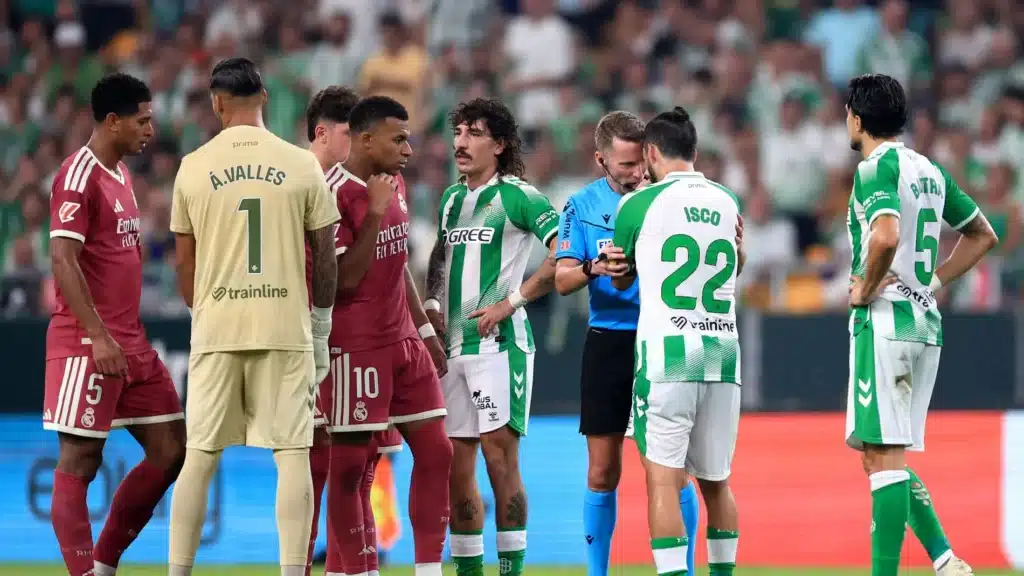
Real Betis ended Real Madrid’s perfect start to La Liga with a 1-0 victory at La Cartuja, but the Betis vs Real Madrid referee decisions produced almost as much discussion as Troy Parrott’s winning goal.
Alejandro Hernández Hernández was the referee, with specialist official Javier Iglesias Villanueva on VAR. Parrott scored the only goal in the 81st minute after Courtois saved Nelson Deossa’s header. Real Madrid then thought Carlos Espí had produced a spectacular late equaliser, only for VAR to disallow it for an earlier offside. In stoppage time, Madrid were awarded a penalty, Álvaro Valles saved Kylian Mbappé’s effort, and VAR then checked whether Marc Bartra had entered the penalty area too early before clearing the rebound.
There was also a major decision much earlier in the second half: Arda Güler, already booked, fouled Marc Roca but escaped a second yellow.
All three incidents deserve separate analysis.
This is our initial post-match verdict. We will update this article when the CTA/RFEF publishes its official analysis or VAR audio from the match.
Quick VAR Verdict
Arda Güler second yellow: ❌ We believe Hernández Hernández should have shown a second yellow.
Carlos Espí disallowed goal: ✅ Correct VAR decision. The offside occurred earlier in the same attacking move.
Real Madrid penalty: ✅ Correctly awarded.
Mbappé penalty retake: ⚠️ Serious unresolved question. If Bartra’s projected feet were already inside the penalty area when Mbappé struck the ball, the RFEF’s own 2026/27 guidance says he had encroached. Because Bartra then became directly involved in clearing/challenging for the rebound, the penalty should be retaken.
That final incident is the one we most want the CTA to explain.
1. Should Arda Güler have received a second yellow?
Güler received his first yellow card in first-half stoppage time after fouling Pablo Fornals.
The important detail is why he was cautioned.
Former international referee Iturralde González explained that Hernández Hernández considered the first foul to have stopped a promising attack. The caution was therefore based mainly on its tactical consequence rather than the physical severity of the challenge.
Then came the 53rd minute.
Güler fouled Marc Roca in the Betis defensive half.
Hernández Hernández awarded the free kick but did not produce another card.
Betis immediately wanted Güler sent off.
And they had a strong argument.
The VAR Verdict: Second yellow should have been shown ❌
For us, this was the first major mistake of the match.
Iturralde’s analysis is particularly relevant. He argued that the second action was more worthy of a yellow card than the first, and criticised the unwritten idea that a second yellow somehow needs to be considerably more serious than a first yellow.
He is correct on that principle.
There is no separate Law saying:
“The second yellow must be worse than the first.”
A cautionable offence is a cautionable offence.
If an action meets the threshold for a yellow card, the referee should show it regardless of whether the player is already booked.
The consequence, dismissal, should not change the definition of the offence.
In Güler’s case, Hernández Hernández appears to have been extremely reluctant to produce the second caution.
Our verdict: Güler was fortunate to remain on the pitch.
Would Real Madrid have gone down to ten men?
Yes.
Had Hernández Hernández shown the yellow, it would have been Güler’s second caution and therefore a red card.
That would have left Real Madrid with ten players from approximately the 53rd minute.
The match was still 0-0 at that stage.
This does not mean Betis would definitely have won more comfortably, or that Real Madrid would definitely have lost because of the dismissal.
We cannot rewrite the match.
But from an officiating perspective, the potential consequence was enormous.
Why didn’t VAR send Güler off?
This is especially interesting because VAR rules changed for 2026/27.
VAR can now review a clearly incorrect second yellow card that has already resulted in a player being sent off.
But VAR still cannot create a second yellow that the referee never showed.
The RFEF’s current VAR manual specifically allows review of a red card resulting from a clearly incorrect second caution. It does not give VAR general power to search for missed yellow cards.
So imagine the opposite situation.
Hernández Hernández shows Güler a second yellow.
VAR then sees that Güler clearly made no cautionable offence.
Under the new rule, Iglesias Villanueva can intervene and the dismissal can be cancelled.
But here Hernández Hernández did not show the second yellow at all.
VAR cannot say:
“Actually, that should have been yellow. Send him off.”
That remains outside the protocol.
Important distinction
Incorrect second yellow GIVEN: ✅ VAR can potentially cancel it.
Second yellow MISSED: ❌ VAR cannot create it.
So if we conclude that Güler deserved another caution, that is an on-field refereeing error, not a VAR error.
Mourinho removed Güler shortly afterwards
Güler eventually left the field in the 64th minute as part of Real Madrid’s changes.
That was probably a sensible game-management decision from José Mourinho.
Once a player has already survived one strong second-yellow appeal, every subsequent foul becomes dangerous.
But the substitution does not change the refereeing analysis.
The question remains whether Güler should still have been available for Mourinho to substitute.
Our view is no.
2. Carlos Espí scores an extraordinary goal, but VAR disallows it
The most spectacular moment of the match arrived after Betis had taken the lead.
Carlos Espí entered in the 82nd minute.
Five minutes later, he appeared to score a remarkable equaliser for Real Madrid.
Vinícius delivered the ball and Espí produced an acrobatic finish.
Initially, the goal looked perfectly legal.
The final pass was not the problem.
That caused considerable confusion among viewers.
Then VAR intervened.
The goal was cancelled because Espí had been in an offside position earlier in the attacking phase, when Marc Cucurella played the ball to him.
La Liga’s official match record identifies exactly that offside: Cucurella attempted the pass and Espí was in an offside position before the later goal.
Why could VAR go so far back?
Because the offside was part of the attacking possession phase that directly led to the goal.
VAR does not only look at the final pass before the ball enters the net.
It checks the relevant attacking phase for offences including:
offside
attacking fouls
handball
ball out of play
The RFEF’s current guidance describes the Attacking Possession Phase as the period of attacking possession before a goal, penalty or DOGSO situation. Merely touching the ball does not automatically reset that phase.
In this case, Espí’s offside involvement occurred before Madrid completed the move.
Once an attacker becomes involved in active play from an offside position, the offence has occurred.
A spectacular finish several seconds later cannot erase it.
The VAR Verdict: Goal correctly disallowed ✅
This decision is much less controversial once the full attacking move is shown.
The television replay initially focused on the final delivery, where there was no obvious offside.
That naturally confused viewers.
But the decisive moment happened earlier.
Espí was offside when Cucurella played the ball to him during the build-up.
The attack then continued and eventually ended with Espí scoring.
VAR was entitled to examine that phase.
Our verdict: Correct offside. Correct VAR intervention. Goal correctly disallowed.
It was an extraordinary finish.
Unfortunately for Madrid, there is no “great goal exception” in Law 11.
Did a Betis touch reset the offside?
This is an important question whenever an offside occurs earlier in an attacking move.
A deliberate, controlled play by a defender can affect whether a player subsequently receives the ball from an opponent or from a team-mate.
But once an attacker in an offside position becomes actively involved in the original pass, the offence has already happened.
The key frame here is therefore the Cucurella-to-Espí pass and Espí’s involvement immediately afterwards.
The official La Liga match record records the offence at that point, and VAR subsequently cancelled the goal.
Unless the CTA later provides evidence that the attacking phase should have been considered reset before Espí’s involvement, we see no basis for criticising this decision.
3. Real Madrid’s late penalty was correct
Madrid received their biggest opportunity to equalise in stoppage time.
Natan challenged Vinícius inside the Betis penalty area.
Hernández Hernández pointed to the spot and booked the Betis defender.
La Liga’s official event log records the penalty as a foul by Natan on Vinícius.
There is little controversy for us here.
The VAR Verdict: Penalty correct ✅
The challenge catches Vinícius illegally inside the area.
Iturralde also described the penalty as clear.
The interesting refereeing controversy came after the penalty was awarded.
Mbappé misses, Valles saves
Mbappé took the penalty in the 94th minute.
Álvaro Valles guessed correctly and saved the shot.
The ball rebounded back into the penalty area.
Marc Bartra then became involved and cleared the danger, with the ball eventually going out for a Real Madrid corner. Cadena SER reports that VAR specifically checked whether Bartra had entered the area before Mbappé took the kick.
The check ended without a retake.
This is where things become much more complicated.
Should Mbappé’s penalty have been retaken?
Potentially, yes.
And the 2026/27 Laws make the argument considerably stronger than many viewers realise.
At a penalty kick, every player other than the kicker and goalkeeper must remain outside the penalty area, behind the penalty mark and at least 9.15 metres away until the ball is kicked.
But encroachment is not automatically punished.
For a defending player, the RFEF says the offence is penalised if that player enters early and then:
plays the rebound, or
challenges an opponent for the rebound, and
by doing so prevents the attacking team from scoring, attempting to score or creating a goalscoring opportunity.
That description is crucial because Bartra was not simply standing harmlessly inside the area.
He became involved in the rebound.
The key question: was Bartra legally inside the area before Mbappé kicked the ball?
This is where a new 2026/27 clarification matters.
There was immediate discussion online that Bartra’s foot had not yet landed inside the penalty area when Mbappé struck the ball.
Under the old simplified interpretation, that might sound decisive.
Under the current RFEF guidance, it is not.
The RFEF’s 2026/27 referee manual says a player’s restart position is determined by the feet or other body parts touching the ground.
But it adds an important new clarification:
If the player is airborne, his position is determined by the projected position of his feet if they were on the ground.
The RFEF goes even further in its dedicated penalty-encroachment section.
It gives almost the exact scenario relevant to Bartra:
If a defender jumps forward before the penalty is taken, his position should be projected onto the ground. If that projected position is inside the penalty area, he is considered to have encroached and must be penalised if he subsequently becomes actively involved.
That is extremely important.
Being airborne does NOT automatically save the defender
This is the detail many discussions are missing.
Imagine Bartra starts outside the penalty area.
As Mbappé approaches the ball, Bartra jumps forward.
At the exact instant Mbappé kicks the ball, Bartra’s rear foot may technically still be off the ground rather than planted inside the box.
That does not automatically mean he is legally outside.
For 2026/27, officials must consider where his feet would be if projected vertically onto the playing surface.
If that projected point is inside the penalty area, Bartra is regarded as having entered early.
This is not our interpretation invented after the match.
It is specifically written in the RFEF’s current referee manual.
And Bartra then affects the rebound
The second requirement is just as important.
Defensive encroachment is generally ignored if it has no impact.
That prevents penalties being constantly retaken because a defender moved a few centimetres too early on the opposite side of the area.
But Bartra was directly involved after Valles’ save.
Cadena SER reports that he cleared the rebound and that VAR checked precisely this possible encroachment.
IFAB Law 14 says a defending player who encroaches is penalised when the rebound comes into play and the encroaching player then plays the ball or challenges an opponent, preventing the attacking team from scoring, attempting to score or creating a goalscoring opportunity.
If both elements are present:
- Bartra was inside under the projected-feet test when Mbappé kicked the penalty.
- Bartra then played/challenged for the rebound and prevented Madrid from continuing the opportunity.
Then the required decision is:
RETAKE THE PENALTY.
The VAR Verdict: This requires an official CTA explanation ⚠️
This is the biggest unresolved refereeing question from the match.
The television images appear to show Bartra moving aggressively into the area before Mbappé makes contact with the ball.
He then becomes directly involved in the rebound.
VAR checked the incident but did not order a retake.
The decisive frame is therefore not simply:
“Was Bartra’s foot touching the grass inside the penalty area?”
The correct 2026/27 question is:
“Where were Bartra’s feet projected onto the ground at the instant Mbappé kicked the ball?”
If the projection was inside, the defender had encroached.
And because he then cleared/challenged for the rebound, his encroachment had a direct impact.
Our preliminary verdict
Based on the available sequence, there is a strong case that the penalty should have been retaken.
However, we want to see the CTA’s calibrated freeze-frame and explanation before labelling this definitively as a VAR error.
This is exactly the type of incident Tiempo de Revisión should address.
Why VAR was allowed to check the encroachment
Unlike Güler’s missed second yellow, this incident falls directly within VAR’s authority.
Penalty-kick encroachment that materially affects what happens after a save is reviewable.
UEFA’s current referee guidance also classifies a player entering the area early and subsequently playing the rebound as a factual VAR situation.
So Iglesias Villanueva was not powerless here.
The VAR did check.
The question is whether the check applied the new restart-position guidance correctly.
There is an important difference between all three controversies
These three incidents demonstrate three completely different parts of modern refereeing.
Güler second yellow
A subjective disciplinary decision that VAR could not create.
Espí disallowed goal
A factual offside decision that VAR was fully entitled to correct.
Bartra penalty encroachment
A factual restart-position question with a specific 2026/27 interpretation, followed by an objective question about whether the defender participated in the rebound.
That is why simply saying “VAR was good” or “VAR was bad” does not properly analyse this match.
Each incident has to be judged under a different part of the Laws and protocol.
Did Hernández Hernández favour one team?
We would not frame the match that way.
There were decisions that benefited both teams.
Güler remaining on the pitch benefited Real Madrid.
Espí’s correctly disallowed goal benefited Betis because the offside was properly detected.
The possible failure to retake Mbappé’s penalty may have benefited Betis if the CTA concludes Bartra was already inside.
That is not evidence of bias.
It is evidence of why decisions should be analysed individually rather than fitted into a club-based narrative.
Hernández Hernández’s overall performance
This was a difficult match to referee.
It became increasingly physical, produced several cautions and ended with an extraordinary sequence of high-impact decisions.
The penalty on Vinícius was correct.
The offside leading to Espí’s disallowed goal was correctly resolved with VAR.
But the Güler decision damages Hernández Hernández’s performance.
In our view, the Real Madrid midfielder should have received a second caution in the 53rd minute.
The late penalty encroachment question is potentially even more significant for the VAR team.
Until we see the CTA’s official explanation, we would separate responsibility:
Güler: On-field referee issue.
Espí goal: Correct referee/VAR teamwork.
Penalty encroachment: VAR decision under serious scrutiny.
The VAR Verdict referee-team rating: 6/10
Güler first yellow: ✅ Correct
Güler foul on Marc Roca: ❌ Second yellow should have been shown
VAR on Güler: ✅ Could not create a missed second caution
Espí disallowed goal: ✅ Correct
Penalty on Vinícius: ✅ Correct
Mbappé penalty save: ✅ Valles’ save itself legal based on current evidence
Bartra encroachment: ⚠️ Strong retake argument, awaiting CTA explanation
Overall: Several correct major decisions, but two important controversies remain.
What should the RFEF explain?
When the CTA publishes its review, we want answers to three precise questions.
1. Was Güler’s foul on Marc Roca considered cautionable?
If not, why did it remain below the yellow-card threshold?
2. Where exactly was Espí offside?
The television broadcast initially created confusion by focusing on the final cross. Showing the full attacking phase and the Cucurella pass would make the decision easier for supporters to understand.
3. How was Bartra’s position assessed at Mbappé’s penalty?
This is the most important one.
The CTA should show the exact frame at the moment Mbappé contacts the ball and apply its own 2026/27 wording:
Was Bartra’s projected foot position inside the penalty area?
If yes, because Bartra subsequently cleared/challenged for the rebound, Law 14 points towards a retake.
If no, the CTA should show why his projected feet were still legally outside.
That would settle the controversy.
Final VAR Verdict
Real Betis deserved enormous credit for their performance and Álvaro Valles produced an outstanding game, but the 1-0 result also contained three major refereeing decisions that deserve proper analysis.
On Arda Güler, we believe Betis have a legitimate complaint.
He was already booked and his 53rd-minute challenge on Marc Roca should, in our view, have produced a second yellow.
VAR could not intervene because the new 2026/27 second-yellow protocol allows video officials to cancel an incorrect second caution, not manufacture one the referee failed to show.
On Carlos Espí’s spectacular disallowed goal, Real Madrid have much less reason to complain.
The offside happened earlier in the move when Cucurella played to Espí. VAR correctly went back through the attacking phase and cancelled the goal.
The late penalty is more complicated.
The penalty itself was correct.
Valles saved Mbappé’s kick.
But Bartra then cleared the rebound after moving forward before the kick.
Under the RFEF’s new 2026/27 guidance, an airborne defender is judged by the projected position of his feet, not simply by whether a boot has already landed on the grass.
If Bartra’s projected feet were inside the penalty area when Mbappé struck the ball, he had encroached.
Because he then became directly involved in preventing Madrid from continuing the rebound, the correct outcome would be:
the penalty should have been retaken.
That is our preliminary interpretation.
Now the next step belongs to the CTA.
When the RFEF publishes the official review or VAR audio, we will update this analysis and compare its explanation directly with the 2026/27 Laws and its own referee manual.

0 Comments
Join the conversation with respect. Comments are moderated and must follow our community rules.
Want to join the discussion?
Please log in or create an account to comment and reply. This keeps the conversation cleaner and safer.