
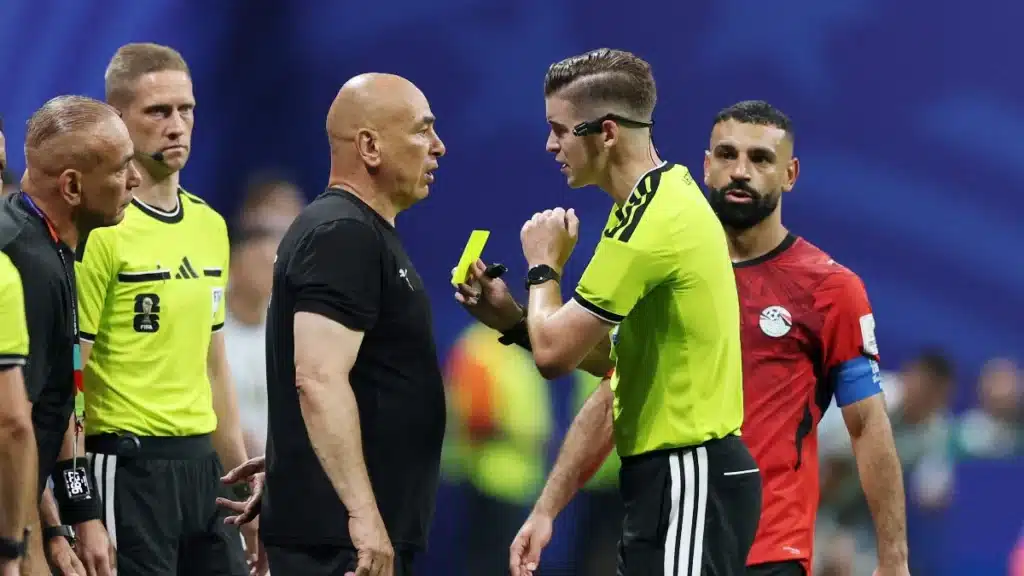
Egypt’s official complaint following the dramatic World Cup defeat to Argentina has reignited one of the biggest questions in football officiating.
Can FIFA actually remove a referee from the tournament after one controversial match?
Many supporters believe that once a national federation files a complaint, FIFA must investigate and punish the referee. In reality, the process is far more structured.
Every referee is evaluated after every match
One fact many fans do not know is that every FIFA World Cup referee receives a detailed assessment after every game, regardless of whether there is controversy. A FIFA Referee Observer watches the entire performance and produces a comprehensive report covering:
- Application of the Laws of the Game
- Match control
- Disciplinary decisions
- Positioning and movement
- Teamwork with assistant referees
- VAR communication
- Personality and player management
- Consistency of decision making
This report is far more important than public criticism or social media reaction. Referees are judged on technical performance, not on how popular their decisions are.
What happens after an official complaint?
When a federation submits an official complaint, FIFA does not automatically suspend the referee. Instead, the complaint is reviewed by the relevant FIFA departments. The Referees Committee will already have:
- the observer’s report,
- every VAR recording,
- broadcast footage from multiple camera angles,
- communication between the referee and VAR,
- and additional technical analysis.
If the complaint raises new issues, FIFA can review those incidents in even greater detail. However, a complaint itself does not prove that the referee made mistakes.
Can FIFA remove a referee?
Yes.
But it is extremely uncommon.
FIFA has the authority to stop appointing a referee if officials conclude that the performance fell below the required World Cup standard.
The referee does not necessarily leave the tournament immediately.
More commonly, they simply receive no further appointments.
From the outside, supporters often say a referee has been “sent home.”
In reality, FIFA usually just stops assigning matches.
Has this happened before?
Yes. Several referees have effectively seen their tournaments end after disappointing performances. Sometimes the reason is a major refereeing error. Sometimes it is a series of inconsistent performances. Sometimes it is simply because other referees perform better and move ahead in FIFA’s internal rankings. World Cup appointments are highly competitive. Every match is effectively another assessment.
What about François Letexier?
Following Argentina’s victory over Egypt, the Egyptian Football Association reportedly requested an investigation into François Letexier and asked FIFA to remove the French officiating team from the remainder of the tournament. That request has attracted global attention.
However, there is no indication that FIFA has suspended Letexier or removed him from the competition. Instead, his performance will be evaluated through the same process applied to every World Cup referee.
If FIFA’s technical assessment concludes that his decisions were correct under the Laws of the Game and the VAR Protocol, the complaint alone is unlikely to affect his future appointments.
Public opinion vs FIFA evaluation
One of the biggest misconceptions in football is that referees are judged by public reaction. They are not. A referee may receive enormous criticism online while still earning a very positive observer report. The opposite can also happen. A match with little public discussion may still receive a poor technical assessment because of positioning, communication or incorrect application of the Laws of the Game. FIFA’s evaluation system focuses on technical accuracy, consistency and teamwork rather than social media opinion.
Why transparency matters
Although FIFA has a detailed referee evaluation process, supporters rarely see it. Unlike some domestic leagues, FIFA does not publish full observer reports or release referee and VAR audio after every match. That lack of transparency often creates speculation when controversial decisions occur. Greater openness would help supporters understand why certain decisions are considered correct and why referees continue to receive appointments after difficult matches.
The VAR Verdict
An official complaint does not automatically mean a referee will be removed from the World Cup. FIFA already reviews every performance through a detailed technical evaluation involving referee observers, VAR analysis and the Referees Committee. If François Letexier‘s decisions against Egypt are judged to be consistent with the Laws of the Game and the VAR Protocol, he could still receive another appointment later in the tournament. The real decision will not be made on social media. It will be made inside FIFA’s referee assessment process, where every incident is analysed frame by frame and every performance is measured against the highest standards in world football.
For The VAR Verdict, that distinction is essential. Debate is part of football. Criticism is expected. But FIFA appointments are decided by technical performance, not by public pressure.

0 Comments
Join the conversation with respect. Comments are moderated and must follow our community rules.
Want to join the discussion?
Please log in or create an account to comment and reply. This keeps the conversation cleaner and safer.