
Barcelona’s Two Penalties vs Sevilla: Right Calls or Referee Mistakes?
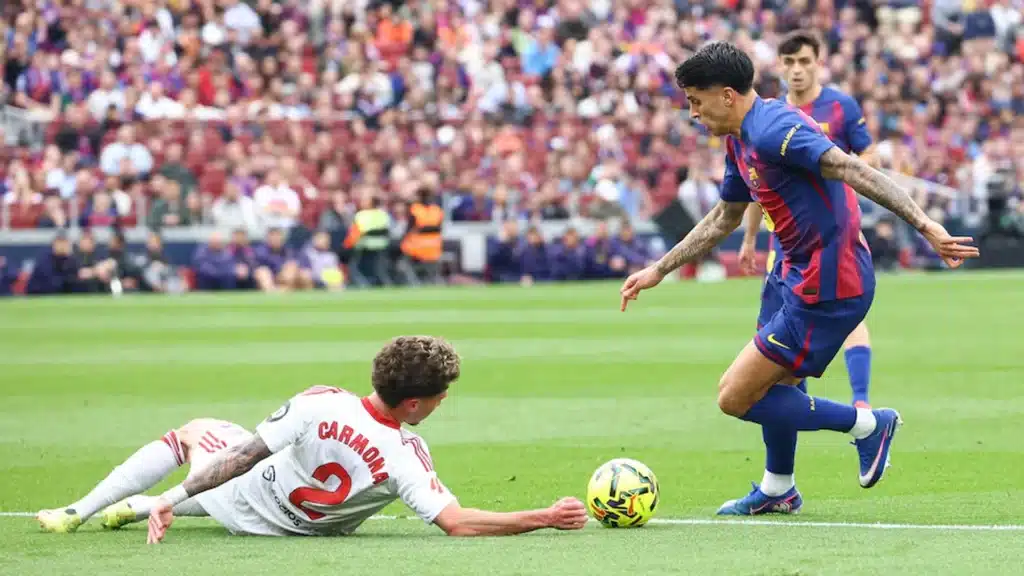
When one team gets two penalties inside the opening 21 minutes, the conversation almost always becomes emotional before it becomes analytical. That is exactly what happened after Barcelona’s win over Sevilla. On social media, many fans immediately argued that the referee had been too generous to Barça. But this is where the noise has to stop and the law has to begin.
For this type of analysis, the key question is not which club benefited. The only question that matters is whether the incidents meet the threshold for a penalty under Law 12. On the official record, Barcelona’s first penalty came from a foul on João Cancelo, while the second came after a VAR review for handball by José Ángel Carmona.
Incident 1: The foul on João Cancelo
The first penalty was awarded in the 8th minute. The official LaLiga match log says that João Cancelo drew a foul in the penalty area, and that the penalty was conceded by Djibril Sow after a foul in the area. Barcelona’s official match recap describes it as Sow’s tackle from behind on Cancelo.
Under IFAB Law 12, a direct free kick — and therefore a penalty inside the area — is awarded when a player trips, tackles, challenges or otherwise commits an offence involving contact in a manner considered careless, reckless or with excessive force. IFAB also states clearly that when the offence involves contact, it is penalised by a direct free kick.
TVV analysis
This is the stronger and simpler of the two decisions.
The official description gives us three important elements: there is a foul, it happens inside the box, and it is caused by a defensive challenge on Cancelo. The added description that the tackle came from behind makes the referee’s decision easier to defend, because those challenges usually leave very little room for a clean, legally controlled intervention once the attacker has gained position.
Could fans still call it soft? Of course. But “soft” and “wrong” are not the same thing. If the defender arrives late, makes contact and brings the attacker down or disrupts him carelessly, the law supports a penalty. Based on the official match record, that is the most reasonable reading of this incident.
Verdict on penalty 1
Right decision.
There is not much here to suggest a major officiating error. The first penalty fits comfortably within a standard Law 12 foul interpretation.

Incident 2: The José Ángel Carmona handball
The second penalty is the one that triggered the louder reaction. The official match log shows a VAR Decision: Penalty Barcelona at 18′, followed by the note that José Ángel Carmona conceded a penalty with a handball in the penalty area. Barcelona’s official recap also states that the second penalty arrived when Carmona handled the ball in his own area.
This is where the analysis gets more delicate, because handball decisions are not judged simply by whether the ball touches the arm. IFAB explicitly says that not every touch of the hand or arm with the ball is an offence. A handball becomes punishable when a player deliberately handles the ball, or when the hand or arm is in a position that makes the body unnaturally bigger and that position is not justified by the player’s body movement for that specific situation.
TVV analysis
This is not a penalty you judge by freeze-frame outrage alone.
The official record does not just say “handball”; it tells us the incident was checked and upgraded through VAR. That matters. It means the officiating team considered the contact significant enough, and the arm position punishable enough, to intervene and award the penalty. That does not automatically make the call perfect, but it does move it out of the category of random guesswork.
For handball incidents like this, the real refereeing questions are always the same: Was the arm away from the body? Did it block space the player had no right to cover? Was that arm position a natural result of movement, or did it make the body unnaturally bigger? Those are the Law 12 checkpoints that matter far more than a fan saying, “the ball just hit his hand.”
On the official information available, the safest and fairest conclusion is that the penalty is supportable, but not as clear-cut as the first one. The reason is simple: foul-contact penalties are usually easier to read from the match log, while handball judgments depend much more heavily on arm position, body shape and interpretation. Without a full replay package in the official written record, it would be too strong to call this an unquestionable decision. But it would also be too strong to call it a clear mistake. That conclusion is an inference from the official VAR award plus the wording of Law 12.
Verdict on penalty 2
Debatable, but supportable.
This is the penalty that fans will argue over longer, but there is not enough in the official record to confidently label it a wrong decision. Under the current handball law, a VAR-awarded penalty for punishable arm position is entirely defensible.
Why the online reaction became so extreme
Two early penalties in one match will always fuel conspiracy talk, especially when the team benefiting is Barcelona. But part of the reaction also comes from the type of incidents involved. The first is a classic contact foul. The second is handball — and handball remains the most emotionally interpreted area of modern officiating because the law depends on context, movement and arm position rather than a simple yes-or-no touch. IFAB’s wording itself explains why so many fans misunderstand these situations: contact with the arm alone is not enough.
That is why these discussions on X often become louder than they are accurate. People do not debate the law. They debate the freeze-frame they liked most.
Final TVV verdict
Barcelona’s first penalty against Sevilla looks like the correct decision. The foul threshold is met, the contact is acknowledged in the official record, and the description of a tackle from behind makes the award easy to defend. The second penalty is more controversial, but controversy alone does not make it wrong. Under Law 12, the handball decision remains debatable but supportable, especially because VAR reviewed the incident and still awarded the penalty.
So the final conclusion is this:
Barcelona were not handed two clearly wrong penalties.
Penalty 1: right.
Penalty 2: arguable, but not clearly incorrect.
