
England vs Uruguay Referee Analysis: Was the Late VAR Penalty the Right Call
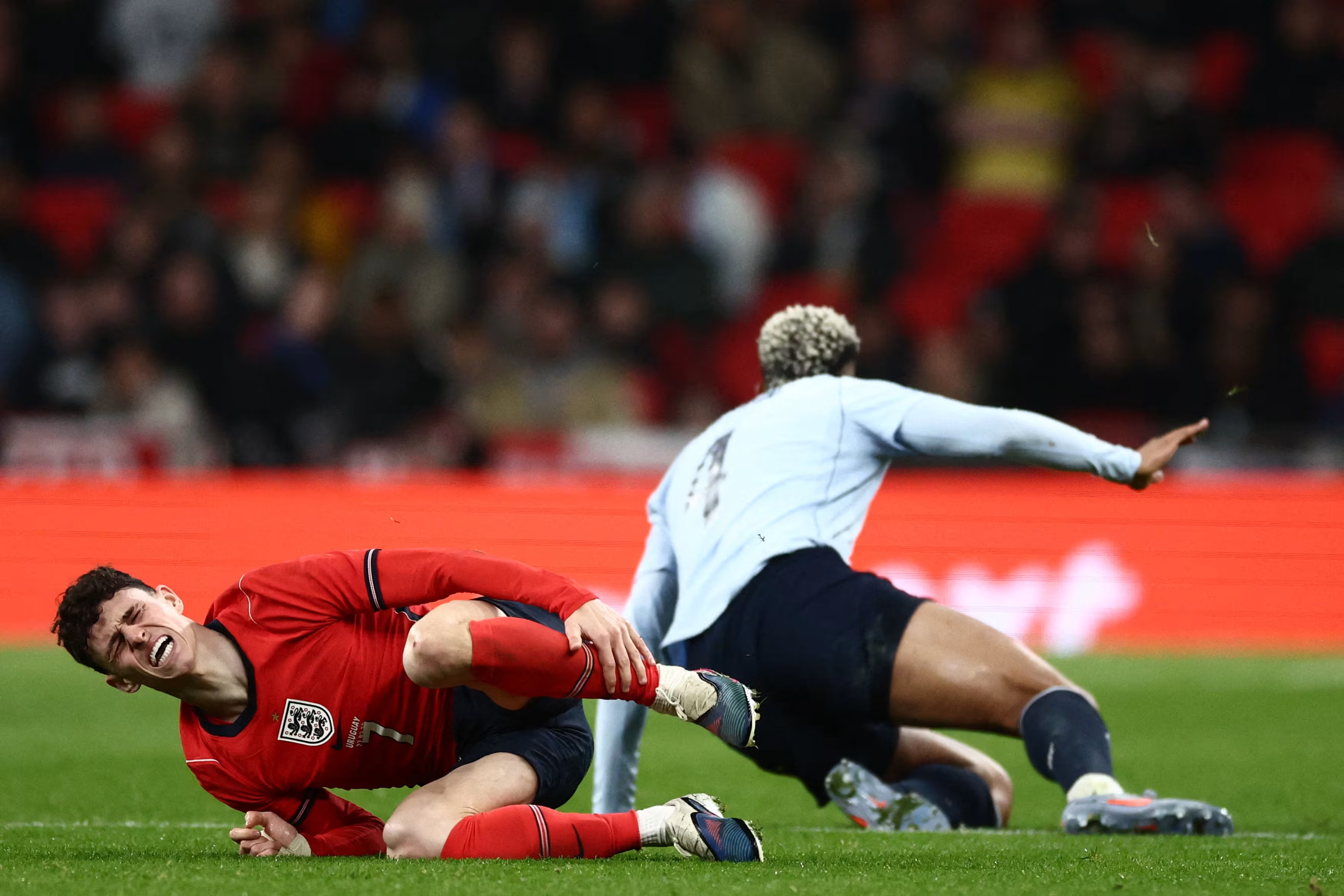
The England vs Uruguay referee analysis starts with one awkward truth: this was not a quiet officiating night. England looked set to win after Ben White scored on his return, only for Uruguay to equalise from a stoppage-time penalty converted by Federico Valverde after White was penalised for a foul. The match then carried an even stranger aftertaste because Manuel Ugarte appeared to receive two yellow cards without being sent off, while Thomas Tuchel also questioned why other incidents did not receive the same level of VAR attention. Sven Jablonski was the referee, with Sören Storks on VAR.
Quick Verdict
The late penalty looks harsh but supportable in law, yet the VAR intervention is more debatable than the final award itself. The Ugarte confusion may have been an administrative correction rather than a missed sending-off, but it was handled badly enough to damage trust in the officiating team.
England vs Uruguay referee analysis: what happened
England and Uruguay drew 1-1 at Wembley on 27 March 2026. White gave England the lead in the 81st minute, but Uruguay levelled deep into stoppage time after a VAR-assisted penalty decision. Sky Sports also reported that Ugarte was first booked for a foul on Cole Palmer in the 71st minute and then again for dissent after White’s goal, before officials later indicated that the earlier caution had in fact belonged to José María Giménez.
That sequence matters because it created two separate debates. One was the football debate: was the penalty really strong enough for VAR to get involved? The other was the credibility debate: if everyone in the stadium thinks a player has seen two yellows, the officials have to be absolutely clear and accurate in how they communicate the correction.
Why the late penalty was given
Under Law 12, a direct free kick or penalty is awarded for a careless trip, challenge or similar contact offence. IFAB’s wording is clear: if there is contact and the challenge is careless, the foul exists even if it is not especially dramatic.
That is why the final penalty decision is not impossible to defend. Reports from the match describe contact from White on the Uruguay attacker in stoppage time, and even critics of the decision largely framed it as soft rather than invented. From a pure law perspective, “soft” does not automatically mean “wrong.” If White clips the attacker and impedes him, a penalty can be awarded.
Where the criticism gets stronger is at the VAR threshold. IFAB allows VAR intervention for penalty/no-penalty situations only when there is a potential clear and obvious error. If the on-field referee had a good view, saw the contact, and judged it insufficient in real time, then overturning that decision requires a high bar. On the reporting available so far, this does not read like a stonewall miss. It reads more like a subjective penalty call that became a VAR penalty, and that is why the intervention feels more controversial than the law itself.
Why VAR could intervene — and why the night still felt inconsistent
This incident sat squarely inside VAR’s scope because penalty/no penalty is one of the four reviewable categories. Direct red-card incidents are also reviewable. What is not reviewable under the current 2025/26 protocol is an ordinary second-yellow decision. Mistaken identity, however, is reviewable if the wrong player was cautioned or sent off.
That distinction is important. If the officials’ eventual explanation was correct and the first caution was mistakenly attributed to Ugarte instead of Giménez, then the crew were entitled to correct the identity. But if that was the explanation, it needed to be handled far more cleanly and transparently than it was. Supporters, players and even broadcasters were left trying to work out whether they had just seen a player survive a second booking or a paperwork correction. Those are very different things.
The frustration from England’s side was also about inconsistency. Tuchel criticised the officiating after challenges on Phil Foden and Noni Madueke did not appear to receive the same level of intervention as the late penalty. A potential serious foul play incident is reviewable under VAR protocol, but without full replay evidence and without an official incident explanation, it would be reckless to declare those challenges definite missed red cards. What can be said is that the overall match management felt uneven.
Law context
Law 12 separates careless, reckless and excessive-force challenges. Careless fouls are penalised without a card, reckless challenges require a caution, and excessive force or a challenge that endangers an opponent’s safety becomes serious foul play and a red card. That framework matters here because the late penalty can be supportable as a careless foul, while the complaints about the Foden challenge clearly point toward the more serious end of the scale.
For the booking chaos, the key law-and-protocol point is this: a player must be sent off for receiving a second caution, but VAR’s role in 2025/26 is limited. It cannot re-referee second yellows as second yellows, yet it can help fix mistaken identity if the wrong player was booked. That is the narrow lane in which the Ugarte explanation makes sense.
Final verdict
The penalty itself was harsh but supportable. The bigger issue is that it did not obviously meet the standard of a VAR overturn if the on-field referee had already seen and judged the contact. On top of that, the Ugarte booking episode turned an already messy refereeing display into one that felt confused. This was not a case of football being ruined by one outrageous decision. It was a case of officiating losing authority because the threshold, the communication and the consistency all came under question at the same time.
Was the late penalty in England vs Uruguay the correct decision?
Probably supportable, yes, if the contact from Ben White is judged careless. The stronger argument is over whether VAR should have overturned the original on-field decision.
Why was Manuel Ugarte not sent off after two yellow cards?
The reported explanation was that one of the cautions initially thought to be Ugarte’s was actually for José María Giménez. If that is true, the issue was mistaken identity rather than a missed second yellow.
Can VAR review a second yellow card?
Under the current 2025/26 VAR protocol, no. VAR can review direct red cards and cases of mistaken identity, but not ordinary second-yellow decisions as second yellows.