
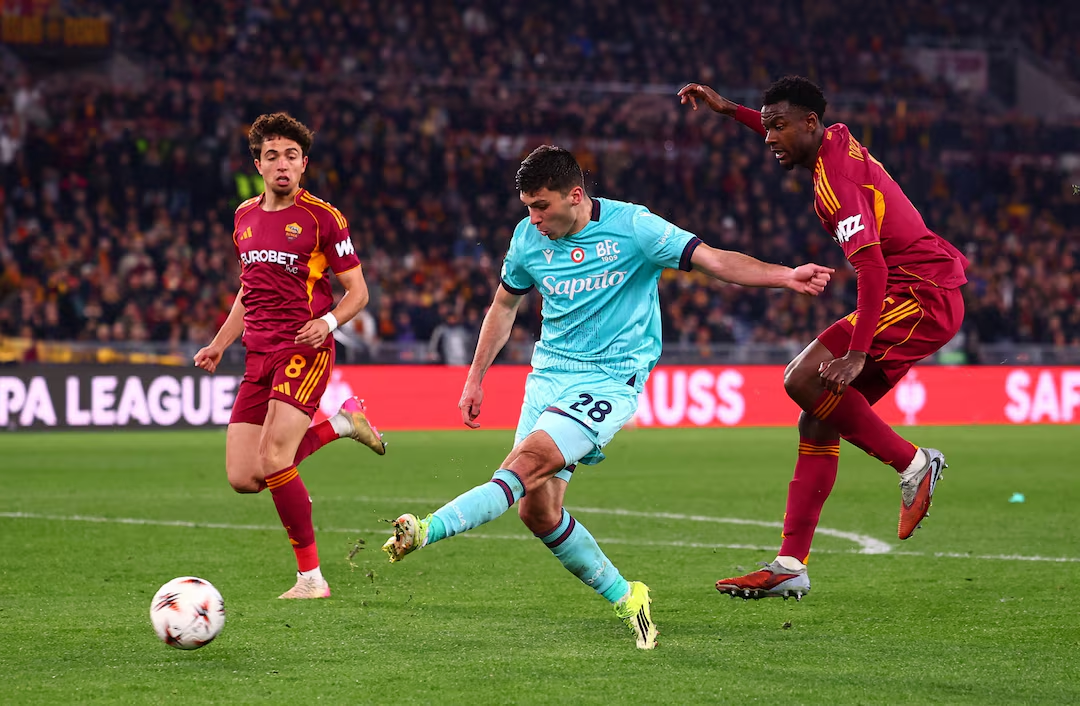
Thursday night in Europe gave us plenty of drama, but not every dramatic match was a refereeing scandal. On March 19, 2026, UEFA’s schedule featured seven Europa League round-of-16 second legs and eight Conference League round-of-16 second legs; the other Europa League second leg, Braga vs Ferencváros, had already been played on March 18. The heaviest officiating discussion came from Roma vs Bologna, Lyon vs Celta Vigo, Porto vs Stuttgart, and AEK Larnaca vs Crystal Palace.
Europa League
The most eventful refereeing performance in the Europa League came in Roma 3-4 Bologna (agg. 4-5 aet), where István Kovács had to handle two major penalty incidents. Public recaps agree that both spot-kicks were given on-field and then confirmed by VAR: the first for El Shaarawy’s contact on Zortea, the second for Freuler’s challenge on Robino Vaz. The first is the softer one and probably the one Roma supporters will dislike most, but based on the available reports it still sits in the supportable category rather than the clearly wrong one. The second looks stronger and cleaner as a penalty decision.
The night’s biggest debatable call was in Lyon 0-2 Celta Vigo, refereed by Irfan Peljto. Match commentary records a straight red for Moussa Niakhaté in the 19th minute and a late second yellow for Nicolás Tagliafico at 90+6. Reuters and ESPN both show how decisive that early dismissal was for the tie. From the public material I could verify, I would not label the Niakhaté red a proven error, but I also would not call it a universally accepted decision. It belongs in the harsh but defensible / debatable bracket, and it unquestionably changed the entire match.
In Porto 2-0 Stuttgart, Anthony Taylor had one major disciplinary moment: Nikolas Nartey was booked in the 76th minute and then shown a second yellow in the 77th for another foul on Pablo Rosario. That sequence makes this one much easier to assess. When a player commits two cautionable fouls in quick succession, the referee is usually being punished more for consistency than blamed for excess. This was not a controversy created by VAR; it was a player losing control of the moment.
In Midtjylland 1-2 Nottingham Forest, with Felix Zwayer in charge, the public reporting noted two disallowed Forest goals for offside before the tie went to penalties. Crucially, those reports described them as part of the match story, not as officiating scandals. Without official calibrated visuals in front of us, the fairest conclusion is that these were routine factual interventions, not the type of calls that should dominate the analysis.
The quieter Europa League ties matter too. Michael Oliver in Freiburg 5-1 Genk, Tobias Stieler in Real Betis 4-0 Panathinaikos, and Davide Massa in Aston Villa 2-0 Lille were not at the center of major public VAR arguments in the reporting I checked. That does not mean every whistle was perfect, but it usually does mean the officials kept the match in the background, which is often exactly what UEFA wants.
Conference League
The busiest Conference League performance came in AEK Larnaca 1-2 Crystal Palace (aet) under Aliyar Aghayev. This is the match where the officiating team deserves credit. Enric Saborit’s second yellow for pulling back Ismaïla Sarr was standard and supportable. Later, VAR correctly overturned the late penalty that had been awarded against Jean-Philippe Mateta, because replays showed the ball hit his thigh/hip rather than his hand. Then VAR intervened again to upgrade Petros Ioannou to a red card after his challenge on Mateta. That is exactly the kind of VAR usage supporters ask for: quick, corrective, and tied to meaningful decisions.
The rest of the Conference League card was much quieter from a refereeing point of view. The appointed referees were Andris Treimanis for Mainz vs Sigma Olomouc, Juan Martínez Munuera for Raków vs Fiorentina, Simone Sozza for AEK Athens vs Celje, Sander van der Eijk for Shakhtar vs Lech Poznań, Srđan Jovanović for Sparta Praha vs AZ Alkmaar, Sascha Stegemann for Rayo Vallecano vs Samsunspor, and Mykola Balakin for Strasbourg vs Rijeka. UEFA’s official round-up highlighted Mikael Ishak’s penalty for Lech and the key turning points in the other ties, but there was no major wave of public VAR outrage around those matches. In a round this busy, that is a sign most of the officiating was solid rather than suspicious.
Verdict
So what is the real refereeing takeaway from March 19? Roma-Bologna was eventful but largely supportable. Porto-Stuttgart was more about player indiscipline than referee controversy. AEK Larnaca-Crystal Palace was a strong example of VAR fixing important late decisions. The one tie that still belongs in the real debate pile is Lyon-Celta Vigo, where the early Niakhaté red was severe enough to define the whole contest and will keep dividing opinion. That is the difference between a dramatic night and a bad one for officiating: there were arguments, yes, but there were also several moments where the referee teams looked calm, coherent and, in the biggest Palace incident, plainly right.

0 Comments
Join the conversation with respect. Comments are moderated and must follow our community rules.
Want to join the discussion?
Please log in or create an account to comment and reply. This keeps the conversation cleaner and safer.