
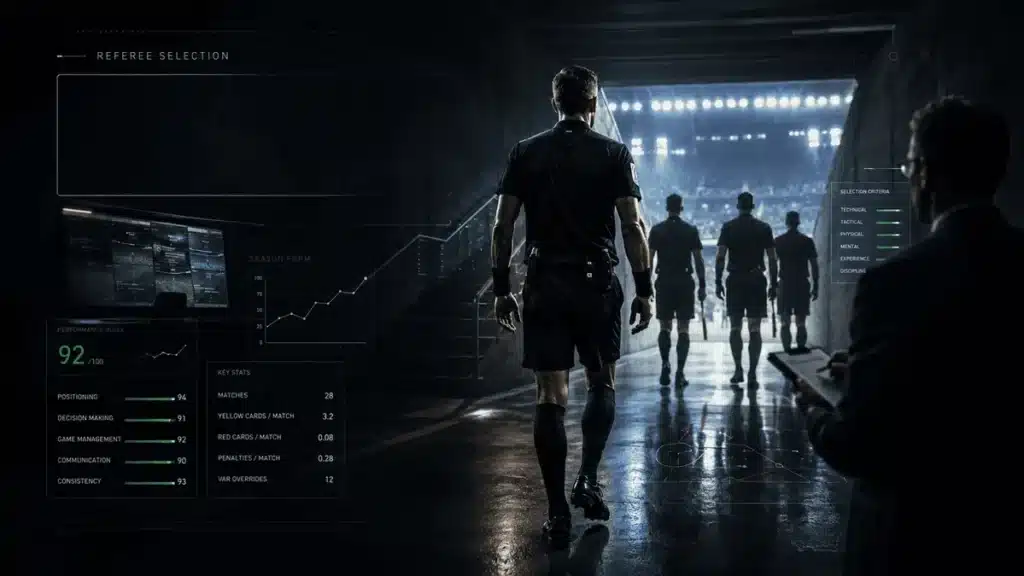
Every time UEFA announces referee appointments for a Champions League semi-final or FIFA reveals a World Cup referee list, the same debate returns. Why do certain referees keep receiving the biggest matches? Fans often focus on controversial moments, disputed penalties or VAR decisions. But inside UEFA and FIFA, elite referee appointments are based on a far more detailed evaluation system that most supporters never see. Modern football officiating is no longer judged only by whether one decision was right or wrong. It is judged by consistency, psychology, communication, fitness, VAR management and trust built over multiple seasons.
The Biggest Myth About Referee Appointments
One controversial moment does not automatically destroy a referee’s standing inside UEFA or FIFA. Likewise, one perfect match does not suddenly make a referee elite. Football supporters naturally remember:
- penalty controversies
- red cards
- VAR incidents
- emotionally charged moments
But referee departments evaluate matches very differently. A referee can receive criticism online while still earning a strong internal assessment if:
- the overall control of the match was stable
- disciplinary management was consistent
- VAR procedures were correct
- communication was effective
- positioning and teamwork were strong
That difference between public reaction and internal evaluation is one of the least understood parts of modern officiating.
1. Match Control Is One of the Most Important Factors
UEFA prioritises referees who can manage emotionally difficult matches without losing authority. That includes:
- controlling player behaviour
- calming confrontations
- managing pressure from crowds
- handling tactical fouls
- maintaining consistency under stress
Top-level referees are expected to prevent chaos, not simply react to it. This is why some referees continue receiving elite matches even after controversial incidents. UEFA may still believe the referee maintained overall control of a highly difficult game.
2. VAR Understanding Is Now Essential
Modern elite referees must work naturally within the VAR system. Under IFAB protocol, VAR can only intervene for:
- goals
- penalties
- direct red cards
- mistaken identity
And even then, only for a “clear and obvious error.” This means referees are evaluated not only on decisions themselves, but also on:
- delaying whistles correctly
- allowing attacking phases to continue
- communication with VAR officials
- calmness during reviews
- understanding intervention thresholds
A referee who constantly creates unnecessary VAR situations is unlikely to gain long-term trust.
Why VAR Cannot Intervene in Every Controversy
One of the biggest misunderstandings in football is the belief that VAR can correct every debatable moment. It cannot. Many decisions remain subjective within the IFAB Laws of the Game:
- handball interpretation
- foul intensity
- physical contact
- disciplinary thresholds
If a decision is supportable within the laws, VAR may decide not to intervene even if fans strongly disagree. That distinction is critical in UEFA and FIFA evaluations.
Law Context
The IFAB Laws of the Game intentionally leave certain decisions interpretational. UEFA also provides internal guidance on:
- handball application
- physical tolerance
- delaying the whistle
- tactical fouls
- intervention standards for VAR
This means referees are judged not only on the final decision, but also on whether they applied current UEFA guidance correctly.
3. Psychological Stability Matters More Than Fans Realise
Elite football matches create enormous pressure. UEFA and FIFA highly value referees who:
- remain calm under abuse from players and crowds
- avoid emotional reactions
- communicate confidently
- maintain authority in hostile environments
A referee may technically know the laws perfectly but still struggle psychologically at elite level. This is one reason FIFA places major importance on personality and emotional control during tournament selection.
4. Physical Fitness and Positioning Are Constantly Monitored
Top refereeing is physically demanding. UEFA tracks:
- sprint numbers
- acceleration
- recovery runs
- positioning angles
- proximity to incidents
Being five metres closer to an incident can completely change the accuracy of a decision. Modern elite referees are expected to maintain world-class fitness levels throughout the season.
5. Referee Observers Play a Huge Role
After every major UEFA match, a referee observer submits a detailed internal report. These reports evaluate:
- key decisions
- disciplinary consistency
- VAR teamwork
- communication
- positioning
- game management
- application of UEFA instructions
These internal reports often matter far more than television debate or social media reaction. Most fans never see these evaluations, but they heavily influence future appointments.
6. FIFA Also Thinks About Long-Term Tournament Cycles
For tournaments like the 2026 FIFA World Cup, FIFA is not only selecting referees for one match. It is building a tournament group capable of handling:
- global pressure
- multilingual communication
- VAR teamwork
- knockout-stage intensity
- media scrutiny
Age profile also matters. FIFA regularly transitions between generations of referees to prepare officials for future international cycles.
João Pinheiro Is One Example of This Process
João Pinheiro is one example of how UEFA evaluates referees differently from public perception. Some of his biggest matches generated debate among fans and media. Yet UEFA has continued trusting him with major appointments because the internal evaluation process includes far more than one controversial moment. That does not automatically mean every decision was correct. It simply shows that elite referee selection is based on broader criteria than many supporters realise. The same logic applies to numerous referees across Europe and international football.
Final Verdict
UEFA and FIFA do not choose referees based purely on reputation, popularity or one controversial incident. Elite appointments are built around:
- long-term consistency
- match control
- VAR understanding
- psychological stability
- communication
- fitness
- observer reports
- trust under pressure
That is why referee selections sometimes surprise fans. Football supporters usually judge moments. UEFA and FIFA judge entire careers, behavioural patterns and long-term reliability at the highest level of the game.

0 Comments
Join the conversation with respect. Comments are moderated and must follow our community rules.
Want to join the discussion?
Please log in or create an account to comment and reply. This keeps the conversation cleaner and safer.