
Fede Valverde Red Card Appeal Answered: Why Real Madrid’s Derby Protest Failed
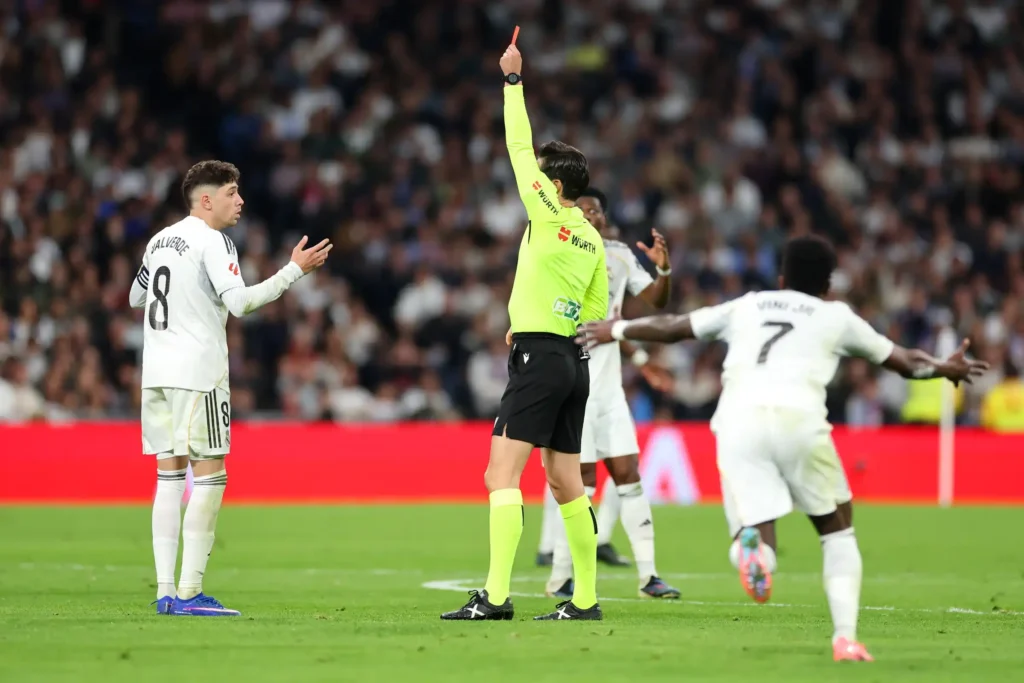
The Fede Valverde red card appeal has now been answered, and the official response is clear: Real Madrid’s challenge failed. After Valverde’s late dismissal in the 77th minute of the 3-2 derby win over Atletico Madrid on March 22, the RFEF’s disciplinary committee imposed a one-match suspension, and the Appeal Committee later upheld it.
Quick Verdict
Supportable red card. Harsh in optics, but not wrong in law.
That is the cleanest reading of this one. The challenge may not have looked like the wildest red card of the season, but once the referee judged excessive force and no realistic chance of playing the ball at the point of contact, the decision sat inside serious-foul-play territory rather than outside it. The appeal outcome reflects that.
What happened in Real Madrid vs Atletico
Valverde, who had earlier scored in the derby, was sent off by referee José Luis Munuera Montero for his challenge on Álex Baena in the closing stages at the Bernabéu. The VAR for the match was Daniel Jesús Trujillo Suárez. Real Madrid still held on to win 3-2, but they had to survive the final stretch with 10 men, and Atletico came close to equalising late on.
Fede Valverde red card appeal: why it failed
This is where the story moved from controversy to official resolution.
First, the RFEF disciplinary committee rejected Real Madrid’s attempt to overturn the dismissal, saying the video evidence did not prove a manifest factual error in the referee’s report. It kept the red card in place and imposed a one-match ban under article 130.1 of the RFEF disciplinary code.
Then the Appeal Committee went further and closed the door on the case. Its decision said there was still no manifest error in the report and that, even if the ball was not within playing distance at the exact moment of impact, the challenge still happened in the course of a live phase of play and fit the same disciplinary framework. In other words, Madrid did not show that the referee’s core reading of the incident was clearly false.
That matters, because appeal bodies in these cases are not there to re-referee every tackle from scratch. They look for a clear factual contradiction, not merely a different football opinion. And the official bodies decided the footage did not contradict the report strongly enough to erase the red.
Why VAR could not intervene
This is the part many supporters still get wrong.
Under the IFAB VAR protocol, VAR can review a direct red card situation, but only to correct a clear and obvious error or a serious missed incident. It is not there to re-officiate every borderline red-yellow debate.
Spain’s refereeing committee later backed both parts of the process: the on-field red card and the VAR decision not to send Munuera Montero to the screen. Its explanation was that the point of contact, the nature of the action and the intensity were compatible with serious foul play, so there was no clear and obvious error to fix.
That is the crucial point. Once the referee has seen the challenge and judged it as excessive-force serious foul play, VAR does not step in just because another referee, pundit or fan might have preferred yellow. It intervenes only if red is clearly wrong. The official review said it was not clearly wrong.
Law context
IFAB Law 12 is straightforward on the principle. A tackle or challenge that endangers the safety of an opponent or uses excessive force must be punished as serious foul play, which means a red card. The law also makes clear that a late lunge from behind can reach that threshold if the force and danger are high enough.
That does not mean every late challenge from behind is automatically red. It means the referee must judge the contact, the force, the chance of playing the ball, and the danger created. In this case, the official review bodies consistently landed on the red-card side of that line.
Was the red card actually correct?
From an officiating analysis perspective, the fairest description is this: the red card was supportable, even if some viewers will still see it as severe.
Why supportable? Because the official record of the incident rests on three connected ideas: Valverde arrived late, the ball was not realistically playable at the moment of the kick, and the contact was judged to involve excessive force. That combination is exactly why the incident survived not only the live decision, but also the VAR check, the disciplinary review and the appeal.
Why do some people still dislike it? Because in real time it can look more like an aggressive stopping foul than a classic horror tackle. There was debate over whether the visual severity matched a straight red. That is a fair football discussion. But a decision can look harsh and still remain legally defensible under Law 12. This feels like one of those cases.
Impact on the match
The dismissal changed the ending of the derby even if it did not change the result. Real Madrid had to protect a one-goal lead with 10 men, and Atletico nearly punished them, with Julián Álvarez hitting the post late on before Madrid saw out the 3-2 win. So the red card mattered immediately, and the failed appeal now means the incident also carries a domestic suspension.
Final verdict
The noise around this incident was always going to be huge because it involved Real Madrid, Atletico, a one-goal game and a straight red in a derby. But once the appeal process is stripped back to the essentials, the conclusion is fairly strong.
This was not a scandalous dismissal overturned by common sense. It was a harsh-looking but supportable red card that survived every level of official review. VAR did not intervene because protocol does not exist to replace one arguable football judgement with another. It exists to correct obvious mistakes, and the authorities ruled this was not one.
FAQ
Was Fede Valverde’s red card appeal accepted?
No. The RFEF Appeal Committee rejected Real Madrid’s appeal and confirmed the one-match suspension.
Why was Fede Valverde sent off against Atletico Madrid?
Referee José Luis Munuera Montero dismissed Valverde for a challenge on Álex Baena that was recorded as a kick on an opponent with excessive force while the ball was not within playing distance.
Why did VAR not overturn the decision?
Because VAR only intervenes on direct red cards for a clear and obvious error. Spain’s refereeing committee later said the contact, nature of the action and intensity were compatible with serious foul play, so no intervention was required.
Was the red card wrong under IFAB Law 12?
Not on the available official reasoning. Law 12 allows a red card for serious foul play when a challenge endangers an opponent’s safety or uses excessive force, and the official reviews all backed that interpretation here.