
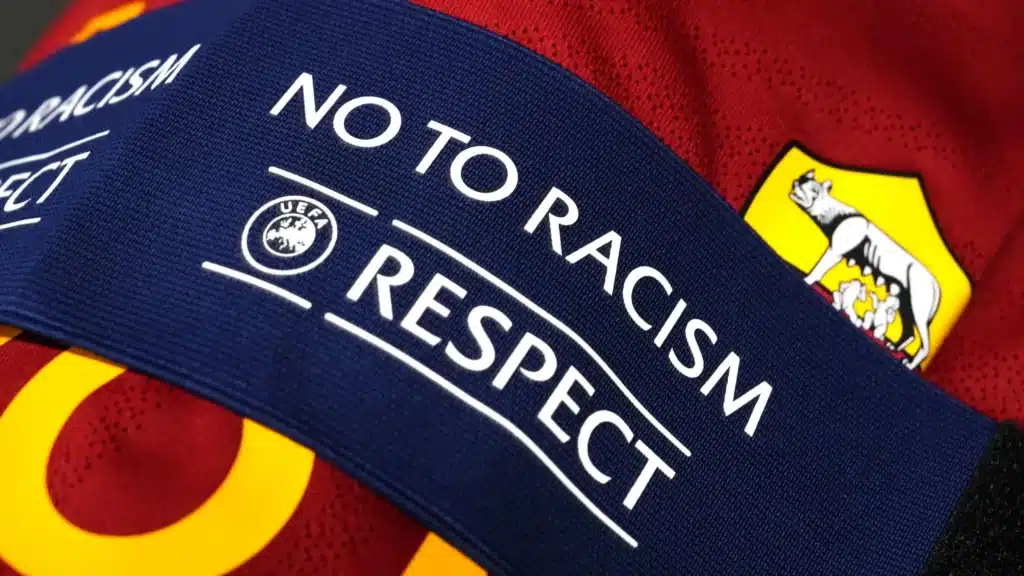
Racism in Football: What Referees Can Do and How They Can Help Stop It
Racism in football is not a side issue anymore. In recent weeks alone, referee Anthony Taylor paused Newcastle United vs Sunderland after reported racist abuse aimed at Lutsharel Geertruida, Iosu Galech Apezteguia halted Espanyol vs Elche after Omar El Hilali accused Rafa Mir of a racist insult, and François Letexier activated the anti-racism protocol after Vinícius Júnior reported an alleged slur during Benfica vs Real Madrid. Three different matches, three different contexts, one common truth: when racism appears, the referee is not there to look away and let the game roll on.
Quick Verdict
The referee’s first job in a racism incident is not to solve the entire case on the spot. It is to protect the targeted player, stop the match if needed, activate the protocol, and create an official record strong enough for authorities to act on later. On that standard, recent interventions by Taylor, Galech Apezteguia and Letexier were supportable and necessary.
What happened in the recent incidents
At St James’ Park on 22 March 2026, Anthony Taylor paused Newcastle vs Sunderland after a report of racist abuse directed at Sunderland defender Lutsharel Geertruida. The Premier League confirmed the anti-discrimination protocol had been followed and opened an investigation. The match resumed, but the incident changed the atmosphere of the derby and became one of the defining talking points of the afternoon. That immediate pause was the right call. Once a player reports racist abuse from the crowd, the referee has to move the match from normal game management to anti-discrimination procedure.
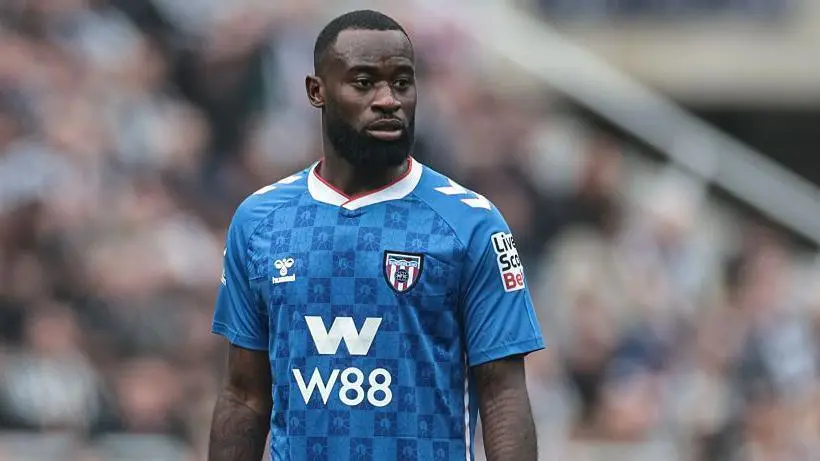
In Espanyol vs Elche on 1 March 2026, Iosu Galech Apezteguia stopped play after Omar El Hilali accused Rafa Mir of a racist insult. The referee’s report made an important point: the allegation was reported to him, but the refereeing team did not directly hear the words. That matters because it explains why activating the protocol could be correct while an immediate send-off remained less certain. The stoppage was right; the evidence for an on-the-spot red card was far less clear.
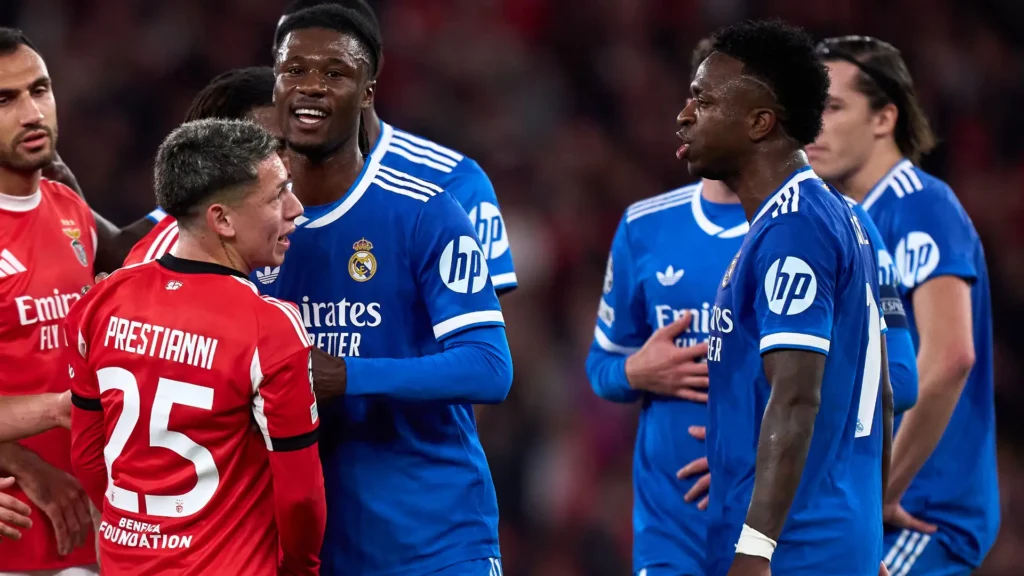
Then came Benfica vs Real Madrid on 17 February 2026. After Vinícius Júnior reported an alleged racist slur from Benfica’s Gianluca Prestianni, François Letexier crossed his arms to signal the anti-racism protocol and halted the match for several minutes. Prestianni denied the allegation, UEFA opened an investigation, and the case moved beyond the 90 minutes. That is exactly why the referee’s intervention matters: not because he can prove everything instantly, but because he can refuse to let the incident disappear into the noise of the match.
There is also a longer backdrop here. In the 2023 Valencia vs Real Madrid match, Vinícius pointed out racist abuse from the stands and the game was halted for several minutes, but the debate afterward was whether stronger intervention should have come earlier. In June 2024, three Valencia fans were convicted for racist abuse against Vinícius in what Reuters described as a first criminal conviction in Spain for racism inside a football stadium. That case showed why official reporting and visible intervention on the day matter long after the final whistle.
Why the referee’s role matters so much
Referees cannot eliminate racism by themselves. They do not control crowd culture, police investigations, federation discipline or criminal prosecutions. But they do control the one thing that matters most in the moment: whether football stops pretending nothing happened. That is not a small power. It is the central one.
Law 5 gives the referee full authority to enforce the Laws of the Game and control the match. Law 12 goes further: using offensive, insulting or abusive language and/or actions is punishable, and can amount to a sending-off offence. In other words, the game already gives referees the legal basis to act when racist conduct comes from a player or team official.
Where the abuse comes from the crowd, the referee’s role becomes procedural as much as disciplinary. UEFA’s long-standing guidance is clear: stop the match, suspend it if the abuse continues, and abandon it as a last resort. FIFA has now reinforced that framework with the No Racism gesture, in which players can cross their hands at the wrists to signal racist abuse and trigger the three-step anti-discrimination procedure.
Why VAR could not always intervene
This is the part many fans still get wrong.
VAR is not a universal justice machine. Under the IFAB VAR protocol, it is limited to four categories: goal/no goal, penalty/no penalty, direct red card, and mistaken identity. That means racist abuse from the crowd is not something VAR can “fix” in the ordinary sense. VAR cannot identify a chanting section, force a stadium announcement, or replace the referee’s anti-discrimination procedure.
Where VAR can matter is narrower. If a player or team official commits conduct that amounts to a direct red card for offensive, insulting or abusive action, VAR may assist. But even there, the practical problem is obvious: cameras may show confrontation without proving the exact words spoken. In cases like El Hilali-Mir or Vinícius-Prestianni, the referee may be right to stop play and activate the protocol, while still lacking enough immediate evidence for an in-game dismissal. That is not weakness. That is the difference between protective intervention and final proof
Law context
Law 5: the referee has full authority to enforce the Laws and control the match.
Law 12: offensive, insulting or abusive language and/or actions are punishable and can justify a send-off.
UEFA guidance: stop, suspend, abandon if racist behaviour persists.
FIFA framework: use the No Racism gesture and trigger the three-step procedure. FIFA has also pushed to make racism a specific disciplinary offence across its member associations.
So the referee is not working in a legal vacuum. The framework exists. The harder question is whether it is applied quickly enough and firmly enough.
What referees can do better
The first improvement is speed. Too often, football waits for confirmation that would satisfy a courtroom before taking a match-control decision. That is the wrong standard. The referee does not need a final verdict before acting. He needs a credible report, a controlled environment, and the courage to prioritise the targeted player over the flow of the game. The recent cases involving Taylor, Galech Apezteguia and Letexier all point in that direction.
The second is visibility. A clear stoppage, a clear gesture, a clear announcement and a clear report matter. They tell players, staff, supporters and broadcasters that this is not being treated as routine background noise. That public clarity is part of the punishment. It strips away the old football habit of minimising abuse until after the match.
The third is accuracy in reporting. A strong referee report does not need invented certainty. In fact, it is better when it is precise about what was heard, what was reported, who informed the referee and what action followed. Galech Apezteguia’s handling of the El Hilali allegation is a useful example of that distinction between an allegation reported in real time and evidence personally heard by the officiating team.
And the fourth is escalation. If the abuse continues, the game should not drift forward out of convenience. UEFA’s procedure exists for a reason. Football cannot keep claiming zero tolerance while treating abandonment as a theoretical option that never arrives.
Final verdict
Referees cannot end racism in football on their own. That would be asking the whistle to fix a social failure. But they can do something crucial: they can make racism impossible to ignore in real time.
That is the real role of the referee here. Stop the match. Protect the player. Trigger the protocol. Use Law 12 where the offender is on the pitch. Write the report that keeps the case alive after the stadium empties.
VAR has limits, and those limits must be understood clearly. It can help with a narrow red-card question. It cannot clean the stands or hear every word. But the referee still has the authority to act, and modern football has already given him the legal pathway to do it.
The balanced verdict is this: when racism appears, the best referees do not wait for perfect certainty. They intervene early, visibly and responsibly. That will not solve everything. But it is where accountability starts.
FAQ
Can a referee stop a football match for racism?
Yes. FIFA’s anti-discrimination framework and UEFA guidance allow the referee to stop the match, suspend it, and ultimately abandon it if racist abuse continues.
Can VAR intervene in racism incidents?
Only in limited cases. VAR can assist on direct red-card matters, including offensive, insulting or abusive actions, but it is not a general tool for crowd abuse or every verbal allegation.
Can a player be sent off for racist language?
Yes. Under IFAB Law 12, offensive, insulting or abusive language and/or actions are punishable and can justify a send-off.
What should a referee do if he did not personally hear the insult?
He can still activate the anti-racism procedure based on a credible report from a player or official, stop play, document the incident and allow disciplinary bodies to investigate further. Recent cases in England, Spain and Europe show exactly that approach.
Is stopping the match enough?
No. The stoppage is only the first step. Real progress depends on accurate reports, federation discipline, stadium action, club responsibility and, where appropriate, criminal sanctions.

0 Comments
Join the conversation with respect. Comments are moderated and must follow our community rules.
Want to join the discussion?
Please log in or create an account to comment and reply. This keeps the conversation cleaner and safer.