
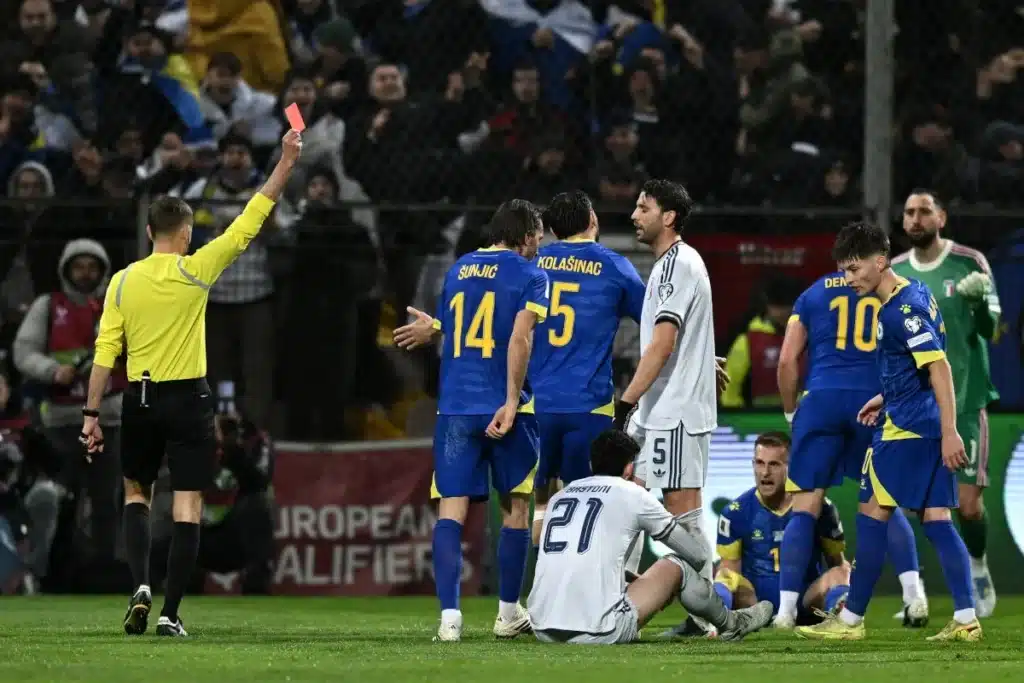
The March 31 European World Cup play-off finals delivered exactly the kind of night you would expect from winner-takes-all football: late goals, extra time, penalties and one giant collapse. Bosnia and Herzegovina knocked out Italy after a 1-1 draw and a 4-1 penalty shootout, Sweden beat Poland 3-2 in Solna, Türkiye edged Kosovo 1-0 in Pristina, and Czechia came through 3-1 on penalties after a 2-2 draw with Denmark in Prague. The four games were handled by Clément Turpin, Slavko Vinčić, Michael Oliver and Maurizio Mariani respectively.
From a refereeing angle, this was not one of those nights where every match turned into a VAR argument. In truth, one decision towered over the rest: Alessandro Bastoni’s first-half red card for Italy in Zenica. The other three finals were high-pressure matches, but the public record around them points far more toward football drama than officiating controversy.
Bosnia and Herzegovina vs Italy: Bastoni red card was the night’s defining call
Italy led through Moise Kean in the 15th minute, but Bastoni was sent off in the 41st, Bosnia equalised through Haris Tabaković in the 79th, and the hosts then won the shootout 4-1. ESPN’s event log shows the foul on Amar Memić and the direct red at 41 minutes, while AP and other match reports identify Bastoni as the player dismissed in the act of stopping a dangerous Bosnia attack.
On the available evidence, that red card looks right. Public descriptions of the incident say Memić was racing onto a poor Italian goal-kick return, with Bastoni the last defender and making a desperate slide from behind or alongside as the Bosnia player moved toward goal. Under IFAB Law 12, the referee must consider distance to goal, general direction of play, likelihood of control and the location and number of defenders when judging DOGSO. Those criteria point strongly toward a send-off here. Even without every television angle, the description is very hard to square with anything other than denying an obvious goalscoring opportunity.
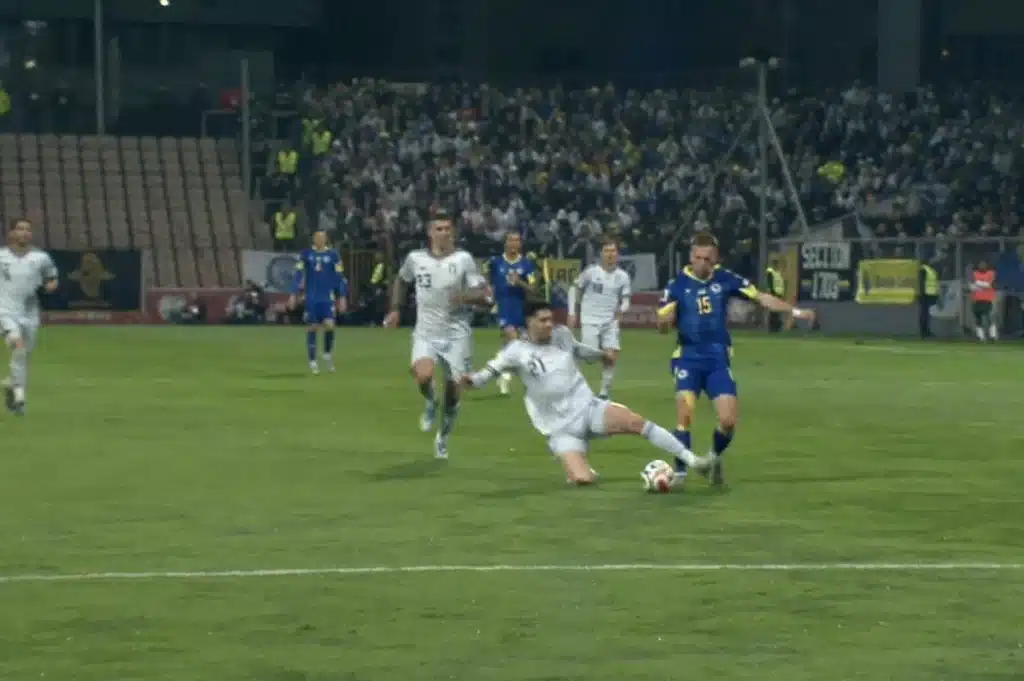
There was also a Bosnia penalty appeal mentioned in live coverage, but this is exactly where an analyst has to stay honest. Without a full replay pack or a detailed official explanation, there is not enough solid public evidence to call that a clear miss. The better verdict is uncertainty, not forced certainty.
So the Bosnia-Italy takeaway is simple: the biggest decision of the night was also the easiest one to defend. Turpin’s red changed the match, but changing the match is not the same thing as getting it wrong. On balance, this looks like the correct application of Law 12.
Sweden vs Poland: big match, but not a big refereeing scandal
Sweden beat Poland 3-2 with goals from Anthony Elanga, Gustaf Lagerbielke and Viktor Gyökeres, while Nicola Zalewski and Karol Świderski scored for Poland. Vinčić refereed, with Christian Dingert on VAR. Reuters and ESPN both frame the game as a chaotic, end-to-end playoff rather than a night dominated by officiating disputes.
The main officiating moment in the public record is the set piece that led to Sweden’s second goal just before half-time. ESPN’s commentary shows a foul at 43 minutes, a yellow card in the same phase, and Lagerbielke’s header at 44. The Guardian’s report also describes Poland conceding from a foul in that sequence. On what is publicly available, there is no strong basis to say the free kick should not have been awarded, and there was no major VAR correction attached to the goal.
Beyond that, the public logs do not show a penalty decision, a red-card flashpoint or a disallowed goal that changed the whole narrative. That matters. Sometimes the right verdict is that the referee did not become the story. For all the noise around the game itself, Sweden-Poland looks more like a football thriller than a refereeing controversy.
Kosovo vs Türkiye: little evidence of a major miss
Türkiye qualified with a 1-0 win through Kerem Aktürkoğlu’s 53rd-minute goal, with Michael Oliver in the middle and Carlos del Cerro Grande on VAR. Reuters, AP and ESPN all tell essentially the same story: Kosovo had a real chance before the break, Türkiye found the breakthrough early in the second half, and the match finished without a major VAR storm.
The public event log includes a couple of handball entries and a handful of cautions, but none of them developed into the kind of widely reported penalty or red-card controversy that would justify a strong “wrong decision” verdict. AP’s recap of the winning goal describes it as Aktürkoğlu applying the final touch to Orkun Kökçü’s dangerous ball across goal, and there is no indication in the available reporting of an offside or attacking handball issue.
That does not mean every decision was perfect. It means there is no credible public case that the referee team materially got the decisive moments wrong. For The VAR Verdict, that is an important distinction. Kosovo-Türkiye was tense, but it was not especially controversial. The cleaner verdict is that Oliver had a difficult atmosphere, an intense game, and no obvious major officiating error on the public evidence.
Czechia vs Denmark: drama from penalties, not from officiating
Czechia and Denmark drew 2-2 after extra time before Czechia won the shootout 3-1. Pavel Šulc struck early, Joachim Andersen equalised, Ladislav Krejčí put Czechia back ahead in extra time, and Kasper Høgh forced penalties. Maurizio Mariani refereed, with Marco Di Bello on VAR.
The available timelines show a match shaped by set plays, pressure and missed penalties rather than by refereeing chaos. ESPN’s full event log shows no sending-off, no awarded penalty in normal or extra time, and no obvious game-defining VAR reversal. The Guardian’s live summary of the match is similar: the main talking points were the goals, Højlund’s miss in the shootout, Hermansen’s save and Jensen’s failed penalty, not a disputed decision from Mariani’s team.
That makes the verdict here fairly straightforward. When a 120-minute playoff ends with the conversation centred on missed kicks rather than on law interpretation, the referee has usually done enough to keep the match under control. Czechia-Denmark was high-stakes and tense, but there is no serious public evidence that officiating distorted the outcome.
The VAR Verdict
March 31 was not a night of widespread refereeing failure. It was a night where one enormous call, Bastoni’s red for Italy, shaped an entire playoff and looks justified under DOGSO principles. Around that, Sweden-Poland, Kosovo-Türkiye and Czechia-Denmark were decided more by finishing, set pieces, goalkeeper moments and nerve than by obvious refereeing mistakes.
So the honest overall verdict is this: one major decision, and probably the correct one. The rest of the night belonged mostly to the players. If The VAR Verdict is judging these four finals as a package, the officiating story is not one of scandal. It is one of a single red card that stands up, and three other matches where the referees largely stayed in the background, which is often the best compliment they can receive.

0 Comments
Join the conversation with respect. Comments are moderated and must follow our community rules.
Want to join the discussion?
Please log in or create an account to comment and reply. This keeps the conversation cleaner and safer.