
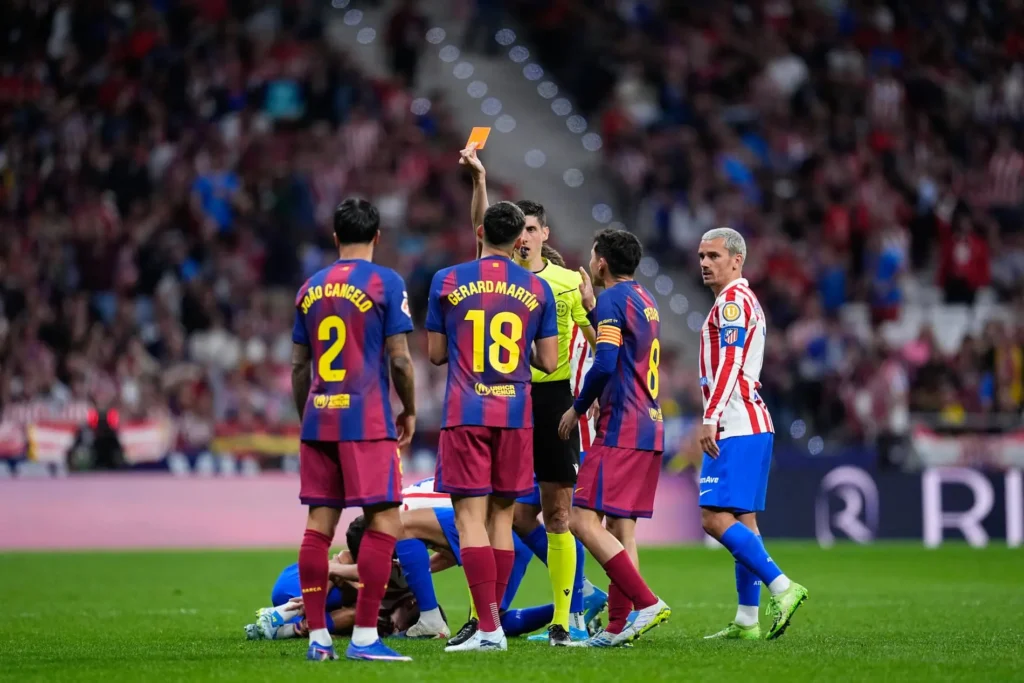
Barcelona’s 2-1 win away to Atlético Madrid will be remembered not only for its title significance, but for one refereeing moment that immediately split opinion: Gerard Martín’s cancelled red card. LaLiga’s official match log records the foul on Thiago Almada at 46′, the VAR check at 49′, and the final downgrade to a yellow card at 50′. Reuters’ match report also notes that Gerard Martín was initially shown red early in the second half before the punishment was changed after review.
The incident that changed the second half
At first glance, the red card did not feel surprising. The challenge looked ugly, the contact was clear, and Atlético immediately had a strong visual case to demand a dismissal. In real time, referee Mateo Busquets Ferrer went for the strongest sanction. But this is exactly the type of moment where modern officiating is supposed to slow the match down and separate emotional reaction from legal threshold. That is why the intervention from VAR Mario Melero López mattered so much.
The key point is that VAR is not there to re-referee every foul. It can intervene on direct red card incidents, including possible serious foul play, and the referee remains the final decision-maker after the review. IFAB is also clear that, after watching the replays, a referee can decide the offence is only cautionable and show yellow instead of red. In other words, the process itself was fully within protocol.
The official match officials and appointments
For the record, the official team for Atlético de Madrid vs FC Barcelona at the Riyadh Air Metropolitano on 4 April 2026 was as follows: Mateo Busquets Ferrer as referee, Íñigo Prieto López de Ceraín and Gonzalo García González as assistant referees, Manuel Pozueta Rodríguez as fourth official, Mario Melero López as VAR, and Javier Iglesias Villanueva as AVAR. The RFEF appointment sheet also lists Félix Sánchez as the official observer/informador.
That matters for analysis, because this was not a vague or unofficial controversy. It was a major LaLiga match handled by a fully designated top-flight crew, and the review later entered the RFEF’s official jornada 30 VAR audio release.
What the VAR audio tells us
The RFEF later published the jornada 30 VAR audios for Primera División, including Atlético de Madrid vs Barcelona. Reporting based on that release says Mario Melero López recommended an on-field review for a possible reversal, and the discussion centred on the idea that Gerard Martín was playing the ball in a normal action and that the follow-through contact happened in the natural dynamic of the play. Busquets Ferrer then cancelled the red card and showed yellow.
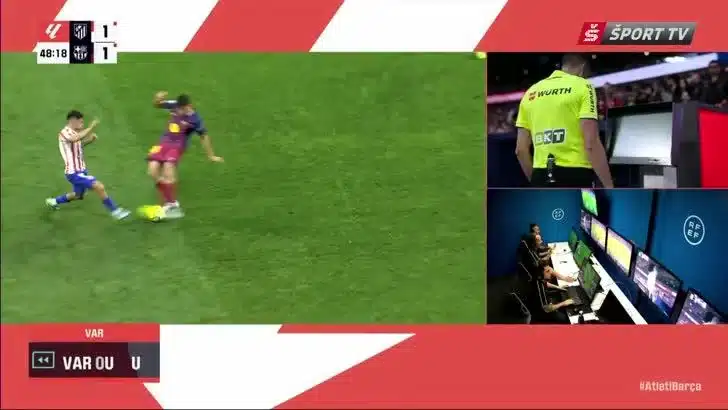
That audio is important because it tells us what the officials were actually judging. They were not saying there was no foul. They were deciding whether the action met the red-card threshold for serious foul play or whether it remained a reckless challenge deserving a caution. That is the entire case in one sentence.
What IFAB Law 12 says
IFAB Law 12 draws a clear line. A reckless challenge is one made with disregard to the danger or consequences for an opponent and must be cautioned. A challenge using excessive force, or one that endangers an opponent’s safety, must lead to a sending-off. Law 12 also states that a tackle or challenge that endangers the safety of an opponent or uses excessive force or brutality is serious foul play.
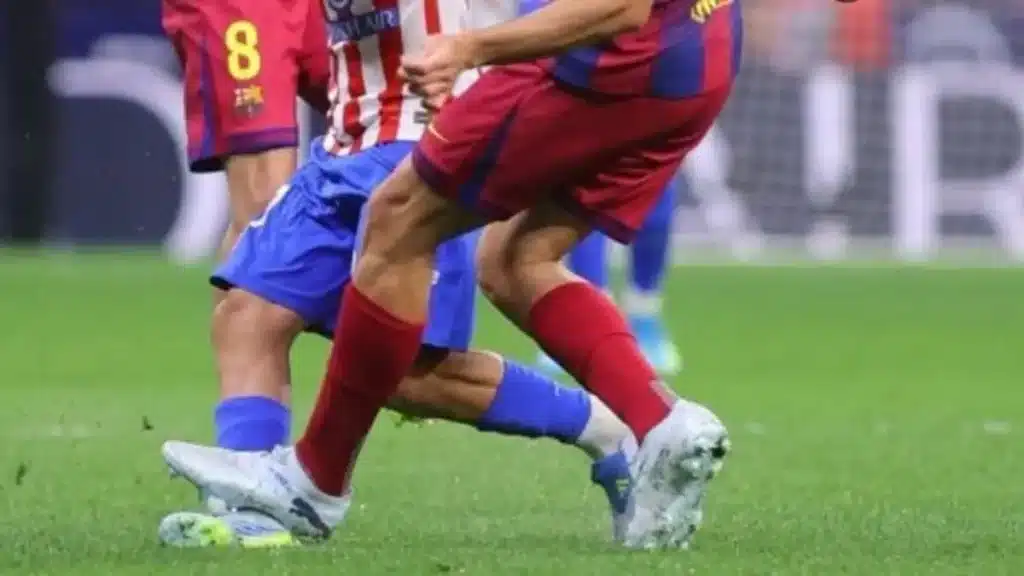
That distinction is why this incident is so divisive. Many supporters see studs and contact and go straight to red. But the law is not based only on the freeze-frame. Referees also judge the speed of the action, the player’s control, whether there is a lunge, whether the player is genuinely playing the ball, and whether the force rises from reckless into excessive.
The actual refereeing verdict
My view is that the downgrade to yellow is defensible, but it is not beyond debate.
The red-card argument is easy to understand. The contact zone is dangerous, the visual is bad, and in modern football these challenges often provoke strong serious-foul-play reactions. If a referee had stayed with red, many observers would have supported it on player-safety grounds alone. That part of the debate is real.
But the yellow-card argument is also strong, and it appears to be the one Busquets Ferrer and Melero López accepted. On the officials’ own reading of the play, Gerard Martín is challenging for the ball in a normal football action, gets the ball, and the step-on comes in the follow-through rather than as a separate lunge or stamp. Once you accept that reading, the offence moves closer to reckless than excessive. Under Law 12, that means caution, not dismissal.
That is why I would not describe this as a clear VAR mistake. I would describe it as a borderline serious-foul-play incident where the referee initially went red, the VAR believed the threshold had not truly been met, and the on-field review brought the decision back down to yellow. Whether everyone agrees is another matter. Whether the final call can be defended within the Laws is, for me, yes.
Where the criticism really belongs
The strongest criticism is not process. The process was correct. The strongest criticism is consistency.
Football supporters can accept difficult decisions more easily when the threshold feels stable from week to week. The problem in cases like this is that similar-looking contact is sometimes punished with red in one match and yellow in another. That is what fuels the anger around VAR far more than the technology itself. If Spanish officiating wants less noise around these moments, it needs not just reviews, but review outcomes that feel consistent across the season. That is partly an inference from the law-plus-protocol framework and from how these incidents are debated publicly, not a formal statement from RFEF.
Final verdict
Verdict: VAR intervention correct. Final yellow card defensible. Red card cancellation controversial, but not lawless.
Gerard Martín’s challenge against Atlético Madrid was a classic borderline case. The original red card was understandable in real time. The downgrade after review was also understandable once the officials judged the action as a normal play for the ball with a reckless follow-through rather than excessive force. For The VAR Verdict, that leaves one fair conclusion: the final outcome was arguable, but the referee and VAR can justify it under IFAB Law 12.

0 Comments
Join the conversation with respect. Comments are moderated and must follow our community rules.
Want to join the discussion?
Please log in or create an account to comment and reply. This keeps the conversation cleaner and safer.