
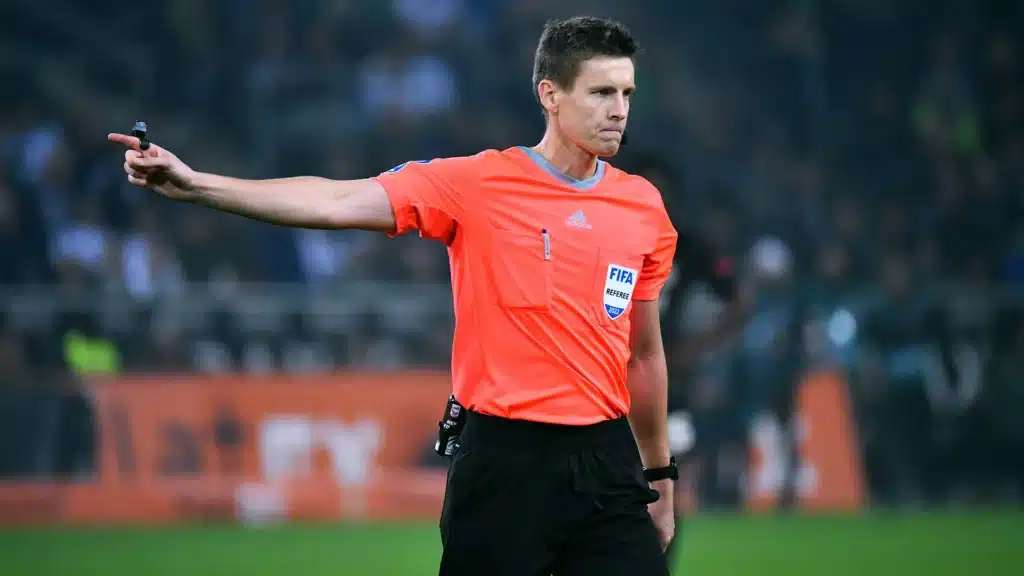
Arsenal vs Atlético Referee: Daniel Siebert Walks Into a Tie Already Burning
The Arsenal vs Atlético referee appointment is not just another UEFA assignment. Daniel Siebert will take charge of a Champions League semi-final second leg that already carries a heavy refereeing storyline: Arsenal feel they were denied a decisive penalty in Madrid, Atlético survived a major VAR review, and the tie arrives in London balanced at 1-1. Reuters reported that Danny Makkelie initially awarded Arsenal a late penalty for a challenge on Eberechi Eze, before overturning it after a VAR review.
That is why Siebert’s role matters.
This is not a match where the referee can hide behind flow, experience or reputation. Arsenal will expect a strong penalty-area threshold. Atlético will test every duel, every restart, every emotional moment. And VAR Bastian Dankert will need to understand the difference between correcting a clear error and re-refereeing a subjective call.
Quick Verdict
Daniel Siebert is a strong but high-risk appointment. He has the UEFA experience for this stage, and his recent Champions League numbers suggest he is not afraid to use cards when needed. But Atlético have a tense history with him, Arsenal arrive after a first-leg VAR controversy, and the biggest danger is not one isolated decision — it is match control.
Our early verdict: good appointment on paper, but only if Siebert sets the disciplinary line early and keeps VAR intervention strict.
Full Referee Team for Arsenal vs Atlético
Match: Arsenal vs Atlético Madrid
Competition: UEFA Champions League semi-final, second leg
Date: Tuesday, 5 May 2026
Venue: Emirates Stadium, London
Referee: Daniel Siebert, Germany
Assistant Referee 1: Jan Seidel, Germany
Assistant Referee 2: Rafael Foltyn, Germany
Fourth Official: Tobias Stieler, Germany
VAR: Bastian Dankert, Germany
AVAR: Robert Schröder, Germany
Law 5 – The Referee lists Siebert and a full German officiating team for the second leg at the Emirates.
Daniel Siebert’s Referee Statistics Before Arsenal vs Atlético
Siebert’s recent Champions League profile is clear: he is not a passive referee. Across his previous eight Champions League appointments this season, he has shown 37 yellow cards, two red cards and awarded one penalty, according to Sports Mole.
That matters because Arsenal vs Atlético is not expected to be a calm technical match. Atlético can slow the game, break rhythm and create emotional pressure. Arsenal will want tempo, clean possession and protection around their attacking players.
Team Record With Daniel Siebert
Arsenal under Siebert:
Arsenal have won all three matches Siebert has refereed involving them, including matches against Olympiacos, Dinamo Zagreb and Sporting CP.
Atlético under Siebert:
Atlético have not beaten English opposition in matches refereed by Siebert, with defeats against Liverpool and Tottenham, plus a 0-0 draw with Manchester City.
This does not prove bias. Referee-team records should never be used that way. But it does explain why Atlético supporters may look at the appointment with concern, while Arsenal fans may see it as a positive sign.
What Happened in the First Leg?
The first leg finished Atlético Madrid 1-1 Arsenal, but the biggest talking point came late in the second half.
Makkelie first awarded Arsenal a penalty after David Hancko caught Eberechi Eze. After a long VAR review, he changed the decision. The Guardian reported that the referee appeared to decide the contact was not strong enough after viewing multiple replays.
Arsenal’s frustration was understandable. If the referee gives a penalty live, VAR should only recommend a review if the original decision is clearly wrong. The existence of contact alone does not automatically mean a penalty must stand, but it makes the VAR threshold much higher.
Referee Decision Identified
Decision: Arsenal penalty awarded, then overturned after VAR review.
On-field referee: Danny Makkelie.
Incident: Hancko challenge on Eberechi Eze.
Our verdict: harsh and questionable VAR intervention, unless UEFA had a conclusive angle showing that the contact was not enough for an offence. Public evidence makes it difficult to call the overturn clearly correct.
Why VAR Could or Could Not Intervene
VAR can intervene on penalty decisions. That is allowed under the protocol.
But the key point is the threshold. IFAB’s VAR protocol says the original decision should not be changed unless the video review clearly shows a clear and obvious error.
That is where the Eze incident becomes controversial.
If the referee had waved play on and VAR recommended a penalty, the question would be: was a clear penalty missed? But because Makkelie gave the penalty first, the question became different: was the penalty clearly wrong?
That is a much harder standard.
The VAR problem: if a referee needs many replays to decide whether contact is enough, that often suggests the decision is subjective rather than clearly wrong. In that situation, the safer protocol logic is usually to stay with the on-field decision.
Law Context: Contact, Fouls and Handball
For the Eze incident, the relevant football logic comes from Law 12: a direct free kick or penalty can be awarded for offences such as tripping, attempting to trip, or careless challenges. The key question is not only whether there was contact, but whether the contact unfairly impeded the attacker.
For the Ben White handball that led to Atlético’s penalty, the law context is different. IFAB Law 12 says a handball offence can occur when a player touches the ball with the hand or arm after making the body unnaturally bigger.
Ben White handball verdict: harsh but supportable under a strict UEFA-style interpretation if the arm was judged to make the body bigger. The deflection off his own body makes it feel unlucky, but it does not automatically cancel the offence.
Eze penalty overturn verdict: more problematic. If there was contact and the referee gave the penalty live, VAR needed a very strong reason to intervene.
Daniel Siebert’s Most Debated Decisions
This is where the appointment becomes even more interesting. Siebert is experienced, but he has had several high-profile controversial matches.
Atlético Madrid vs Liverpool, 2021
Siebert sent off Antoine Griezmann for a high boot against Liverpool. That decision was controversial emotionally, but in law terms it was supportable because high contact to an opponent’s head can be serious foul play even without intent.
Later in the same match, Siebert awarded Atlético a late penalty before overturning it after a VAR review. The Guardian’s live report described surprise at the reversal, noting the original penalty call was changed after the pitchside review.
Verdict: Griezmann red card was supportable. The overturned Atlético penalty was debatable, but not a clear “wrong decision” without full angle context.
Atlético Madrid vs Manchester City, 2022
This was a major game-management test. Former Premier League referee Mark Halsey argued that Siebert missed an early chance to control Atlético’s aggressive approach and later struggled to regain control as the match became heated.
Verdict: not about one single law error. The criticism was about control, timing and not dealing with the first flashpoints strongly enough.
AC Milan vs Chelsea, 2022
Siebert awarded Chelsea a penalty and sent off Fikayo Tomori after contact on Mason Mount. The red card was widely debated because the contact looked light, but The Guardian’s analysis noted the law argument: Tomori made no genuine attempt to play the ball, so the referee could view it as denying an obvious goalscoring opportunity.
Verdict: harsh in optics, supportable in law. This is exactly the type of decision that can be technically defensible but still feel too severe for the game.
Bayern Munich vs Borussia Dortmund, 2022
This is the clearest example of an admitted error. Siebert later accepted that Borussia Dortmund should have been awarded a penalty for Benjamin Pavard’s challenge on Jude Bellingham.
Verdict: incorrect decision, later acknowledged. This matters because it shows that even experienced referees can miss major penalty-area incidents in high-pressure matches.
What Siebert Must Get Right at the Emirates
1. The First Atlético Tactical Foul
Atlético know how to break rhythm. If Siebert allows repeated small fouls without early control, Arsenal will become frustrated and the crowd will turn every challenge into a flashpoint.
2. Penalty-Area Contact
After the Eze controversy, every Arsenal penalty appeal will be explosive. Siebert must make a strong on-field decision and VAR must only intervene if the error is obvious.
3. Dissent and Technical Area Behaviour
Diego Simeone’s teams feed off emotion. Mikel Arteta will also be under pressure after what happened in Madrid. Siebert cannot allow the benches to control the temperature of the match.
4. VAR Discipline
Bastian Dankert’s job is not to search for the “perfect” decision. His job is to identify clear and obvious errors. That distinction could decide the tie.
Impact on the Match
This referee appointment could directly shape the rhythm of the second leg.
If Siebert is too lenient early, Atlético may drag Arsenal into a broken, emotional game. If he is too strict, he may create a card-heavy match where every duel becomes dangerous. Arsenal need tempo. Atlético need disruption. The referee’s line will influence which team gets the game they want.
The first leg already showed how one review can change the entire feeling of a tie. The second leg cannot afford another VAR decision that feels more forensic than clear.
Final Verdict
Daniel Siebert is a credible Champions League semi-final referee, but Arsenal vs Atlético is a dangerous assignment. His experience is not in question. His challenge is control.
The best version of this match is one where Siebert sets the standard early, protects players without overreacting, and leaves VAR for only the obvious mistakes. The worst version is another night where the post-match discussion is not about Arsenal, Atlético or the final — but about whether UEFA’s refereeing team crossed the line from correcting errors into re-refereeing football.
The verdict: Siebert is a strong appointment, but the pressure is enormous. After the first-leg controversy, anything less than a clear, consistent and disciplined performance will become part of the story.

0 Comments
Join the conversation with respect. Comments are moderated and must follow our community rules.
Want to join the discussion?
Please log in or create an account to comment and reply. This keeps the conversation cleaner and safer.