
West Ham vs Arsenal VAR: Was Callum Wilson’s Late Equaliser Correctly Disallowed?
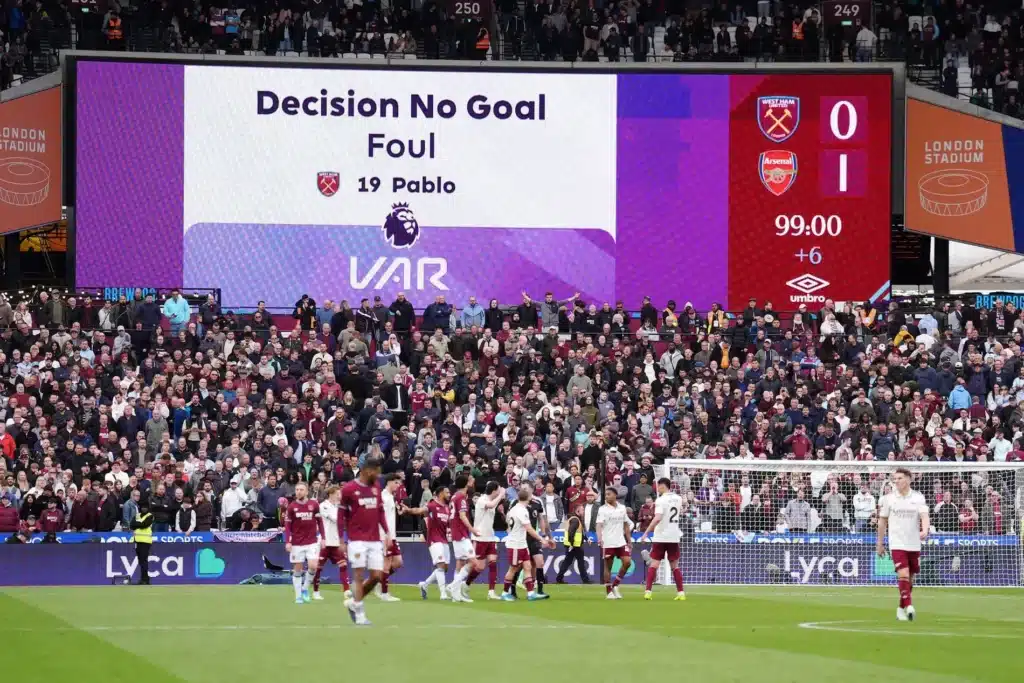
Some VAR decisions disappear after the final whistle. This one will not. The West Ham vs Arsenal VAR controversy arrived in the 95th minute, with Arsenal protecting a narrow 1-0 lead, West Ham fighting for survival, and Callum Wilson thinking he had dragged the home side level. The ball crossed the line. The stadium erupted. Then came the check. After a lengthy review, VAR Darren England advised referee Chris Kavanagh to go to the pitchside monitor. Kavanagh eventually disallowed the goal, judging that West Ham’s Pablo had fouled Arsenal goalkeeper David Raya before Wilson’s finish. Arsenal escaped with a huge win; West Ham were left furious. Gary Neville called it the “biggest moment in VAR history” in the Premier League, and while that wording is dramatic, the stakes were genuinely enormous: Arsenal’s title race on one side, West Ham’s relegation fight on the other.
Quick Verdict
The decision is supportable in law, and probably correct if the replay angle clearly shows Pablo holding or impeding Raya’s arm as the goalkeeper tries to attack the ball.
The uncomfortable part is not the Law. Law 12 gives the referee enough basis to penalise holding or impeding with contact. The uncomfortable part is the VAR threshold: after a goal had initially been awarded, was the missed foul clear enough to justify intervention? On balance, yes — because the contact appeared to directly affect Raya’s ability to challenge for the cross, and the incident happened immediately before the goal.
What happened?
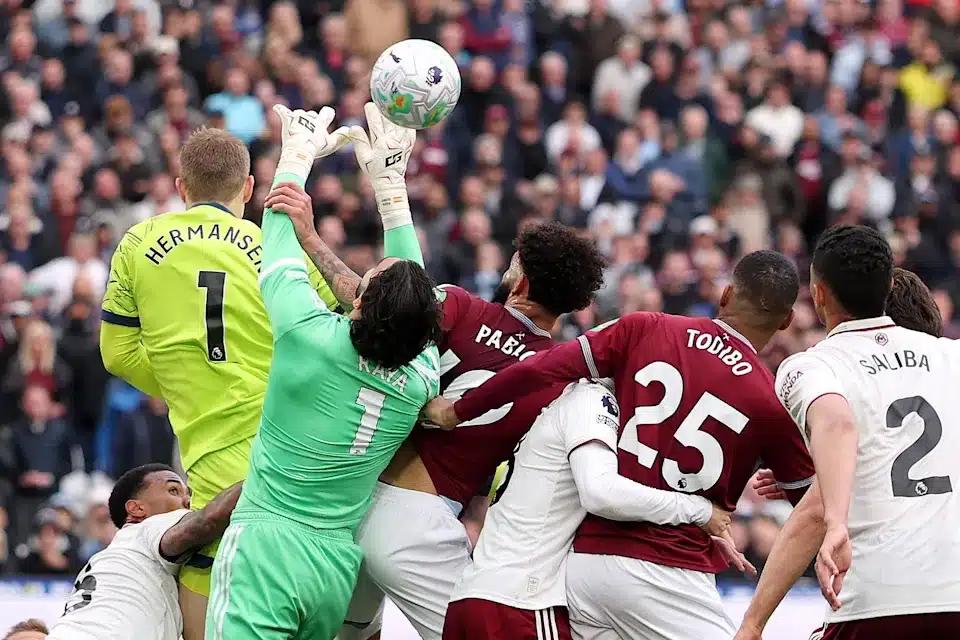
West Ham delivered a late set-piece into Arsenal’s penalty area. Raya came into a crowded area to claim or challenge for the ball. In the middle of the bodies, Pablo made contact with the Arsenal goalkeeper, with replays showing Raya’s arm appearing to be held or restricted. The ball eventually dropped into the danger area and Callum Wilson forced it over the line. Chris Kavanagh initially allowed the goal, but Arsenal players immediately protested. VAR Darren England checked the attacking phase and recommended an on-field review. After watching the footage, Kavanagh changed his decision and ruled the goal out for a foul. That sequence matters. This was not VAR checking a random piece of contact far away from the goal. It was a possible attacking offence in the same phase that directly affected the goalkeeper before the ball ended up in the net.
The referee decision
The final referee decision was:
No goal. Foul by Pablo on David Raya. Free-kick to Arsenal.
Chris Kavanagh’s original on-field outcome was effectively goal/no goal in favour of West Ham, because the ball had crossed the line. After the VAR review, he decided the attacking team had committed an offence before the goal was scored. That is a reviewable incident under VAR protocol because it concerns a goal and a possible attacking-team foul in the build-up. IFAB’s VAR protocol allows review for a “clear and obvious error” in goal/no-goal situations, including an attacking-team offence such as a foul in the build-up to the goal.
Law context
The relevant law is IFAB Law 12: Fouls and Misconduct. Law 12 allows a direct free-kick when a player holds an opponent or impedes an opponent with contact.
That is the key point here. The question is not whether goalkeepers deserve special protection on every corner. They do not. Modern refereeing rightly allows physical contact at set-pieces. But a goalkeeper still has the same protection as any other player when an opponent uses the arm or body to hold, block, or restrict movement unfairly. If Raya’s arm was held while he was trying to reach the ball, that is not normal set-piece contact. It becomes a Law 12 offence.
Why VAR could intervene
VAR could intervene because this was a goal/no-goal situation. The Premier League’s VAR guidance says VAR can be used for clear and obvious errors in match-changing situations, including goals. It can also review attacking-team offences in the build-up to a goal.
So the protocol route is clean:
West Ham scored.
VAR checked the attacking phase.
VAR identified a possible foul on Raya.
The referee reviewed the footage.
The referee changed the decision.
The key debate is whether the error was clear and obvious. For subjective fouls, VAR is not supposed to re-referee every contact inside the box. It should step in only when the footage shows the referee has missed something significant. In this case, the argument for intervention is strong because the suspected hold was on the goalkeeper’s arm, happened as he tried to play the ball, and came immediately before the goal. That makes it materially different from ordinary shirt-pulling or minor jostling away from the ball.
Why West Ham will feel frustrated
West Ham’s frustration is understandable. Set-pieces are full of contact. Every corner includes blocks, nudges, shirt pulls, arms across bodies, and players trying to create space. If every piece of holding were punished, many corners would end before the ball reached the six-yard box. That is why consistency matters. Supporters and coaches do not only ask whether one incident can be justified by the law. They ask whether similar incidents are punished in the same way every week. That is the strongest West Ham argument. Not that holding a goalkeeper is legal — it is not. The argument is that Premier League refereeing often lets similar penalty-area contact go, then suddenly applies a stricter standard in the 95th minute of a season-defining match. That does not automatically make the decision wrong. But it explains why the controversy is so loud.
Was it harsh?
In optics, yes. In law, not really. It feels harsh because West Ham had scored a dramatic equaliser and because the review took time. Long reviews naturally create doubt in the viewer’s mind: if it takes that long, how clear can it be? But refereeing does not work only on speed. Some incidents need the right angle. A goalkeeper’s arm being held inside a crowd can be difficult to identify live, and the best replay may reveal something the referee could not see from his original position. Once the referee sees that the goalkeeper’s ability to challenge for the ball has been restricted, the foul becomes much easier to defend.
Was Chris Kavanagh right?
Based on the available footage and reporting, yes, the final decision is supportable and likely correct.
The decisive question is whether Pablo’s contact actually prevented Raya from making a fair attempt to play the ball. If the answer is yes, then the goal cannot stand. The attacking team has gained an advantage from an offence in the build-up. For The VAR Verdict, this is not a “VAR disaster” decision. It is a decision where the law supports the final outcome, while the wider debate about consistency remains valid.
That distinction matters.
A correct decision can still expose a consistency problem.
A controversial decision is not automatically a wrong decision.
And a late decision is not automatically unfair simply because the consequences are huge.
Impact on the match
The impact was massive. Arsenal kept a 1-0 win that pushed them closer to the Premier League title. West Ham lost a point that could be crucial in their relegation battle. Reuters reported that the result left West Ham in 18th place while Arsenal moved five points clear at the top. That is why this incident will be replayed and argued over. Not because the law is especially complicated, but because the timing was brutal. A foul on a goalkeeper in the 20th minute is a talking point. A foul on a goalkeeper in the 95th minute, with a title and survival race attached, becomes a national debate.
Final Verdict
VAR was right to check the incident, and Chris Kavanagh’s final decision to disallow Callum Wilson’s goal was supportable under IFAB Law 12.
If Pablo held or restricted David Raya’s arm as the goalkeeper tried to reach the ball, that is a foul. Because the offence came directly before the goal, VAR was allowed to recommend a review. The only fair criticism is about the Premier League’s wider consistency on contact at corners. West Ham can reasonably ask why similar holding is not always punished. But on this incident alone, the decision was not invented, not outside protocol, and not a case of VAR looking for something irrelevant.
It was harsh in the moment. It was painful for West Ham. It was huge for Arsenal. But in law, it stands.

0 Comments
Join the conversation with respect. Comments are moderated and must follow our community rules.
Want to join the discussion?
Please log in or create an account to comment and reply. This keeps the conversation cleaner and safer.