
March 14 Referee Roundup: The Right Calls, the Big Debates and the Quiet Games Across Europe’s Top Five Leagues
March 14 was not a day of one giant officiating scandal across Europe’s top five leagues. It was something more interesting: a day where the biggest moments were mostly about threshold, not chaos. The clearest referee storyline came in La Liga, the busiest technical debate came in Bundesliga, the Premier League gave us one credible penalty grievance and one routine VAR offside correction, Serie A produced a controversy in the buildup to a late equaliser, and Ligue 1 was comparatively quiet. That is important, because not every strong referee roundup needs a robbery narrative. Sometimes the real story is that most of the major calls are actually supportable.
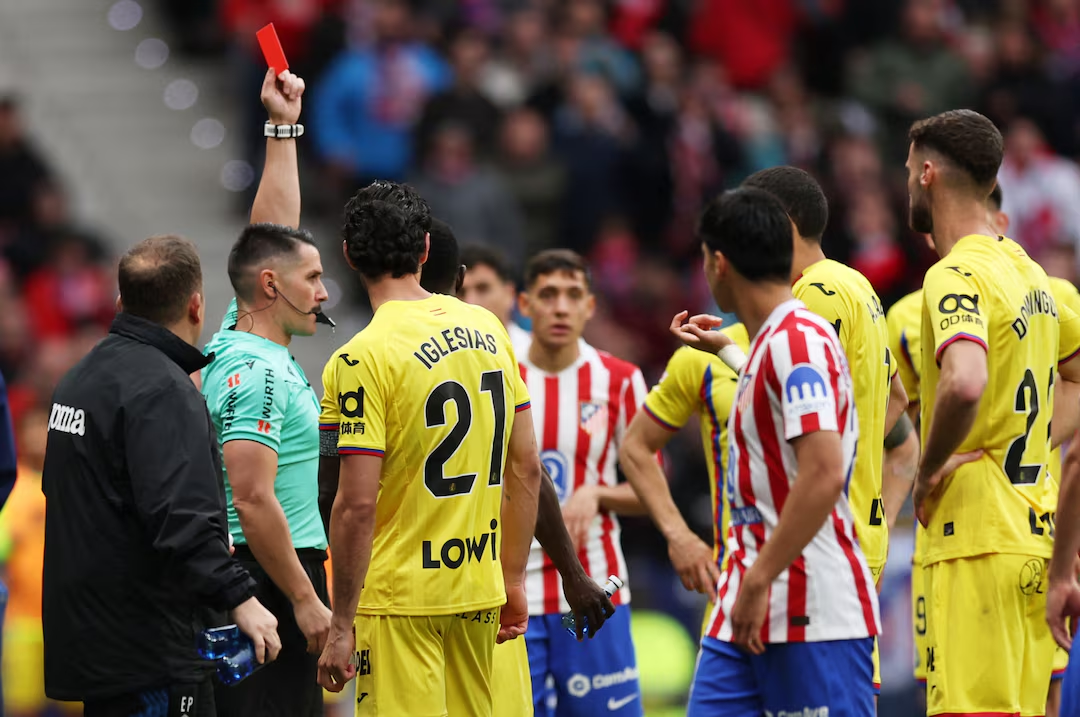
The clearest correct major decision of the day came at the Metropolitano. In Atlético Madrid’s 1-0 win over Getafe, Abdel Abqar was sent off after a VAR review showed off-the-ball contact on Alexander Sørloth, while Sørloth himself was booked for the retaliation. By Law 12, violent conduct is defined as excessive force or brutality against an opponent when not challenging for the ball, and that is why this decision looks right from a refereeing perspective. This was not a normal football challenge mistimed in a duel. It was off the ball, deliberate, and outside the protection that players sometimes get in genuine attempts to play. The yellow for Sørloth is also supportable because retaliation is judged separately from the original act. Verdict: correct red, correct VAR intervention.
The most complex refereeing match of the day was Bayer Leverkusen vs Bayern Munich. Reuters reported that Bayern had two goals ruled out for handball, had Nicolas Jackson sent off before halftime for what it described as a wild tackle, saw Luis Díaz later dismissed on a second booking for diving, and then survived a stoppage-time VAR offside review that wiped out what Leverkusen thought was the winner. The key legal point on the two disallowed Bayern goals is simple: Law 12 says it is an offence if a player scores directly from the hand or arm, or scores immediately after the ball has touched the hand or arm, even accidentally. That makes the handball-based disallowances supportable in law even if Bayern hated them. Jackson’s red also sounds supportable because Law 12 distinguishes reckless contact from excessive force, and “wild tackle” language usually points toward the latter. Díaz’s second yellow for simulation is the most debatable call in that game because simulation depends heavily on the replay angle and the referee’s read of contact. But the Tah and Kane disallowances, plus the late offside chalk-off for Leverkusen, all fit the Laws cleanly. Verdict: more correct law application than actual injustice.
In the Premier League, the biggest complaint came from Chelsea after their 1-0 loss to Newcastle. Liam Rosenior argued that referee Paul Tierney missed a penalty when Cole Palmer went down under pressure from Nick Woltemade in the second half. That is a real grievance, but not one I can professionally label a clear mistake from the evidence I could verify. Right now, the strongest public sourcing is the manager’s complaint plus a text description of the incident. That is enough to say Chelsea had an arguable claim, but not enough to downgrade the officials with confidence. For a site like The VAR Verdict, that distinction matters. There is a difference between “the losing side has a point” and “the referee was wrong.” Verdict: possible miss, but not proven enough from available evidence to call a clear error.
The other Premier League decision-led match was Sunderland vs Brighton. Sunderland had a goal disallowed after VAR found Omar Alderete offside in the buildup, and Brighton’s winner survived a later VAR check. The Guardian also reported that Sunderland felt a foul on Habib Diarra should have stopped play before Yankuba Minteh’s goal stood. From a professional angle, the offside ruling looks like the most straightforward part of that story: a few centimetres is still offside. The foul complaint before Brighton’s goal is more subjective, but with the goal standing after review and no stronger evidence of a clear, stoppable offence in the public reports I checked, this sits in the category of a supportable on-field decision rather than an obvious officiating failure. Verdict: routine offside correction, no compelling evidence of a major error on the winner.
Serie A gave us a different sort of controversy. Inter were held 1-1 by Atalanta, and Reuters reported that Cristian Chivu was sent off for protesting a foul in the buildup to Atalanta’s equaliser. Here, the honest refereeing verdict has to be more cautious. The reporting confirms the controversy and the bench reaction, but not enough visual detail to let me say the officials clearly missed a foul before the goal. So the better professional conclusion is this: there was a major complaint, and it influenced the emotional reading of the result, but it does not yet rise to the level of a verified refereeing blunder from the evidence publicly available to me. Verdict: controversial sequence, but not enough verified detail to grade as a wrong decision.
Ligue 1 was the quietest of the five major leagues from a referee-analysis point of view. Reuters’ main Saturday Ligue 1 report was Lorient’s 2-1 win over Lens, and the story there was the result and the title-race impact, not the officials. That may sound less dramatic, but it is still part of a good roundup. One of the easiest ways to lose credibility in football analysis is to force controversy into matches that do not actually have it. On the verified reporting I found, Ligue 1’s March 14 narrative was sporting, not officiating. Verdict: no major, well-sourced refereeing flashpoint.
So the overall March 14 conclusion is pretty clear: the strongest big decisions were mostly right. Atlético-Getafe gave us the day’s clearest correct red card. Leverkusen-Bayern gave us a cluster of law-heavy calls that largely stand up on the rules. Sunderland-Brighton produced a normal modern VAR offside intervention. Chelsea-Newcastle and Inter-Atalanta are the two matches where fans have the most room to argue, but based on the evidence I could verify, neither gives me enough to publish a hard “wrong decision” verdict. For The VAR Verdict, that is the right line to take: firm where the law is clear, cautious where the proof is incomplete.
