
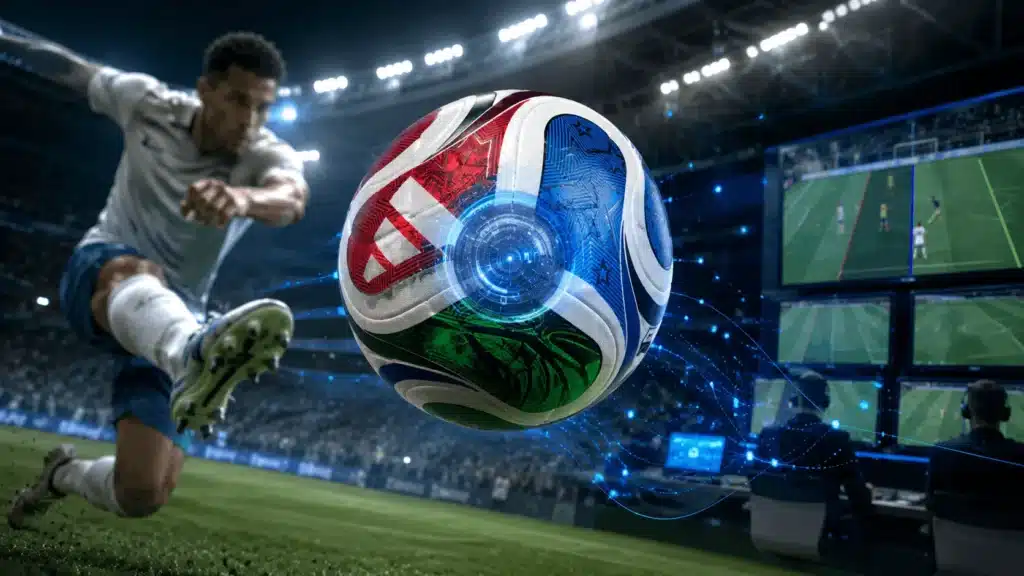
Croatia’s dramatic late goal against Portugal sparked another debate among football fans. Many supporters were surprised that VAR identified the exact moment the Croatian player touched the ball before the offside decision was confirmed. That immediately raised one question across social media.
How can the ball detect such a tiny touch?
The answer lies inside the ball itself.
What is Connected Ball Technology?
The official FIFA World Cup match ball contains a tiny Inertial Measurement Unit (IMU) sensor positioned at its centre. The sensor weighs only a few grams and has virtually no effect on how the ball behaves during a match. Its purpose is not to decide whether something is a foul or an offside. Instead, it provides extremely accurate timing data that helps VAR determine the exact instant a player touches the ball. That timing is then combined with Semi Automated Offside Technology, which tracks every player’s position around the pitch.
How many times does the sensor collect data?
The sensor inside the ball sends information around 500 times every second. That means it records the movement of the ball every two milliseconds. Because of this incredible speed, the system knows the exact frame when contact occurs, something that is almost impossible for the human eye to judge consistently.
Can the sensor detect the smallest touch?
Yes. The system is designed to detect very small contacts. If a player slightly changes the movement of the ball using:
- the foot
- the knee
- the chest
- the shoulder
- the head
the sensor records that impact. This allows VAR to know precisely when possession changes or when a pass begins.
What if the ball only touches a player’s hair?
This has become one of the most common questions after Croatia’s disallowed goal. The answer is more complicated. The sensor does not recognise body parts. It only measures changes in the ball’s movement through acceleration, vibration and impact. If the ball genuinely changes direction or receives enough force after brushing a player’s hair, the sensor may register that contact. However, if only a few strands of hair brush the ball without creating measurable impact, the system may not detect anything.
That is why the sensor is never used alone.
Why does VAR still use video?
The connected ball is only one part of the technology. VAR also studies:
- Multiple broadcast cameras
- High speed tracking cameras
- Semi Automated Offside Technology
- Player limb tracking
- Ball sensor data
Every piece of information is combined before an offside decision is confirmed. This makes the process far more accurate than relying on television replays alone.
How does this help with offside?
Offside decisions depend on one critical moment. Exactly when the ball is played. Even a difference of one frame can change whether an attacker is onside or offside. Previously, VAR operators had to choose that frame manually using video. Today, the connected ball provides the precise moment of contact automatically. This removes much of the human estimation that previously existed.
Was it used during Croatia’s disallowed goal?
Yes. The late Croatia goal against Portugal was another example of the technology working as intended. The ball sensor helped identify the exact moment the attacking pass was made. Semi Automated Offside Technology then compared that moment with the position of the Croatian attacker. After combining both pieces of information, the offside decision was confirmed and the goal was correctly disallowed. The technology did not make the decision by itself. It simply provided the referee team with more accurate information.
Is the system perfect?
No technology is perfect. The connected ball cannot decide:
- whether a challenge is a foul
- whether contact is careless
- whether a handball is deliberate
Those decisions remain entirely with the referee. The technology simply provides objective data that helps officials apply the Laws of the Game more accurately.
Final Verdict
The connected ball is one of the biggest technological advances football has ever introduced. By sending hundreds of data points every second, it allows VAR to identify the exact moment a player touches the ball, making offside decisions faster and more accurate. Can it detect an incredibly slight touch? In many cases, yes. But the system does not work in isolation. Every decision is still supported by video evidence, player tracking and the referee team’s judgement. Croatia’s late disallowed goal against Portugal showed exactly why FIFA invested in this technology. In the biggest matches, where one touch can decide who stays in the World Cup, precision matters more than ever.

0 Comments
Join the conversation with respect. Comments are moderated and must follow our community rules.
Want to join the discussion?
Please log in or create an account to comment and reply. This keeps the conversation cleaner and safer.