
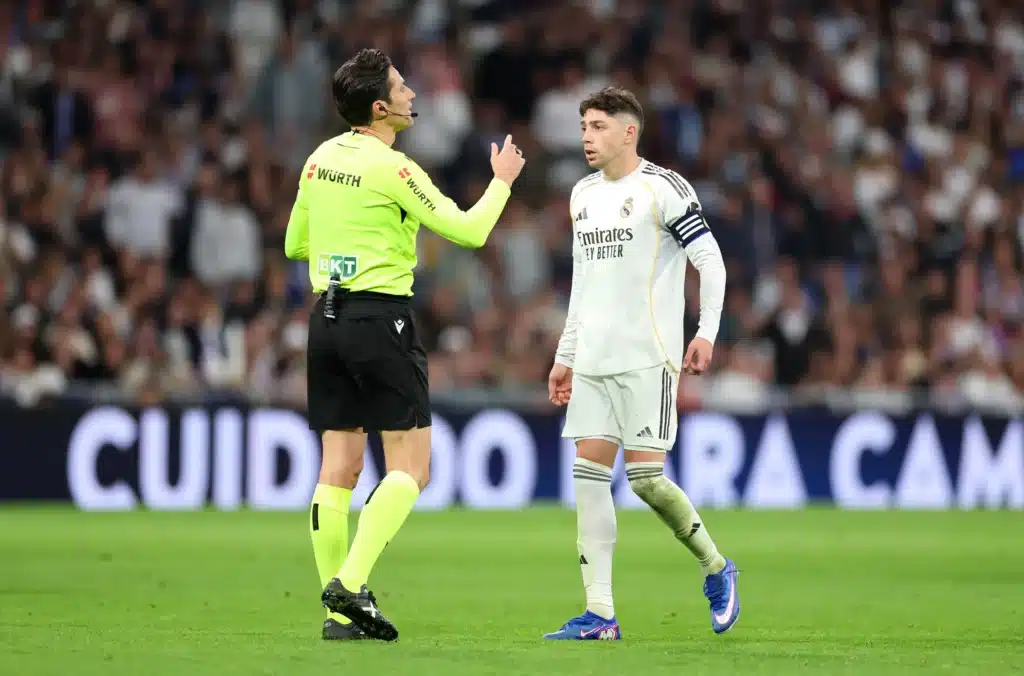
The Madrid derby gave us almost everything: goals, momentum swings, tension, and then one decision that instantly became the main talking point. Real Madrid beat Atletico Madrid 3-2 at the Bernabéu in a match officiated by José Luis Munuera Montero, but the biggest post-match debate centered on Federico Valverde’s straight red card in the 77th minute after a challenge on Álex Baena. By that stage, the game had already swung repeatedly, with Atletico leading through Ademola Lookman before Vinícius Júnior’s penalty, Valverde’s goal, Nahuel Molina’s equaliser, and Vinícius’s winner made it 3-2.
The incident itself is why this story has exploded. Munuera Montero did not hesitate. He whistled the foul, showed Valverde a straight red, and Real Madrid had to play the final stretch of the derby with ten men. LaLiga’s official live log records the foul, the dismissal, and the key consequence that followed: Atletico pushed immediately, and Julián Álvarez hit the post just four minutes later. That sequence matters, because it shows the decision was not just symbolic or disciplinary on paper. It directly altered the pressure, the space, and the emotional temperature of the final minutes.
What made the debate even louder was the referee’s explanation after the match. Álvaro Arbeloa confirmed that Munuera Montero personally explained the decision to him and said the challenge involved excessive force. Other reports quoting the exchange describe the referee’s view in even more specific terms: Valverde came from behind, did not play the ball, and in the referee’s opinion his only intention was to bring the opponent down with excessive force. Arbeloa publicly disagreed, saying he did not see intent to injure and felt the action did not reach red-card level.
This is where the law becomes decisive. Under IFAB Law 12, a tackle or challenge that endangers the safety of an opponent or uses excessive force must be punished as serious foul play and a red card. The same law specifically notes that a challenge from behind can qualify if it uses excessive force or endangers safety. That is the legal basis Munuera Montero was clearly relying on. So from a purely technical standpoint, the referee’s decision is not outside the framework of the Laws of the Game.
The second question is whether VAR should have intervened. IFAB’s VAR protocol is very clear here: a direct-red decision can only be changed if the video shows a clear and obvious error. VAR is not there to re-referee every high-intensity foul or replace the on-field referee’s threshold on borderline red-card incidents. If the referee had a clear view and judged the contact, speed, and force as excessive, VAR only steps in if replay clearly proves that assessment wrong. That is a very high bar.
My verdict is this: the red card is harsh, but defendable; VAR should not intervene. On my reading, this is one of those “orange” incidents that many referees would downgrade to yellow because the contact looks more tactical than brutal. But once Munuera Montero interpreted it as excessive force from behind, the video evidence does not obviously destroy that interpretation. In other words, I would understand a yellow on the field, but I do not think VAR had a strong enough basis to overturn a referee who was well placed and decisive.
That distinction is important. People often mix up two different questions: “Would I personally give red?” and “Should VAR cancel the red?” Those are not the same thing. A match official can be severe without being clearly wrong. This derby incident sits exactly in that space. It is debatable, emotional, and guaranteed to divide fans, but that does not automatically make the use of VAR incorrect. By the letter of the protocol, non-intervention is easier to defend than many supporters will want to admit.
The impact on the match was obvious. Real Madrid had to protect a one-goal lead with ten men in the closing stages, and Atletico immediately increased the pressure. The Álva rez chance off the post in the 81st minute underlined how quickly a disciplinary decision can reshape the closing script of a top-level game. Real still held on, but the red card changed the ending from a football contest into a survival exercise. That is why this controversy will keep running: it was not an isolated call in a dead moment, it became the lens through which the last 15 minutes were watched.
As for the wider noise around the incident, social media reports have pushed the idea that the refereeing authorities are likely to stand by Munuera Montero’s interpretation. Whether or not that becomes formalized, the real technical debate is already clear. The referee saw excessive force. Arbeloa saw a hard foul below red-card level. The law allows the referee’s position. The VAR threshold protects the original call. That is why the final verdict is uncomfortable for many, but logically consistent.
Final verdict:
Red card: harsh but technically defendable.
VAR intervention: no, not unless the replay clearly proves the on-field decision wrong.
Overall refereeing takeaway: severe decision, not necessarily a protocol error.
FAQ
Was Fede Valverde’s red card correct?
It was defendable under Law 12, because IFAB allows a red card for a challenge from behind if the referee judges it to involve excessive force or to endanger the opponent’s safety. I still think it was on the harsh side, but it is not outside the law.
Should VAR have overturned the decision?
No. VAR can only intervene on a direct-red decision if the on-field call is a clear and obvious error. This looked like a debatable interpretation, not an obviously impossible one, so the protocol supports staying with the referee’s original decision.
What did the referee tell Arbeloa
Arbeloa said Munuera Montero explained that the challenge involved excessive force. Other reports of the exchange said the referee believed Valverde came from behind, did not play the ball, and brought the opponent down with excessive force.
How much did the red card affect the match?
A lot. Real Madrid had to finish with ten men after the 77th-minute dismissal, and Atletico nearly equalised soon after when Julián Álvarez hit the post in the 81st minute. The red card clearly changed the match’s final phase.

0 Comments
Join the conversation with respect. Comments are moderated and must follow our community rules.
Want to join the discussion?
Please log in or create an account to comment and reply. This keeps the conversation cleaner and safer.