
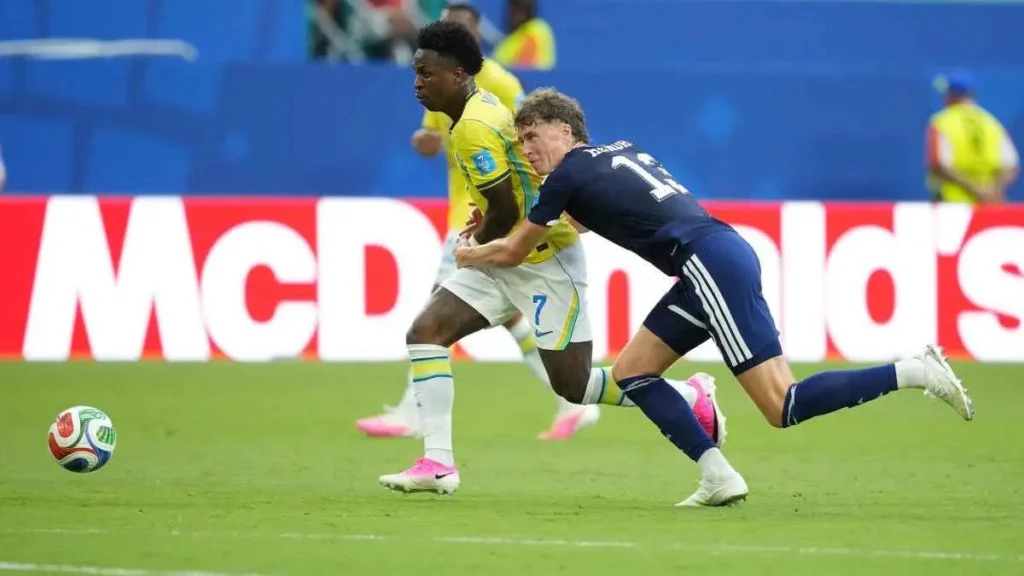
Brazil won the match, but the refereeing debate did not end with the final whistle. After Brazil’s 3-0 victory over Scotland at the 2026 World Cup, the CBF reportedly filed a formal complaint to FIFA over the VAR decision that cancelled a Vinícius Jr goal. The controversy has grown because Brazil are not only questioning one decision they are using a Lionel Messi goal for Argentina as a comparison point in a wider argument about consistency.
Brazil’s 3-0 win over Scotland should have been remembered mainly as another statement performance from Vinícius Júnior. Instead, the match has now become one of the biggest VAR debates of the World Cup. Brazil won comfortably, topped their group, and moved into the knockout stage, with Vinícius scoring twice in the match. But the controversy came in the first half, when he appeared to score another goal after winning the ball from Scotland defender Jack Hendry before finishing past Angus Gunn. The goal was eventually disallowed after a VAR review, with referee César Ramos judging that Vinícius had committed a foul in the build-up.
Now the incident has gone beyond normal post-match frustration. According to multiple reports, the Brazilian Football Confederation has filed a formal complaint to FIFA over the decision, arguing that the VAR intervention was not consistent with how similar incidents have been handled elsewhere in the tournament.
The most eye-catching part of Brazil’s complaint is the comparison with Argentina. Reports say Brazil referenced Lionel Messi’s goal against Austria, arguing that a similar physical challenge in the build-up to that goal was allowed to stand, while Vinícius’ goal against Scotland was cancelled.
For The VAR Verdict, this is where the story becomes bigger than one disallowed goal. This is not only a Brazil story, a Vinícius story, or even a Messi story. It is a VAR consistency story.
What happened in Scotland vs Brazil?
The key incident came with Brazil already leading. Vinícius pressed Jack Hendry, challenged for the ball, won possession, and finished the move with the kind of calmness that has made him one of the most dangerous forwards in the tournament. On the field, the goal initially appeared to be given. But VAR checked the attacking phase of play and recommended an on-field review. After going to the monitor, referee César Ramos disallowed the goal for a foul by Vinícius on Hendry.
The debate is simple: was Vinícius’ challenge a clear foul, or was it normal attacking pressure that became exaggerated when slowed down on replay? That question matters because VAR is not supposed to re-referee every physical contact. It is supposed to correct clear and obvious errors.
The Law: when is this a foul?
Under IFAB Law 12, a direct free kick is awarded when a player commits offences such as charging, pushing, tackling, challenging, or tripping an opponent in a manner considered careless, reckless, or using excessive force. The Law also states that impeding an opponent with contact is punished by a direct free kick.
So, in pure Law terms, the referee had a possible route to disallow the goal if he believed Vinícius unfairly impeded Hendry or made careless contact that affected the defender’s ability to play the ball.
That is the argument in favour of the decision.
But the more difficult question is not whether a foul could be given. The real VAR question is whether the original decision to allow play to continue was clearly and obviously wrong.
The VAR protocol question
The IFAB VAR protocol is clear: the original decision should not be changed unless the video review clearly shows a “clear and obvious error.” VAR can review goal/no-goal situations, including an attacking-team foul in the build-up to a goal. But the final decision remains with the referee after the review.
That means the Vinícius incident was reviewable. VAR is allowed to check attacking fouls before goals.
But being reviewable does not automatically mean VAR should intervene.
This is the key distinction. VAR can intervene if the attacking foul is clear. If the incident is subjective, light, debatable, or dependent on interpretation, the safer approach is usually to stay with the on-field decision.
From the available replays and reports, this looked like a highly subjective contact. Vinícius did place pressure on Hendry. There may have been contact. Hendry was affected. But whether that contact was enough to punish as a foul is exactly the type of decision where football expects a high threshold before VAR gets involved.
That is why Brazil’s frustration is understandable, even if the final decision can still be defended under Law 12.
Was César Ramos wrong?
The honest answer is: not clearly.
Ramos had legal grounds to disallow the goal if, after seeing the replay, he believed Vinícius’ contact unfairly prevented Hendry from clearing the ball. In that sense, the decision is not impossible to justify.
But The VAR Verdict’s concern is the intervention threshold.
If the referee had immediately given a foul on the field, it would have been much easier to support. The problem is that the goal was initially allowed, then overturned after video review. Once VAR enters the process, the question becomes stricter: did the replay clearly prove that allowing the goal was a major error?
That is where the decision becomes controversial.
This did not look like a situation where Vinícius clearly kicked, tripped, or pushed Hendry with obvious force. It looked more like a physical duel where the defender was under pressure and the attacker won the ball aggressively. Those moments happen many times in a match.
If VAR starts cancelling goals for every small contact in the build-up, then the game risks becoming inconsistent and overly forensic.
Why the Messi comparison matters
The Messi angle is the reason this story will explode online.
Brazil are reportedly arguing that Argentina’s goal against Austria was allowed to stand despite a similar challenge in the build-up. Their point is not simply “Argentina got lucky.” Their argument is about consistency: if one goal stands after a physical challenge, why was Vinícius’ goal cancelled for a similar level of contact?
This is always the most difficult area for FIFA and referees. Football fans can accept strict decisions if they are applied the same way. What frustrates players, coaches, and supporters is when one match appears to have a high threshold for contact, while another match has a low threshold.
That is why Brazil’s complaint is dangerous for FIFA. It is not just emotional reaction after a defeat — Brazil actually won 3-0. That makes the complaint stronger because it cannot easily be dismissed as a losing team blaming the referee.
Brazil are effectively saying: even when the result did not hurt us, the decision showed a consistency problem.
The VAR Verdict
For us, the best verdict is balanced:
Law 12 gives the referee a possible basis to disallow the goal, but the VAR intervention feels questionable because the contact was subjective and may not have reached the clear-and-obvious threshold.
That distinction matters.
This is not a case where we can say the goal 100% had to stand. There was contact. Hendry was affected. Ramos had a reason to view it as an attacking foul.
But VAR should not be used to search for soft contact after a goal unless the offence is clearly punishable. The more subjective the contact, the more the on-field decision should carry weight.
In our view, this was the kind of incident where “check complete” would have been easier to defend. Once the goal was given on the field, the evidence needed to overturn it should have been strong. Based on the available footage and reports, that threshold is debatable at best.
Why this story matters for the World Cup
This incident now creates a wider question for FIFA: how much contact is allowed before a goal? If the standard is strict, then referees must apply it in every match. If the standard is more flexible, then VAR should avoid intervening in soft or subjective attacking fouls.
The worst outcome is a tournament where identical-looking challenges are treated differently depending on the match, referee, or VAR team. That is why the Vinícius decision matters. It is not just about one cancelled Brazil goal. It is about the credibility of VAR at the World Cup. Fans do not expect referees to be perfect. Football is too fast, too physical, and too subjective for perfection. But fans do expect consistency, especially when technology is involved.
Final verdict
Brazil’s complaint to FIFA will not change the result. Brazil still won the match, topped the group, and moved forward in the tournament. But the debate around Vinícius Júnior’s disallowed goal will not disappear quickly.
The referee had a possible Law 12 explanation. VAR had the right to check the attacking phase. But the biggest question remains the same:
Was this really a clear and obvious error, or did VAR re-referee a normal physical duel?
For The VAR Verdict, that is the heart of the controversy.
And when Brazil, Vinícius Jr, Messi, FIFA, and VAR are all part of the same story, this is exactly the kind of decision that can dominate the World Cup conversation.

0 Comments
Join the conversation with respect. Comments are moderated and must follow our community rules.
Want to join the discussion?
Please log in or create an account to comment and reply. This keeps the conversation cleaner and safer.