
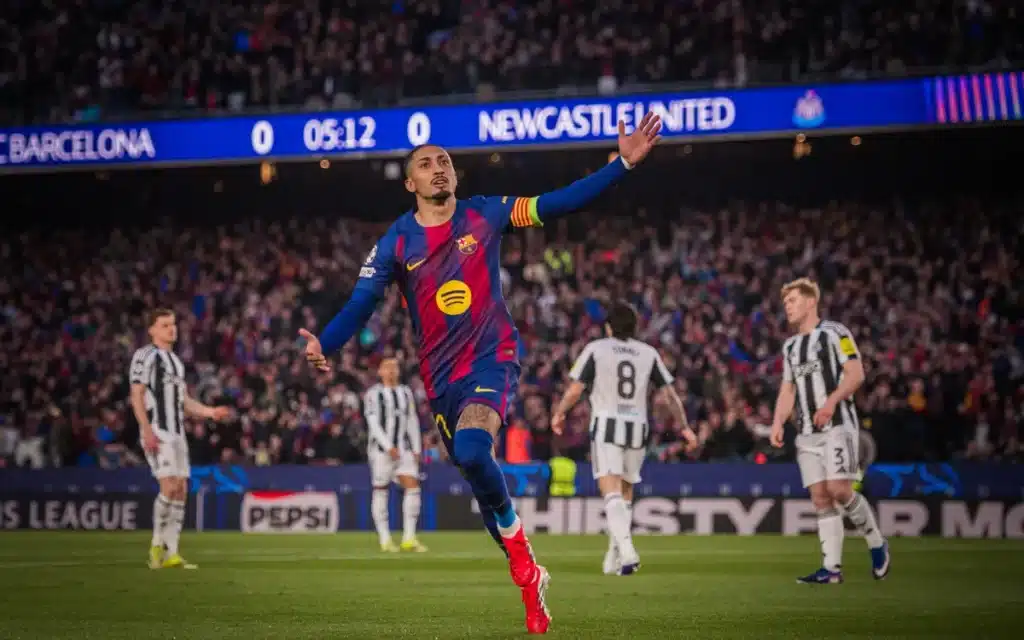
UEFA’s four Wednesday, March 18 round-of-16 second legs were Barcelona vs Newcastle, Bayern München vs Atalanta, Liverpool vs Galatasaray, and Tottenham vs Atlético de Madrid, with François Letexier, Benoît Bastien, Szymon Marciniak, and Daniel Siebert listed as the referees for those games. By full time, Barcelona had beaten Newcastle 7-2 to go through 8-3 on aggregate, Bayern had beaten Atalanta 4-1 to advance 10-2 on aggregate, Liverpool had beaten Galatasaray 4-0 to progress 4-1 on aggregate, and Tottenham had beaten Atlético 3-2 on the night but gone out 7-5 on aggregate.
March 18 Champions League referee review
There were not many truly wild decisions across the four matches, but there were some important moments that shaped the tone of the night. The cleanest refereeing performance came in Munich, the most debated one came in Barcelona, Liverpool had the softest big call of the evening, and Tottenham-Atlético was the match where game control mattered more than one huge VAR controversy.
Barcelona 7-2 Newcastle (8-3 agg)
Referee: François Letexier
The biggest correct decision in Barcelona was the first-half penalty. ESPN’s live commentary records Raphinha drawing the foul, Kieran Trippier conceding the penalty, and VAR sending Letexier to a penalty decision for Barcelona. Newcastle’s own match report also notes that Letexier initially waved play on before changing his mind after reviewing the incident. On balance, that is a strong example of VAR working properly: the original decision was improved, not protected.
Where the criticism of Letexier becomes more understandable is in his disciplinary control, especially around Joelinton. The official live log shows Joelinton was booked in the 17th minute for a foul on Lamine Yamal, and it also records another Joelinton foul on Robert Lewandowski in the 63rd minute before he was substituted a minute later. That does not automatically prove there was a mandatory second yellow in every complained-about moment, but it absolutely explains why Barcelona felt Newcastle’s margin for error became too generous once that early booking was on the board. My verdict: Letexier got the penalty call right, but he allowed too much frustration to build in open play.
There is also an important law point here. Under the current IFAB VAR protocol, VAR may intervene for goal/no goal, penalty/no penalty, and direct red card situations, but not for a missed second yellow. So even if Barcelona believed Joelinton should have gone, that was a decision Letexier had to make live on the field; VAR could not rescue him on a second-caution situation.
Bayern München 4-1 Atalanta (10-2 agg)
Referee: Benoît Bastien
Bastien had the clearest big decision of the night, and he handled it well. ESPN’s commentary shows Bayern were awarded a penalty after a VAR review for handball by Giorgio Scalvini in the 21st minute, and Harry Kane converted in the 25th. The Guardian’s live coverage added the important detail that Kane’s first effort had been saved, but the kick was retaken because the goalkeeper had come off his line. That is exactly the sort of sequence where law knowledge and procedural calm matter.
The law supports both parts of the decision. IFAB Law 12 says a handball offence occurs when a player’s arm or hand has made the body unnaturally bigger, and Law 14 says that if a defending player, including the goalkeeper, commits an offence and the penalty is saved or missed, the penalty is retaken. So on the night’s biggest Bayern refereeing moment, Bastien was backed up by both the VAR process and the letter of the Laws of the Game. My verdict: this was the best-officiated major call of the four matches.
Because Bayern were so dominant overall, the referee never lost control of the match. That matters too. A referee is not only judged by controversy; sometimes the best performance is the one that feels calm because the important decisions are made early and made cleanly.
Liverpool 4-0 Galatasaray (4-1 agg)
Officially listed referee: Szymon Marciniak
Liverpool’s match had one clear correct intervention and one debatable penalty. The correct one was the VAR no-goal in the second half. ESPN’s log shows Liverpool thought they had a third through a Wilfried Singo own goal, but VAR overturned it because Jeremie Frimpong had been offside in the move. That is a straightforward and fully supportable correction.
The softer call was the first-half Liverpool penalty. ESPN records Ismail Jakobs conceding a penalty after fouling Dominik Szoboszlai, while The Guardian’s live blog describes Szoboszlai as getting there first and then going down dramatically. That combination usually tells you the same story: there was contact, but the attacker helped the referee notice it. My verdict: not a robbery, not a scandal, but definitely a generous penalty rather than an undeniable one. In big European ties, those are exactly the decisions defenders never forgive.
That said, the match did not turn on that call because Salah missed the spot kick anyway and Liverpool still went on to win 4-0. In other words, the debate remains about the quality of the decision, not about whether the referee decided the tie. That distinction is important in serious refereeing analysis.
Tottenham 3-2 Atlético Madrid (Atlético win 7-5 agg)
Referee: Daniel Siebert
Siebert’s match was not the loudest one, but it was not simple either. ESPN’s commentary shows Atlético had an early offside against Ademola Lookman in the sixth minute, and there is nothing controversial there from the live record. Later, Spurs won a penalty in the 89th minute when José María Giménez fouled Xavi Simons, and Simons converted at 90 minutes to make it 3-2. Based on the official play-by-play, that is a supportable late penalty call.
The one moment Spurs fans will keep talking about is Atlético’s first goal. The Guardian’s live coverage notes that Spurs appealed for a foul on Simons in the buildup to Julián Álvarez’s strike, but the goal stood. Without a verified replay sequence in the official text sources, I would stop short of calling that a clear refereeing error. My verdict: Siebert got the routine decisions right, gave the late penalty when it was there, and left only one real grey-area complaint behind him. That is not perfect, but it is acceptable in a difficult knockout match.
Final verdict
If I were ranking the refereeing nights from strongest to weakest, I would put Benoît Bastien first because his biggest decision was both important and correct, Daniel Siebert second because he kept control of a match with emotional swings, the Liverpool game third because the no-goal correction was right but the penalty was soft, and François Letexier fourth because even though the Barcelona penalty was correctly fixed by VAR, the broader disciplinary management left too many people angry. That is the difference between getting one big moment right and really controlling an entire Champions League tie.
For publication, the strongest editorial angle is this: March 18 was not a night of outrageous VAR scandal, but it was a night that showed how much the credibility of elite refereeing still depends on consistency, especially with cautions, soft penalties, and game management in emotionally charged ties.

0 Comments
Join the conversation with respect. Comments are moderated and must follow our community rules.
Want to join the discussion?
Please log in or create an account to comment and reply. This keeps the conversation cleaner and safer.