
The Round of 32 gave us three very different refereeing stories.
Brazil survived Japan with a late winner and very little VAR noise. Germany went out to Paraguay after a decision that will be replayed for years. Morocco knocked out the Netherlands after a tense, physical match where the referee had to manage emotion, contact and pressure until the final penalty.
From an officiating point of view, Germany vs Paraguay was the headline. The big question is simple. Did VAR correct a clear error, or did it create one?
Brazil vs Japan: Mariani stayed calm in a match that never fully exploded
Brazil beat Japan 2 to 1 in Houston, with Gabriel Martinelli scoring deep in stoppage time after Casemiro had earlier brought Brazil level. Japan had led through Kaishu Sano and, for long periods, looked organised enough to punish Brazil’s slow first half. The referee was Maurizio Mariani of Italy, with Marco Di Bello listed as VAR for the match. This was not a match dominated by refereeing controversy. That matters. Sometimes the best refereeing performance is not the one with the most dramatic intervention, but the one where the official keeps the game within control and does not become the story.
There were still some debatable management points. Brazil’s physical pressure increased after half time and Japan had to defend deeper, which naturally created more contact around the penalty area. Mariani’s threshold was fairly consistent. He did not look eager to give soft free kicks in attacking zones and he allowed the game to breathe.
The key verdict is that there was no publicly confirmed major VAR error from this match. Japan can feel heartbroken because of the timing of the winner, not because of an obvious officiating injustice.
VAR verdict
Correct overall. No major intervention was needed.
Germany vs Paraguay: The most controversial VAR decision of the round
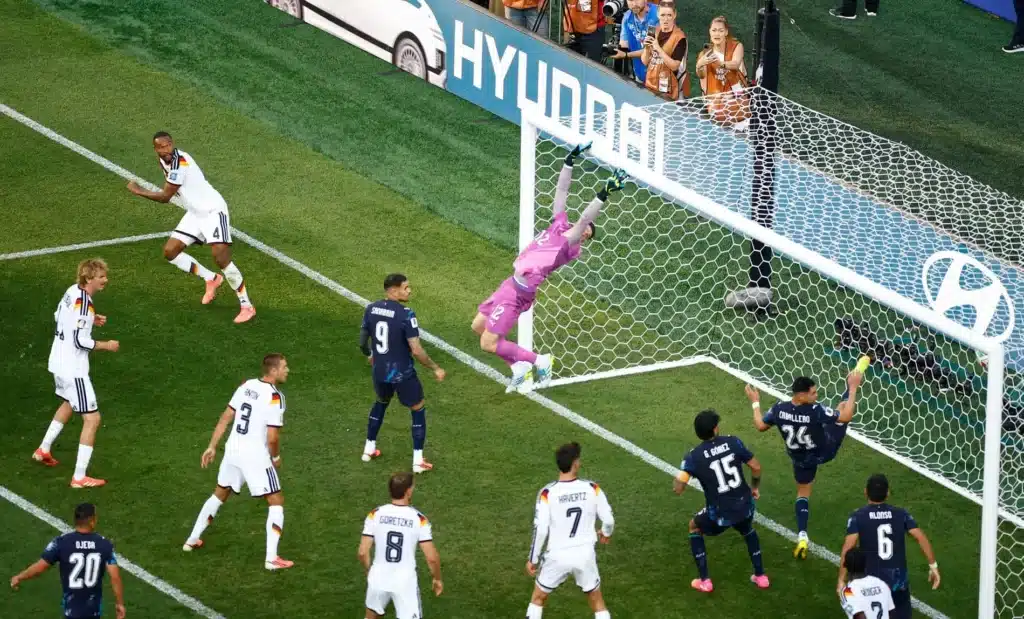
Paraguay eliminated Germany 4 to 3 on penalties after a 1 to 1 draw over 120 minutes. Reuters reported that Germany had a Jonathan Tah header disallowed in extra time after a VAR review for a foul on the goalkeeper. This is the decision that will dominate the referee discussion.
The referee was Jalal Jayed of Morocco.
The decisive incident came in extra time. Tah headed in what looked like a potential Germany winner, but the goal was cancelled after the review. The offence was judged to be contact or obstruction on Paraguay goalkeeper Orlando Gill during the corner kick sequence.
Under Law 12, a direct free kick can be awarded if a player holds an opponent or impedes an opponent with contact. The law also gives the referee the power to punish careless contact, pushing, charging or jumping at an opponent. So, in law, the referee had a route to disallow the goal.
The real problem is the VAR threshold.
IFAB’s VAR protocol says the original decision should only be changed when the review clearly shows a clear and obvious error. It also says goal and no goal incidents can be reviewed when there is a possible attacking team offence in the build up to the goal.
That is where this decision becomes highly debatable. If the referee had disallowed the goal live, it would have been easier to defend. But the goal was initially given. To overturn it, the VAR needed to show that the referee had clearly missed a foul that materially affected the goalkeeper.
From the available reports and reaction, the contact was viewed by many as soft, especially because the match had already been allowed to run with a fairly physical standard. Bavarian Football Works reported strong criticism of the decision, including the view that the VAR intervention felt inconsistent with the contact level allowed during the match.
That is the issue. Refereeing is not only about one freeze frame. It is about the match standard. If the referee allows holding, blocking and body contact for most of the game, then a small amount of contact on a goalkeeper must be very clear to justify cancelling a goal in extra time.
For The VAR Verdict, this should be classified as a major debatable decision, and possibly a wrong VAR intervention depending on the best available angle. The safer wording is important. We should not say with certainty that FIFA got it wrong unless official audio or a technical report confirms that. But we can say the review did not look like the kind of obvious error VAR was designed to correct.
VAR verdict
Highly debatable. The on field goal should probably have stood unless the goalkeeper was clearly blocked from playing the ball.
Referee rating: Jalal Jayed, 5 out of 10
The overall match management was damaged by the biggest call of the night. The decision may have legal support under Law 12, but the VAR threshold is where the performance loses marks.
Netherlands vs Morocco: High pressure, high emotion, but no major VAR scandal
Morocco beat the Netherlands 3 to 2 on penalties after a 1 to 1 draw in Monterrey. Cody Gakpo scored for the Netherlands in the second half, before Issa Diop equalised in stoppage time. Yassine Bounou then became decisive in the shootout as Morocco advanced.
Wilton Sampaio was listed as the referee for Netherlands vs Morocco.
This was a very different test from Brazil vs Japan. The match had emotion, tactical frustration, physical duels and late pressure. The Guardian described it as a tense, spiky game, with repeated challenges and a heavy emotional atmosphere.
For a referee, these matches are dangerous. They can turn quickly. Every foul feels bigger because the score is tight. Every yellow card can feel political because both teams know one mistake could decide a knockout tie.
Sampaio’s biggest challenge was not one single VAR incident. It was control. Did he keep the game competitive without letting it become chaotic? Mostly, yes.
There were moments where players wanted more protection. There were also moments where the referee allowed strong physical contact and trusted players to continue. That approach can be defended in a knockout match, as long as the line remains consistent.
The late Morocco equaliser did not appear to carry a major confirmed foul or offside controversy in the available match reports. The penalty shootout also did not create a major review issue. That leaves the referee’s performance in the category of firm but acceptable.
VAR verdict
No major confirmed VAR error. The match was intense, but the decisive moments were football moments more than refereeing moments.
Referee rating: Wilton Sampaio, 7 out of 10
A demanding game handled with authority. Some foul selection could be debated, but there was no obvious match changing mistake.
Referee ratings from the three matches
Maurizio Mariani, Brazil vs Japan: 7.5 out of 10
Calm performance, good control, no major VAR controversy.
Jalal Jayed, Germany vs Paraguay: 5 out of 10
The disallowed Germany goal defines the performance. The foul can be argued in law, but the VAR threshold is the serious concern.
Wilton Sampaio, Netherlands vs Morocco: 7 out of 10
Strong control in a tense knockout match. Some physical contact was allowed, but the match did not become unmanageable.
Best referee of the three matches
Maurizio Mariani was the best referee of this set.
He had a knockout match with pressure, a huge favourite under stress and a late winning goal, but the officiating stayed in the background. That is not easy. Brazil vs Japan was about tactics, substitutions and finishing, not about the referee.
Most debated decision
The disallowed Jonathan Tah goal in Germany vs Paraguay.
This is exactly the type of incident that creates VAR frustration. If fans need several replays, different angles and long explanations to understand why a goal was cancelled, then the clear and obvious standard becomes harder to defend.
The key question is not whether there was any contact. The key question is whether the contact was enough to say the referee clearly and obviously made an error by allowing the goal.
That is a much higher bar.
The VAR Verdict final conclusion
Brazil vs Japan was a clean refereeing night. Netherlands vs Morocco was tense but largely controlled. Germany vs Paraguay was the match where VAR took centre stage.
The Tah disallowed goal is the kind of decision that separates technical refereeing from football expectation. In pure law, officials can punish obstruction or holding on a goalkeeper. But in VAR protocol, overturning a goal requires more than a possible foul. It requires a clear and obvious error.
That is why this decision feels so controversial.
For Paraguay, it is a historic win. For Germany, it is a painful exit. For refereeing, it is another reminder that VAR does not remove debate from football. Sometimes, it simply moves the debate from the pitch to the monitor.

0 Comments
Join the conversation with respect. Comments are moderated and must follow our community rules.
Want to join the discussion?
Please log in or create an account to comment and reply. This keeps the conversation cleaner and safer.