
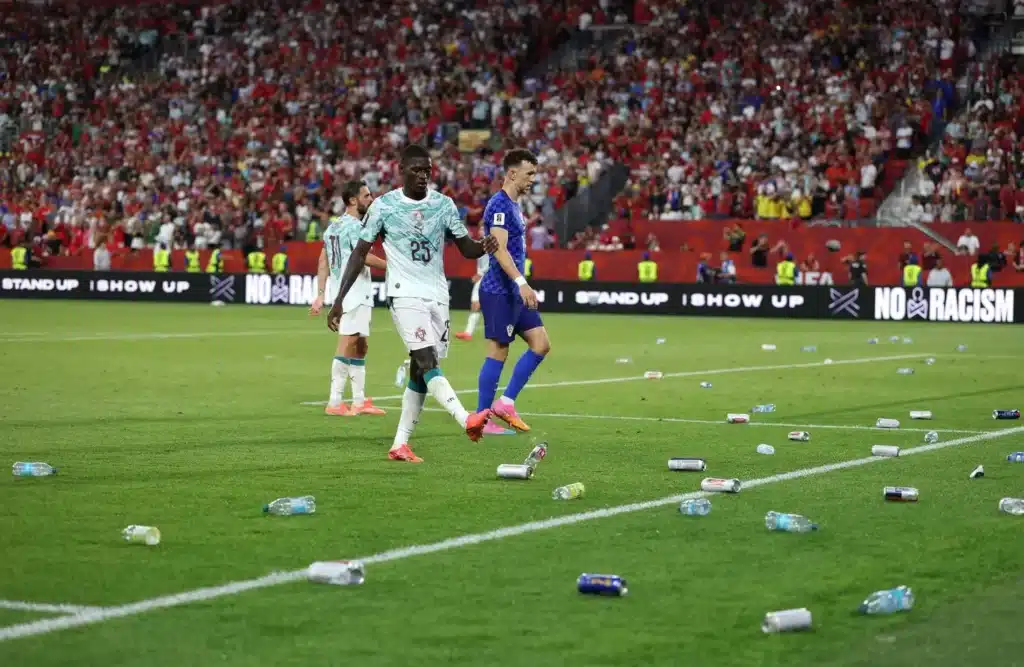
Portugal survived a major late scare against Croatia, while Switzerland handled Algeria in another tense Round of 32 match. For the referees, both games carried different types of pressure.
The biggest decision of the night came in Portugal vs Croatia, where Croatia had a late goal disallowed for offside. In a knockout match, that is exactly the kind of moment that decides not only a game, but sometimes an entire tournament.
For The VAR Verdict, the key question is simple. Was the decision correct under the Laws of the Game?
Portugal vs Croatia referee analysis
Norwegian referee Espen Eskås was in charge of Portugal vs Croatia, a match that always had the potential to become emotional, tactical and difficult to manage.
Portugal had the lead, Croatia pushed late, and the final minutes became the most important refereeing period of the match.
Key moment: Croatia’s late goal disallowed for offside
Croatia thought they had scored a dramatic late equaliser when the ball ended up in the Portuguese net.
The celebrations did not last long.
The assistant referee and VAR team checked the attacking phase, and the goal was ruled out for offside.
Based on the available angles, the decision appears correct.
Under Law 11, a player is in an offside position if any part of the head, body or feet is nearer to the opponents’ goal line than both the ball and the second last opponent. The hands and arms are not considered for offside.
In this incident, the Croatian attacker appeared to be ahead of the second last defender when the decisive pass was played. Because he then became involved in active play, the goal had to be disallowed.
This is exactly why VAR exists. A late knockout goal cannot be judged casually. If the player is offside, even by a small margin, the referee team has no option. The goal must be cancelled.
It was a painful decision for Croatia, but in Law, it was the right call.
Why the process was correct
The referee team handled the situation properly.
The attacking move was allowed to finish before the offside decision was confirmed. That is the correct modern officiating approach, especially when there is a potential goal scoring situation.
Once the ball entered the net, VAR had the chance to check the exact position at the moment the pass was played.
There was no need for the referee to go to the monitor because offside is a factual decision. The VAR team can confirm it directly if the lines and camera angle show the attacker was beyond the second last defender.
From a refereeing perspective, this was good teamwork between the assistant referee, the referee and VAR.
Match control
Apart from the late disallowed goal, Eskås managed the game with calm authority.
Portugal and Croatia both used tactical fouls at different moments, especially in midfield. The referee did not overreact to every contact, but he also did not allow the game to become uncontrolled.
That balance is important in knockout football. Too many soft whistles can kill the rhythm. Too much tolerance can invite frustration.
Eskås found a good middle ground.
Portugal vs Croatia referee verdict
The late offside decision was the defining moment, and it was handled correctly.
Croatia will feel frustrated because of the timing, but the Laws of the Game do not change because the incident happens in the final minutes.
Referee rating: 8.6/10
A strong performance, with the key match changing decision correctly supported by VAR.
Switzerland vs Algeria referee analysis
Argentine referee Yael Falcón Pérez had a different challenge in Switzerland vs Algeria.
This match was not defined by one huge VAR controversy, but it still required strong match control. Switzerland were organised and physical, while Algeria brought speed, direct attacks and emotional energy.
That combination can create problems for any referee.
Physical duels and foul recognition
Falcón Pérez allowed fair contact but punished challenges that crossed the line into careless or reckless play.
That was important because both teams contested aerial balls aggressively. In matches like this, consistency is more important than strictness. Players can accept physical football if the referee applies the same standard to both sides.
Overall, the foul line was clear enough, and the match did not lose control.
Penalty area incidents
There were moments of contact inside and around the penalty area, but nothing that clearly reached the threshold for a penalty.
Under Law 12, contact alone is not enough for a foul. The referee must judge whether the challenge is careless, reckless or uses excessive force.
This is a point many fans often misunderstand. A player can go down inside the box without it automatically becoming a penalty.
In Switzerland vs Algeria, the referee’s decisions to let several physical moments continue were reasonable based on the available play.
VAR performance
VAR remained quiet, and that was not a problem.
A quiet VAR does not mean nothing was checked. It usually means there was no clear and obvious error.
The role of VAR is not to re referee every duel. It is there for goals, penalty incidents, direct red cards and cases of mistaken identity.
In this match, there was no obvious situation that required a major intervention.
Switzerland vs Algeria referee verdict
Falcón Pérez delivered a controlled and confident performance in a match that could easily have become messy.
He managed physical contact well, kept his disciplinary line stable and avoided unnecessary VAR delays.
Referee rating: 8.4/10
A solid knockout stage performance with good consistency and strong control of physical play.
Final verdict
Portugal vs Croatia gave us the major refereeing talking point of the night with Croatia’s late disallowed goal.
It was dramatic. It was painful for Croatia. But based on Law 11, it was the correct decision.
Switzerland vs Algeria was less controversial, but still important from an officiating point of view. Yael Falcón Pérez had to manage physical football, penalty area contact and emotional pressure, and he did it with control.
For FIFA, both matches offered encouraging signs. VAR was not overused, but when it mattered in Portugal vs Croatia, it helped deliver the correct outcome.
For The VAR Verdict, the conclusion is clear. The biggest decision of the night was correct, and the overall refereeing standard remained strong.

0 Comments
Join the conversation with respect. Comments are moderated and must follow our community rules.
Want to join the discussion?
Please log in or create an account to comment and reply. This keeps the conversation cleaner and safer.