
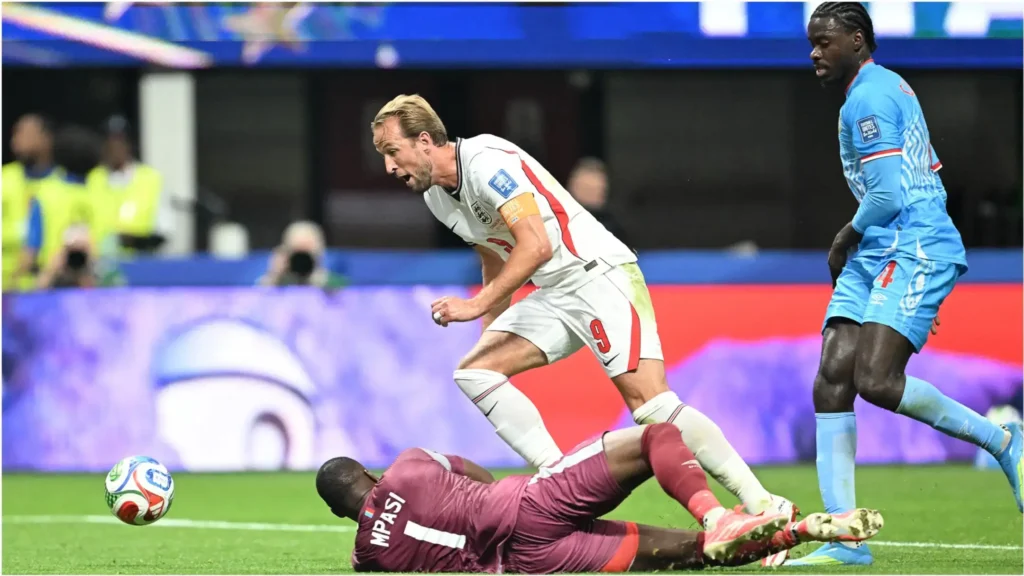
England are through to the last 16 of the World Cup, but their 2 to 1 win over DR Congo will not be remembered only for Harry Kane’s late rescue act. From a refereeing point of view, the biggest talking point came before half time, when England had a strong penalty appeal rejected after contact between Kane and DR Congo goalkeeper Lionel Mpasi.
The incident came at a crucial moment. DR Congo were leading, England were chasing the game, and Kane appeared to get to the ball before Mpasi inside the penalty area. The goalkeeper came out, there was contact, Kane went down, and referee Adham Makhadmeh decided not to award a penalty. VAR checked the incident but did not recommend an on field review.
For The VAR Verdict, this was the key officiating error of the match.
The VAR Verdict: Penalty to England
Our verdict is clear. England should have been awarded a penalty.
The main question under Law 12 is not whether Kane made the fall look dramatic. The question is whether the goalkeeper challenged carelessly and made contact that unfairly stopped the attacker after the ball had been played.
From the available broadcast evidence, Kane reached the ball first and touched it away from the goalkeeper. Mpasi then arrived late and made contact with Kane. In that situation, the goalkeeper is entitled to challenge for the ball, but he is not entitled to miss the ball and take out the opponent.
That is the difference between legal contact and a careless foul.
A goalkeeper inside the penalty area does not get special protection simply because he is the goalkeeper. Once he comes out to challenge at an attacker’s feet, he is judged like any other defender. If he is late, if he makes contact with the opponent instead of the ball, and if that contact affects the opponent’s ability to continue, the expected decision is a penalty kick.
Why the referee may have said no penalty
There is one possible explanation for the referee’s decision. Kane did appear to anticipate the contact. His body shape suggested he knew Mpasi was coming, and that may have influenced the referee’s live judgement.
This is where these incidents become difficult. Referees are trained to separate real fouls from attackers who search for contact. If the attacker moves unnaturally into the goalkeeper, or if the contact is very small and does not cause the fall, the referee can allow play to continue.
But this incident had more than minimal contact. Kane had played the ball first. Mpasi was late. The contact came from the goalkeeper’s challenge, not from Kane simply falling over a planted leg.
That is why the no penalty decision is hard to support.
The simulation question
The referee appeared to indicate that Kane had gone down too easily. That created another problem.
If the referee truly judged that Kane had simulated to deceive him, then the expected disciplinary outcome would normally be a yellow card for unsporting behaviour. No penalty and no caution often leaves the decision in an uncomfortable middle area. It suggests the referee may not have been fully convinced it was simulation, but also did not feel the contact was enough for a penalty.
At World Cup knockout level, that is not the strongest decision profile. When the evidence shows a late goalkeeper challenge with clear contact inside the penalty area, the referee needs either a very strong reason to reject it or support from VAR to correct it.
Why VAR should have intervened
This was a penalty or no penalty situation, which is exactly the type of match changing incident VAR is allowed to check.
The VAR standard is clear and obvious error. VAR is not there to re referee every small piece of contact. But when an attacker gets to the ball first and is then taken down by a late goalkeeper challenge, the non award of a penalty can reach that threshold.
In our view, VAR should have recommended an on field review.
An on field review would not have forced the referee to change the decision automatically. It would simply have allowed Makhadmeh to see the key elements again: Kane’s first touch, Mpasi’s late arrival, the point of contact, and the effect of that contact on Kane’s movement.
For a subjective foul decision, the better process would have been to send the referee to the monitor. That would have given the decision more credibility, whatever the final outcome.
Was it a red card for Mpasi?
This is important. Even if a penalty had been awarded, it does not automatically mean Mpasi should have been sent off.
The goalkeeper was challenging for the ball. If the referee judged the foul as careless, the restart would be a penalty with no card unless there was also a separate tactical or disciplinary reason. If the situation was judged as denying an obvious goal scoring opportunity, the sanction would still need careful assessment because the offence came from an attempt to play the ball inside the penalty area.
Based on the available angles, the correct headline is not red card. The correct headline is penalty to England.
DR Congo’s early goal was a defensive failure, not a refereeing issue
DR Congo’s opener came from England’s poor defensive organisation rather than any clear officiating controversy. Brian Cipenga was left free at the far side and finished well. There was no obvious offside issue from the available match coverage, and there was no clear foul in the attacking phase that would justify a VAR intervention.
From a refereeing perspective, the goal looked clean.
Bellingham booking looked correct
Jude Bellingham’s first half caution also looked understandable. His challenge was late and reckless enough to justify a yellow card under Law 12. The referee had to manage the temperature of the match, and that caution was a fair way to control a period when England were becoming emotional and frustrated.
That decision was not the problem. The penalty incident was.
Overall referee performance
Adham Makhadmeh had a difficult match. The tempo was high, England were nervous, DR Congo were aggressive in transition, and the crowd energy made every contact feel bigger. For large parts of the game, he tried to let football flow and did not over whistle.
But the penalty incident lowers the overall mark.
At this level, one major missed penalty can change the entire assessment of a referee’s performance. England eventually won, so the decision did not decide the result. But that should not protect the officiating team from criticism. A wrong decision is still a wrong decision, even if the team affected later recovers.
Referee rating: 6 out of 10
VAR rating: 5 out of 10
The referee’s live error was understandable because of speed, angle and Kane’s body movement. The VAR error was harder to accept because the replay gave the video team enough time and enough evidence to recommend a review.
Final verdict
England survived the match, but the officiating team did not get the biggest call right.
Kane was first to the ball. Mpasi arrived late. Contact from the goalkeeper affected the attacker inside the penalty area. Under Law 12, that is a careless challenge and should result in a penalty.
VAR should have sent Adham Makhadmeh to the monitor. The fact that England later came back to win does not change the analysis.
The correct decision should have been: penalty to England, no red card, and likely no further disciplinary action unless the referee judged the challenge as more than careless.

0 Comments
Join the conversation with respect. Comments are moderated and must follow our community rules.
Want to join the discussion?
Please log in or create an account to comment and reply. This keeps the conversation cleaner and safer.