
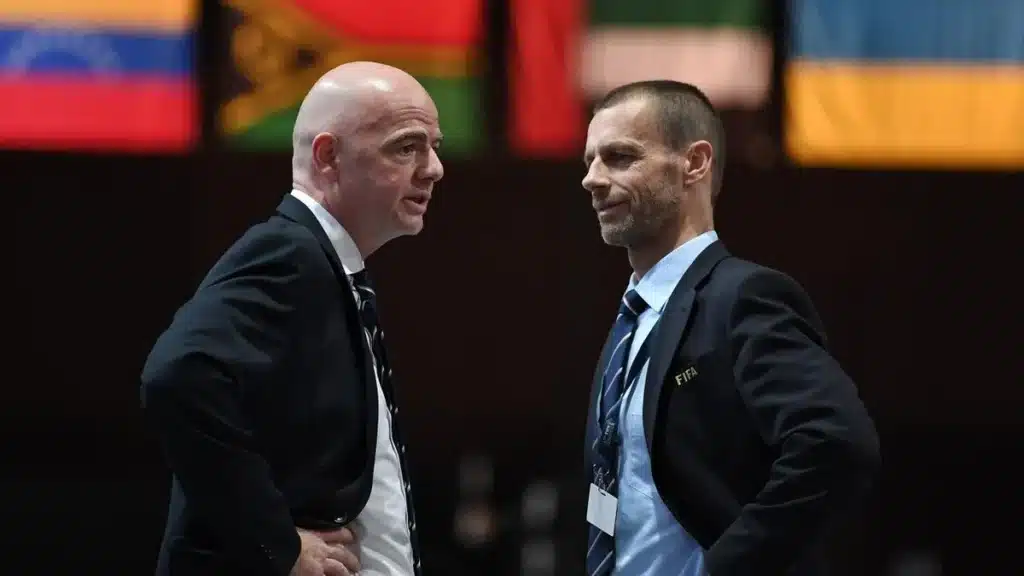
A new disagreement has emerged between football’s two biggest governing bodies after UEFA decided it will not follow FIFA’s controversial interpretation of the Video Assistant Referee protocol used during the 2026 FIFA World Cup.
The debate follows one of the tournament’s most controversial moments, when Switzerland’s Breel Embolo was sent off after a VAR review changed the identity of the player receiving a yellow card. The decision immediately divided referees, coaches and supporters across the football world.
What Happened?
During the World Cup quarterfinal between Argentina and Switzerland, referee João Pinheiro initially cautioned Argentina’s Leandro Paredes for a challenge on Breel Embolo.
Following a VAR review, officials concluded that Embolo had simulated the contact. The yellow card was removed from Paredes and shown to Embolo instead. Because Embolo had already been booked, the second caution resulted in a red card.
Although many believed the final outcome reflected what happened on the pitch, the way VAR reached that outcome immediately raised questions.
Why UEFA Disagrees
According to reports, UEFA believes FIFA has interpreted the new “mistaken identity” provision more broadly than intended by the IFAB protocol. UEFA has instructed its referees to continue applying the VAR protocol more strictly in its own competitions.
UEFA’s position is that VAR should not become a tool for reviewing ordinary first yellow cards except where the protocol explicitly allows it.
This means similar incidents are unlikely to be handled the same way in the Champions League, Europa League or UEFA European Championship.
What Do the IFAB Laws Say?
Earlier this year, IFAB approved changes expanding the VAR protocol. The updated protocol allows reviews for:
- Clearly incorrect second yellow card red cards.
- Mistaken identity where the wrong player receives disciplinary action.
- Competition organisers may also allow reviews of clearly incorrect corner-kick decisions if they can be corrected immediately.
The disagreement is not about whether IFAB changed the protocol. It is about how broadly those changes should be interpreted during matches.
More Than One Disagreement
This is not the first time UEFA has chosen a different approach from FIFA. UEFA has also confirmed it will not automatically adopt FIFA’s application of red cards for players covering their mouths during confrontations or leaving the field in protest where competition options exist.
These decisions highlight that some IFAB-approved changes allow competition organisers to choose how they are implemented.
What This Means for Referees
Referees working FIFA competitions and UEFA competitions may now be required to apply different interpretations of certain Laws and VAR procedures. That places greater importance on competition-specific preparation.
Elite officials regularly receive detailed pre-tournament instructions explaining exactly how particular situations should be managed. While the Laws of the Game remain universal, their application can differ where IFAB has approved optional competition rules.
VAR Verdict
The disagreement is not a rejection of VAR itself. It is a debate over how much influence VAR should have when reviewing disciplinary decisions.
FIFA believes the expanded interpretation helps referees reach the correct outcome. UEFA believes that expanding VAR beyond clearly defined reviewable situations risks creating inconsistency and unnecessary controversy. As football continues to evolve, this debate could shape how VAR is used in major competitions for years to come.

0 Comments
Join the conversation with respect. Comments are moderated and must follow our community rules.
Want to join the discussion?
Please log in or create an account to comment and reply. This keeps the conversation cleaner and safer.