
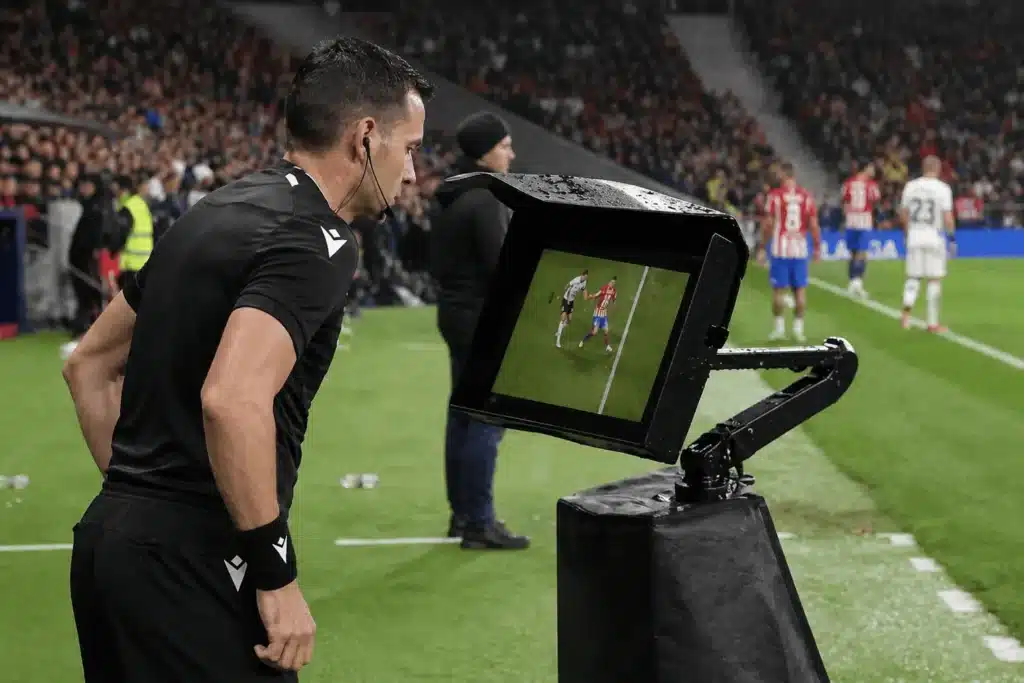
The first qualifying round of the 2026/27 UEFA Champions League ended with late penalties, extra-time drama and one VAR check that lasted almost five minutes. Fourteen clubs advanced to the next stage, but several second legs also produced important talking points for referees and video match officials.
There has been no official confirmation of a major refereeing error from UEFA, but the matches in Kuopio, Dublin, Pristina and Győr showed how quickly one decision can change an entire European tie. This Champions League referee review examines the key incidents, the use of VAR and the performances that attracted the most attention.
Champions League first qualifying round second-leg results
The return matches were played on July 14 and 15. KuPS survived an extraordinary comeback from Vardar, Shamrock Rovers overturned a two-goal first-leg deficit, while Kauno Žalgiris eliminated Drita with a stoppage-time penalty.
| Second leg | Aggregate result |
|---|---|
| KuPS 2-3 Vardar after extra time | KuPS won 4-3 |
| Iberia Tbilisi 2-2 Flora Tallinn | Iberia won 5-4 |
| Inter Escaldes 1-1 Lincoln Red Imps | Lincoln won 4-2 |
| Riga 3-2 Ararat-Armenia | Ararat-Armenia won 4-3 |
| Győri ETO 2-2 Víkingur Reykjavík | Víkingur won 3-2 |
| The New Saints 1-2 Sabah | Sabah won 4-1 |
| Levski Sofia 4-0 Borac | Levski won 5-1 |
| Drita 2-3 Kauno Žalgiris | Kauno Žalgiris won 4-3 |
| Shamrock Rovers 5-1 Floriana | Shamrock Rovers won 5-3 |
| Larne 2-1 Tre Fiori | Larne won 3-1 |
| Universitatea Craiova 1-0 Vitebsk | Craiova won 5-1 |
| Atert Bissen 1-2 Klaksvík | Klaksvík won 4-2 |
| Egnatia 6-1 Petrocub | Egnatia won 7-2 |
| Sutjeska 0-2 Kairat Almaty | Kairat won 4-1 |
The complete results and the next-round fixtures are available through UEFA’s official Champions League qualifying guide.
KuPS vs Vardar: Two penalties in a dramatic extra-time finish
The most demanding refereeing assignment of the round belonged to Scottish official Matthew MacDermid in KuPS against Vardar. The Finnish champions had won the first leg 2-0, but Vardar erased that advantage and forced extra time with a penalty converted by Goran Zakarić in the 90th minute.
Reports from the match state that Gerson Rodrigues went down inside the KuPS penalty area in the 87th minute, with the penalty decision arriving several minutes later. The long sequence contributed to ten minutes of additional time and placed considerable pressure on MacDermid and VAR Kevin Clancy.
The timing of the award does not make the penalty incorrect. A referee must be prepared to give a decisive penalty in the final minute if the offence meets the required standard. However, when a decision takes several minutes, spectators need a clearer understanding of whether the referee is waiting for VAR confirmation, checking an earlier offence or managing a separate incident.
The tie produced another penalty during extra time. After KuPS scored in the 100th minute and Vardar responded two minutes later, Ian Puleio was penalised for handball inside the Vardar area. Piotr Parzyszek converted in the 105th minute to put KuPS ahead on aggregate.
The available match reporting supports the second penalty because the ball was handled inside the area. Without UEFA publishing the footage and technical explanation, it is difficult to assess the precise position of Puleio’s arm, but there is no clear evidence that the decision was an obvious mistake. KuPS progressed 4-3 on aggregate despite losing 3-2 on the night. Flashscore’s match report confirms the two decisive penalty incidents.
The VAR Verdict: Both penalties were potentially match-changing, but neither has been shown to be clearly incorrect. The main concern was the length and visibility of the first decision-making process.
Shamrock Rovers vs Floriana: Five-minute VAR check raises questions
Shamrock Rovers produced the comeback of the round, recovering from a 2-0 first-leg defeat to beat Floriana 5-1 in Dublin. Swedish referee Joakim Sars controlled the match, with Austrian official Alan Kijas operating as VAR.
The most notable refereeing moment came during the first half when Rovers appealed for a penalty. The potential offence was checked for almost five minutes before the match continued without a spot kick. According to RTÉ’s report, the lengthy review ended with the penalty being denied.
A long check is not proof that the final decision was wrong. The VAR may need to examine the original contact, a possible offside position and any offence during the attacking phase. Nevertheless, a five-minute delay is excessive for a decision that does not result in an on-field review or a change to the referee’s original call.
The VAR protocol requires a clear and obvious error before intervention. If the replays did not provide conclusive evidence of a foul, allowing the original no-penalty decision to stand was the correct application of that threshold. The weakness was not necessarily the outcome, but the time required to reach it.
Sars was being observed by former World Cup final referee and current PGMOL chief Howard Webb. That made the assignment particularly significant for the Swedish official’s development at UEFA level.
The VAR Verdict: The no-penalty outcome may have been supportable, but a five-minute silent check damages confidence and interrupts the match unnecessarily. UEFA must continue working to make lengthy reviews faster and easier to understand.
Drita vs Kauno Žalgiris: A 90+3-minute penalty decides the tie
Kauno Žalgiris secured one of the biggest results in the club’s European history by defeating Drita 3-2 in Pristina. The tie was level at 3-3 on aggregate when referee Oğuzhan Çakir awarded the Lithuanian side a penalty in stoppage time.
Amine Benchaib converted in the 93rd minute, giving Kauno Žalgiris a 4-3 aggregate victory. It was the type of decision that demands complete concentration because the penalty effectively decided which club remained in the Champions League.
The fact that the incident occurred in stoppage time should not influence the referee’s threshold. Officials are sometimes accused of avoiding major decisions late in important matches, but the Laws of the Game do not change according to the score, the minute or the consequences.
Çakir was supported by VAR Onur Özütoprak. No public UEFA explanation has yet identified an error in the penalty decision, and there was no reported reversal after the check. Without a detailed technical explanation or released VAR audio, claims that the penalty was automatically controversial because of its timing would be unfair.
The VAR Verdict: A late penalty requires the same evidence as a penalty in the first minute. There is currently no confirmed information showing that Çakir’s decision was incorrect.
Győri ETO vs Víkingur: Card management becomes the major issue
Mateo Erceg’s performance in Győri ETO’s 2-2 draw with Víkingur Reykjavík created a different kind of refereeing discussion. The Croatian official awarded Győr a penalty in the 36th minute and showed eight yellow cards during a match in which the Hungarian side needed to overturn a first-leg deficit.
Three cautions arrived within four minutes before the penalty. Rajmund Tóth was booked for a foul, while Szabolcs Schön and Stefan Vlădoiu were cautioned following arguments. That sequence placed the referee at the centre of the match during an emotionally difficult period.
Cautioning players for clear dissent is completely defensible, particularly when several players surround or challenge the referee. However, the disciplinary threshold must remain consistent. If dissent is punished firmly while tactical fouls or reckless challenges are treated more leniently, players can quickly lose confidence in the referee’s overall line.
The penalty was awarded after Óskar Borgthórsson fouled Tóth inside the area. Milán Vitális converted, and Győr briefly moved ahead before Víkingur equalised in the second half. The Icelandic club advanced 3-2 on aggregate.
The VAR Verdict: The penalty was supported by the recorded match sequence. Erceg’s more difficult challenge was maintaining a consistent disciplinary line in a match containing repeated protests and tactical fouls.
UEFA gives developing referees important assignments
One of the most interesting elements of the first qualifying round was UEFA’s selection of officials. Established English referee Andrew Madley handled Levski Sofia’s 4-0 victory over Borac, but several other matches were assigned to referees still building their experience in major European competition.
The appointments also included senior observers. Howard Webb assessed Joakim Sars in Dublin, while former Portuguese referee Vítor Pereira observed Mateo Erceg in Győr. These appointments suggest that UEFA is using the early qualifying rounds to evaluate officials who could receive more prominent matches later in the season.
Every second leg had a VAR and assistant VAR team appointed. That provided an additional layer of protection in high-pressure ties, but the Shamrock Rovers incident demonstrated that access to technology does not automatically produce a fast or transparent process. The complete list of referee and VAR appointments shows the scale of UEFA’s officiating operation across the 14 matches.
Overall Champions League referee review
The first qualifying round did not produce a confirmed refereeing scandal, but it offered several useful lessons. MacDermid faced the greatest pressure in Kuopio, Çakir had to make a tie-deciding stoppage-time call in Pristina, and Sars was involved in the longest and least transparent VAR check of the round.
The positive conclusion is that major incidents were checked and there is no public evidence of a decisive clear error. The concern is that spectators were often left waiting without knowing what the officials were examining.
UEFA has previously published technical explanations for selected Champions League VAR interventions. Extending that approach to important qualifying incidents would improve transparency, especially when a penalty decides a tie or a review lasts several minutes.
The second qualifying round begins on July 21 and 22, with the return legs scheduled for July 28 and 29. As stronger clubs enter and the financial consequences increase, the pressure on referees and VAR teams will only become greater.

0 Comments
Join the conversation with respect. Comments are moderated and must follow our community rules.
Want to join the discussion?
Please log in or create an account to comment and reply. This keeps the conversation cleaner and safer.