
France’s World Cup semi-final defeat to Spain did not end quietly. After the 2-0 loss, Didier Deschamps questioned the level of referee Iván Barton, especially after a first-half penalty helped Spain take control of the match. His comments immediately turned the officiating into one of the biggest talking points of the semi-final.
Deschamps did not blame the referee alone. He admitted Spain were stronger and that France were not good enough on the night. But he still asked whether Barton was at the level required to referee a World Cup semi-final, pointing to several situations he felt were handled poorly. That has created an important question for supporters and refereeing observers. Was the criticism fair, or did Barton make the right decisions in a difficult match?
The answer is that Barton’s overall performance was better than the reaction suggests. The penalty for Spain was supportable under Law 12, the overturned France free kick was not a VAR intervention, and most of the key decisions can be explained clearly within the Laws of the Game.
What did Didier Deschamps say about the referee?
After the match, Deschamps questioned whether Iván Barton had been at the required level for a World Cup semi-final. His strongest frustration appeared to be around the penalty awarded to Spain after Lucas Digne caught Lamine Yamal inside the area. Deschamps also mentioned that there were several situations during the match, not only the penalty, although he did not give a full incident-by-incident breakdown. France players also showed frustration, with some feeling that key moments went against them.
It is important to separate emotion from analysis. France had just lost a World Cup semi-final, so frustration was natural. But a disappointed reaction does not automatically mean the referee was wrong. The key is to look at each major decision through the Laws of the Game and the VAR protocol.
Was Spain’s penalty the correct decision?
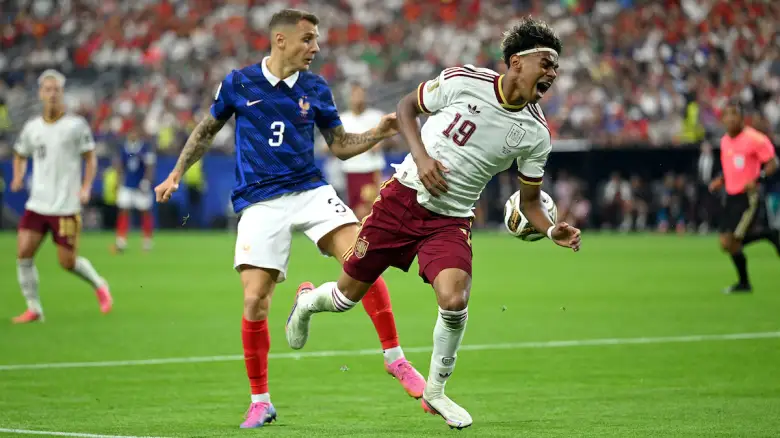
The most important decision came in the first half when Lucas Digne fouled Lamine Yamal inside the penalty area. Yamal reached the ball first, moved it away from danger, and Digne then made contact with him while attempting to clear. Barton awarded the penalty, and Spain scored from the spot.
Under Law 12, a direct free kick or penalty can be awarded when a player trips, kicks, or attempts to kick an opponent in a careless manner. Intent is not required. A defender can try to play the ball and still commit a foul if he arrives late and catches the opponent.
That is why the penalty decision was correct. Digne was late, Yamal got to the ball first, and the contact affected the Spanish attacker. This was not simply shoulder-to-shoulder contact or a normal coming together. It was a late defensive action inside the penalty area.
VAR did not need to rescue the referee here because Barton made the decision on the field. From a refereeing point of view, this was the best outcome. The referee saw the incident, made a clear decision, and the available replays supported it. It was a big call, but big calls are not wrong just because they happen in a semi-final.
Why the penalty looked controversial to France
France’s frustration is understandable because the penalty changed the rhythm of the match. In a World Cup semi-final, an early goal from the spot can shape everything that follows. France had to chase the game, Spain gained confidence, and the match moved in Spain’s direction.
But emotional impact is not the same as refereeing error. The Laws do not change because the match is important. If the same foul happens in midfield, most people accept it as a free kick. When it happens in the penalty area, the decision feels bigger, but the referee must apply the same standard.
This is where Barton deserves credit. Some referees become hesitant in huge matches and avoid difficult penalty decisions unless the foul is extreme. Barton did not do that. He judged the contact, applied the Law, and gave the penalty.
Was France’s overturned free kick a VAR decision?
Another moment caused confusion when France were initially awarded a free kick near the edge of Spain’s penalty area after Ousmane Dembélé went down. Many fans believed VAR had intervened because the decision was changed after a delay.
But this was not a VAR review. Reports explained that Barton changed the decision after receiving advice from his assistant referee, who had a better view of the incident. The assistant judged that Dembélé had stumbled before meaningful contact from the Spanish player, so the original free kick was cancelled.
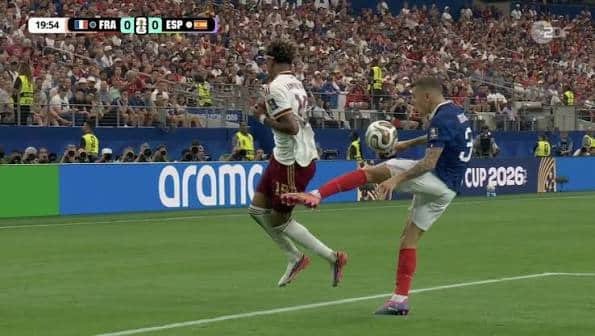
That distinction matters. VAR cannot intervene for a normal free kick unless it is connected to a reviewable situation such as a penalty, red card, goal, or mistaken identity. This was standard teamwork between the referee and assistant referee, not video review.
From a match-officials perspective, changing the decision was acceptable. If the assistant referee had a clearer angle and correctly saw that there was no foul, Barton was right to accept that information. It may have looked messy because the communication was not immediately clear to viewers, but the process itself was valid.
Did Iván Barton control the match well?
Overall, Barton handled a difficult semi-final with authority. The match had pressure, star players, emotional reactions, and huge stakes. Despite that, it did not become chaotic. He allowed physical football when possible, punished clear fouls, and did not let the game turn into constant protests.
There was also an early awkward moment when Barton briefly forgot his vanishing spray before a free kick. That created attention online, but it had no real impact on the match. It was a minor administrative mistake, not a refereeing performance issue.
The important question is whether he got the major football decisions right. On the penalty, he did. On the overturned France free kick, the explanation supports the decision. On general match management, there was no evidence that the game became too big for him.
Did VAR have a major role in France vs Spain?
No. That is one of the key points of this match. Unlike several other World Cup knockout matches, this semi-final was not dominated by long VAR reviews or controversial monitor checks. The main decisions were handled mostly on the field.
That is important because some of the online reaction treated the match as another VAR controversy. In reality, the biggest talking points were classic refereeing decisions. Barton and his assistant referee made the key calls, while VAR remained in the background.
For football, that is usually a positive sign. The best VAR matches are often the ones where the referee makes strong on-field decisions and video review does not need to take over.
Was Deschamps right to criticise the referee?
Deschamps had the right to express frustration, especially after such an important defeat. Managers often feel that key decisions influence momentum, and France clearly believed some calls went against them.
But based on the main incidents, the criticism does not prove that Barton had a poor match. The penalty was a correct and supportable decision. The overturned free kick was not a VAR mistake, but a correction based on assistant referee advice. France’s defeat was more about Spain’s control, France’s lack of rhythm, and Spain’s better execution than about refereeing.
Deschamps himself admitted Spain were better. That is the most important context. Refereeing decisions can be debated, but they should not hide the football story. Spain deserved the win, and Barton’s decisions did not unfairly decide the match.
The VAR Verdict
Iván Barton’s performance in France vs Spain was stronger than the post-match criticism suggests. The penalty awarded to Spain was correct under Law 12 because Lucas Digne arrived late and caught Lamine Yamal after the Spanish attacker played the ball. The overturned France free kick was not VAR interference, but a normal correction after advice from the assistant referee.
There were small moments that could have been communicated better, and France’s frustration is understandable after a World Cup semi-final defeat. But the major decisions were supportable, and Barton did not lose control of the match.
Verdict: Iván Barton made the key decisions correctly. Deschamps’ criticism reflects France’s frustration, but the referee was not the reason France lost.

0 Comments
Join the conversation with respect. Comments are moderated and must follow our community rules.
Want to join the discussion?
Please log in or create an account to comment and reply. This keeps the conversation cleaner and safer.