
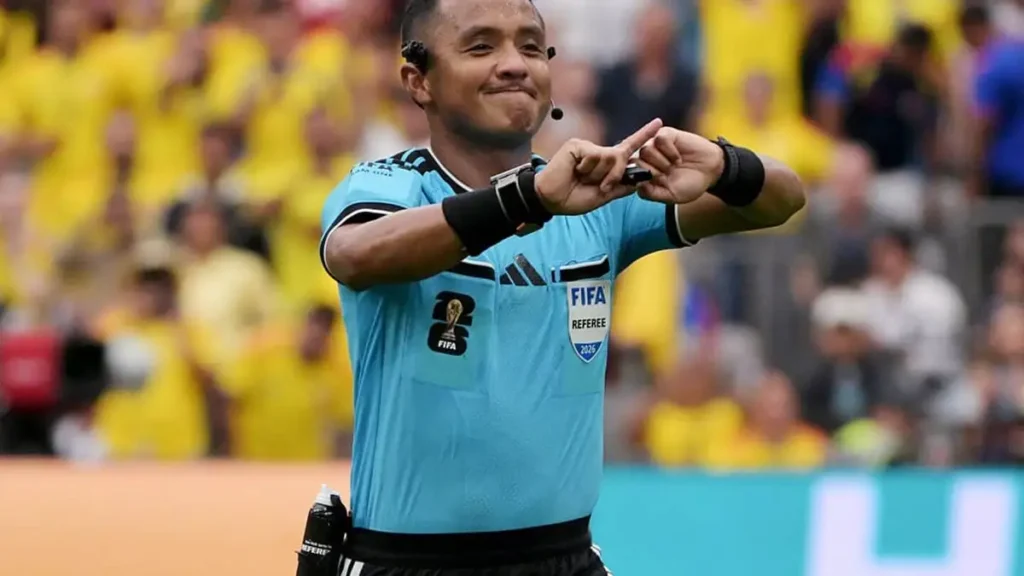
Iván Barton changed decision without VAR during the World Cup semifinal between France and Spain, creating confusion among viewers who believed the video officials had intervened. The referee initially awarded France a free kick but reversed the call before play restarted after receiving information from another member of the on field officiating team.
There was no visit to the referee review area and no formal VAR intervention. Barton was advised through the officials’ communication system, most likely because his assistant referee had a clearer angle of the challenge. The final decision remained Barton’s responsibility, but the procedure was fully permitted under the IFAB Laws of the Game.
Why Iván Barton Changed Decision Without VAR
Under IFAB Law 5, a referee may change a decision after realising it was incorrect or after receiving advice from another match official, provided play has not restarted. This authority is not connected to VAR and existed long before video technology was introduced.
Assistant referees are expected to help with more than offside decisions. They can provide information about fouls, misconduct, incidents outside the referee’s view and challenges where their position offers a better angle. At elite level, the referee, assistants and fourth official communicate throughout the match using headsets.
In this situation, Barton had already stopped play, but the restart had not been taken. That gave him the legal opportunity to reconsider the original call after receiving additional information. Once he accepted that the first decision was incorrect, he was entitled to cancel it and restart the match according to the corrected decision.
Why VAR Could Not Intervene
The incident was not one of the situations covered by the VAR protocol. VAR is generally restricted to goals, penalty incidents, direct red cards and mistaken identity involving disciplinary sanctions. An ordinary free kick decision outside those categories cannot be reviewed simply because the referee may have made a mistake.
This distinction is important because many supporters now associate every delayed or corrected decision with VAR. In reality, on field officials continue to correct decisions through normal teamwork. A referee may pause briefly to listen to an assistant, discuss an incident with the fourth official or confirm what happened before allowing play to resume.
The absence of a monitor review therefore does not mean the decision was changed improperly. It means the correction came from the on field team rather than the video officials.
The Assistant Referee’s Responsibility
An assistant referee should intervene when they have clear and credible information that can help the referee reach the correct decision. They should not attempt to control every foul, but they are expected to communicate when their angle is significantly better or when the referee has missed an important part of the incident.
The referee may be positioned behind the challenge, have players blocking the view or see only the reaction rather than the initial contact. An assistant positioned near the touchline may see whether the defender played the ball, whether the attacker committed the first offence or whether there was no foul at all.
That information can be delivered immediately through the communication system. The referee then decides whether to maintain or change the original call.
Was Barton Right to Reverse the Decision?
From a procedural perspective, Barton acted correctly. The Laws of the Game do not require a referee to protect an original decision once better information becomes available. The priority is to reach the correct outcome before the restart.
Changing a decision should not be interpreted as uncertainty or weakness. Elite referees are encouraged to trust their colleagues when another official has a clearer view. Refusing to correct a decision merely to appear confident would be poor officiating.
The key requirement is timing. Once play has restarted, the referee normally cannot return to an earlier decision simply because new information arrives. Barton completed the communication before the restart, so the correction remained lawful.
Why Viewers Thought VAR Was Involved
The delay looked similar to a silent VAR check, which explains the confusion. Television audiences often cannot hear the communication between the referee and assistant referees, while broadcasters may not immediately explain which official provided the information.
Modern matches also include frequent silent VAR checks that occur without the referee going to the monitor. However, a silent check does not allow VAR to correct every decision. The incident must still fall within one of the protocol’s reviewable categories.
In France against Spain, the change was best understood as normal on field cooperation rather than a VAR decision.
What the Incident Shows About Modern Refereeing
VAR has changed football, but it has not replaced teamwork between match officials. Assistant referees remain responsible for helping the referee make decisions in real time, while the fourth official can also provide information about incidents near the technical areas or outside the referee’s immediate view.
The best refereeing teams use all available angles without creating unnecessary delays. When an assistant has clear information and communicates quickly, an incorrect call can be corrected before VAR becomes relevant.
That is exactly how the officiating system is designed to work.
VAR Verdict
Iván Barton changed decision without VAR legally and correctly because play had not restarted and another match official provided additional information. The incident was not reviewable under the VAR protocol, but that did not prevent the on field referee team from correcting the original call.
Decision: Correct procedure.
Relevant law: IFAB Law 5.
VAR involvement: None.
Final assessment: Strong teamwork and an appropriate correction before the restart. Barton’s willingness to use information from his assistant helped the officials reach the correct outcome without an unnecessary video review.

0 Comments
Join the conversation with respect. Comments are moderated and must follow our community rules.
Want to join the discussion?
Please log in or create an account to comment and reply. This keeps the conversation cleaner and safer.