

The Mbappe penalty retake controversy has become one of the biggest refereeing talking points from Real Betis’ 1-0 win over Real Madrid. Álvaro Valles saved Mbappé’s stoppage-time penalty, but Marc Bartra then became involved in the rebound after appearing to move into the penalty area before the kick was taken.
Spanish reports on Saturday say the Comité Técnico de Árbitros, the CTA, believes referee Alejandro Hernández Hernández and VAR Javier Iglesias Villanueva were correct not to order the penalty to be retaken after Álvaro Valles saved Kylian Mbappé’s stoppage-time spot kick.
The controversy centred on Marc Bartra.
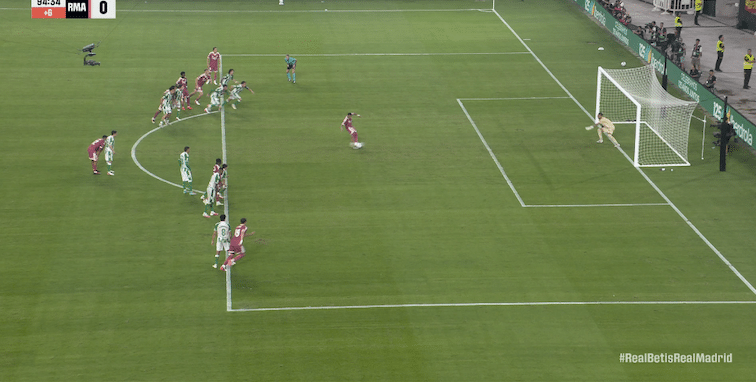
Bartra moved towards the penalty area before Mbappé struck the ball and then became directly involved in the rebound, preventing the Real Madrid forward from getting another clean attempt.
At first sight, that appears to satisfy the classic penalty-encroachment scenario.
But according to reports citing the CTA’s interpretation, Bartra was not considered to have committed an offence because of one very specific detail:
he was still airborne at the exact moment Mbappé kicked the ball.
That explanation has not ended the debate.
In fact, the RFEF’s own 2026/27 referee manual makes the situation even more interesting.
What happened after Mbappé’s penalty?
Real Madrid were awarded a penalty in stoppage time after Natan fouled Vinícius Junior.
Mbappé took the kick.
Valles saved it.
Bartra then reached the rebound and prevented Mbappé from recovering possession, eventually helping Betis clear the danger.
VAR spent several minutes examining whether Bartra had entered the penalty area too early.
Hernández Hernández ultimately did not order a retake.
Real Madrid’s own match report confirms that VAR specifically reviewed Bartra’s position before the kick because he subsequently became involved in the rebound.
What is the CTA’s reported explanation?
AS reports that the CTA considers Bartra’s position legal.
The explanation distinguishes between two situations.
If a player is running naturally towards the penalty area and one foot is still airborne when the kick is taken, the CTA reportedly does not consider that player to have encroached simply because part of his body is already over the line.
However, if a player deliberately jumps forward with both feet off the ground in an attempt to exploit the rule, the projected position of the player can be used and the encroachment can be punished.
According to the reported CTA view, Bartra was in the first category.
He was running forward rather than deliberately jumping with both feet to circumvent the rule.
Therefore:
No encroachment. No retake.
Bartra says he knew about the rule
Perhaps the most remarkable part came after the match.
Bartra revealed that he had previously discussed this exact type of situation with a referee acquaintance.
He explained that he had seen a similar movement in another match and had been told that if his foot remained in the air at the moment the penalty was struck, the kick would not automatically have to be retaken.
Bartra effectively used that information during Mbappé’s penalty.
He also admitted that if Mbappé had waited a fraction longer, Bartra would probably have landed inside the area and the situation would have been different.
That makes the incident particularly interesting from a refereeing perspective.
This was not simply a defender accidentally moving too early.
Bartra was consciously trying to time his movement within his understanding of the rule.
But what does the RFEF’s own manual actually say?
This is where the story becomes complicated.
The RFEF’s official 2026/27 referee manual says that a player is considered to have encroached if, when the penalty is taken, one or both feet are inside the penalty area or on the line.
It also says that body projections are not normally considered when assessing encroachment.
That supports the CTA interpretation reported today.
If Bartra’s planted foot remained outside and his other foot was airborne, there is an argument that he had not yet entered.
But the same official page then provides an additional example.
It says that if a defender jumps into the penalty area before the kick, the player should be projected onto the ground. If that projection falls inside the penalty area and the player subsequently participates in the action, the defender should be considered to have encroached.
And the RFEF’s separate 2026/27 Laws-change page states more generally:
If a player is airborne during a restart, the player’s position is determined by the projected position of the feet if they were touching the ground.
That is why the debate has not disappeared.
The crucial distinction appears to be HOW Bartra became airborne
Based on today’s reporting, the CTA does not appear to apply the projection rule to every natural running stride.
Instead, it distinguishes between:
A player naturally running forward with one foot airborne
and
A player deliberately jumping into the area to avoid technically planting a foot inside before the kick.
The second situation is punished.
The first apparently is not.
That distinction is extremely important because it is not immediately obvious from simply watching the replay.
It also explains why two people can read the RFEF manual and reach different conclusions.
What does IFAB Law 14 say?
The current 2026/27 Law 14 requires all players other than the kicker and goalkeeper to remain outside the penalty area until the ball is kicked.
A defender is penalised for encroachment when that player subsequently plays the rebound or challenges an opponent and prevents the attacking team from scoring, attempting to score or creating a goalscoring opportunity.
That second part clearly applies to the Betis incident if Bartra was considered to have encroached.
Bartra became directly involved in the rebound.
So the real dispute is not whether his involvement mattered.
It did.
The entire controversy comes down to his position at the instant Mbappé struck the penalty.
If Bartra was inside, the penalty had to be retaken
This part is straightforward.
If Bartra is legally considered to have entered the penalty area early, then his later involvement makes the encroachment punishable.
IFAB Law 14 says that when a team-mate of the goalkeeper commits a punishable encroachment offence and the penalty is saved or missed:
the penalty is retaken.
So there are only two possible chains of reasoning:
CTA interpretation
Bartra had not legally entered → no encroachment → rebound involvement allowed → no retake.
Alternative interpretation
Bartra’s projected position was inside → encroachment → Bartra affects rebound → penalty must be retaken.
That is the entire controversy.
Referee experts do not completely agree
The decision is not universally accepted.
Former referee and analyst Iturralde González questioned the outcome during the post-match discussion, while Real Madrid TV has strongly argued that the kick should have been repeated.
Other referee analysis has also argued that the new projected-position guidance means Bartra should have been regarded as inside even though his foot had not yet landed.
So this is not simply a case where social media misunderstood a basic rule.
There is a genuine interpretation question involving the RFEF’s new 2026/27 guidance.
The VAR Verdict: CTA explanation is defensible, but the rule needs clarification
Based on the new information, we would change our preliminary verdict from last night.
We initially believed there was a strong case that the penalty should have been retaken because the new RFEF guidance allows an airborne defender’s position to be projected onto the ground.
The CTA’s reported interpretation now provides an important additional distinction:
natural running movement is apparently treated differently from deliberately jumping forward to exploit the rule.
If that is indeed the CTA’s official interpretation, then the decision not to retake Mbappé’s penalty was correct under Spain’s current refereeing criteria.
However, the written guidance could be clearer.
The same manual says body projections are not normally considered, then gives an airborne-defender example where projection is explicitly used.
For referees, players and supporters, the distinction between a normal running stride and a deliberate jump needs to be explained publicly.
We are still waiting for the official RFEF review
One important caveat remains.
As of Saturday afternoon, the RFEF has not yet published the Matchday 4 edition of Tiempo de Revisión or the official VAR audio from Betis vs Real Madrid.
The latest publicly available programme still covers the previous round.
Therefore, today’s CTA position comes from Spanish media reporting based on explanations attributed to the refereeing committee.
That is significant.
But it is not yet the same thing as the CTA publishing its own complete audiovisual explanation.
When that happens, The VAR Verdict will update this article again.
Quick answer: Why wasn’t Mbappé’s penalty retaken?
Why was Mbappé’s penalty against Betis not retaken?
According to Spanish reports citing the CTA, Marc Bartra was not considered to have legally encroached because he was running forward and his inside foot had not yet landed when Mbappé struck the penalty.
Did Bartra affect the rebound?
Yes. That is not in dispute.
Would the penalty have been retaken if Bartra had encroached?
Yes. Because he subsequently became directly involved in preventing Real Madrid from continuing the rebound.
Why is the decision still controversial?
Because the RFEF’s 2026/27 referee manual also contains a projection rule for airborne players, creating debate over exactly when that rule should apply.
Final VAR Verdict
The information available today changes the analysis.
Our initial interpretation was that Bartra’s projected position could make the penalty a mandatory retake.
The CTA reportedly disagrees.
Its distinction is that Bartra was running naturally with a foot airborne, rather than deliberately jumping into the area to exploit the Laws.
Under that interpretation:
✅ Valles’ penalty save stands
✅ Bartra’s rebound intervention is legal
✅ No penalty retake
But this incident has exposed a genuine ambiguity in how the new 2026/27 guidance is understood.
The CTA now has an excellent opportunity to resolve it publicly.
Show the exact freeze-frame.
Explain Bartra’s foot position.
Explain why the projection rule does or does not apply.
And clarify exactly where the line sits between a normal running stride and a deliberate jump into the penalty area.
Until Tiempo de Revisión or the VAR audio is published, the reported CTA position is clear, but the full official explanation is still pending.

0 Comments
Join the conversation with respect. Comments are moderated and must follow our community rules.
Want to join the discussion?
Please log in or create an account to comment and reply. This keeps the conversation cleaner and safer.