
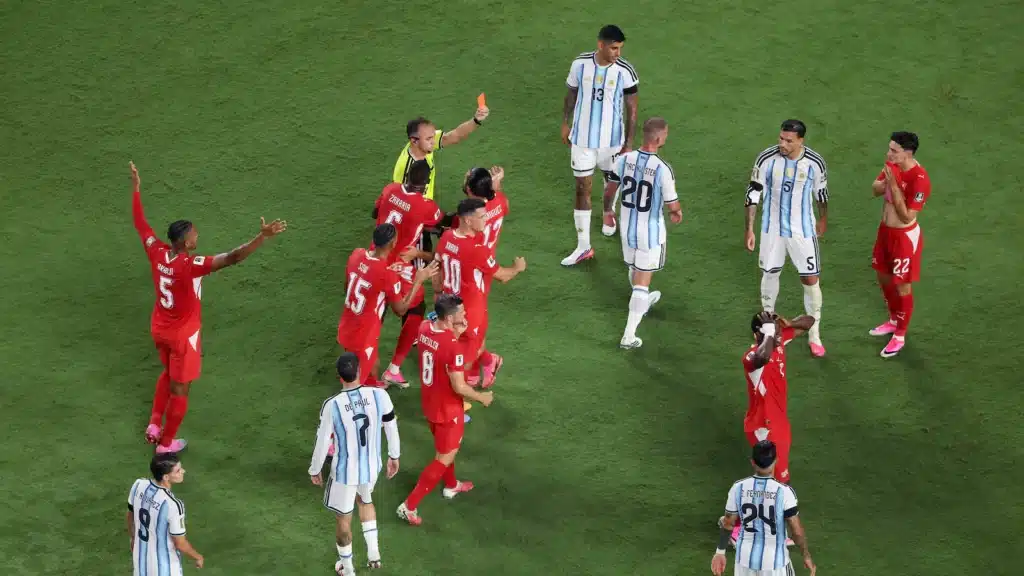
The quarterfinals showed exactly why VAR remains one of football’s most debated technologies. Some interventions corrected important mistakes, while others generated fresh controversy.
France vs Morocco
VAR spent more than three minutes reviewing France’s penalty before confirming Facundo Tello‘s decision. The lengthy delay became one of the biggest talking points of the tournament.
England vs Norway
This match produced two excellent VAR interventions. Norway’s second goal was correctly disallowed after Erling Haaland pushed Elliot Anderson before the ball entered the net. Later, England’s stoppage-time penalty was also correctly overturned after Turpin reviewed the incident.
Argentina vs Switzerland
VAR once again played a decisive role. João Pinheiro reviewed Breel Embolo’s attempt to win a penalty and ultimately issued a second yellow card for simulation. It was one of the boldest refereeing decisions of the knockout stage.
Spain vs Belgium
Unlike the other quarterfinals, VAR stayed almost completely in the background. Michael Oliver’s strong on-field performance meant there was little need for intervention, demonstrating how the system works best when the referee gets the key decisions right.
The VAR Verdict
The quarterfinals highlighted both sides of modern VAR. It corrected important mistakes, but long reviews and subjective decisions continued to divide opinion.
Overall, the technology had a significant impact on the outcome of several matches. As the World Cup moves into the semifinals, every future VAR review will carry even greater importance.

0 Comments
Join the conversation with respect. Comments are moderated and must follow our community rules.
Want to join the discussion?
Please log in or create an account to comment and reply. This keeps the conversation cleaner and safer.