
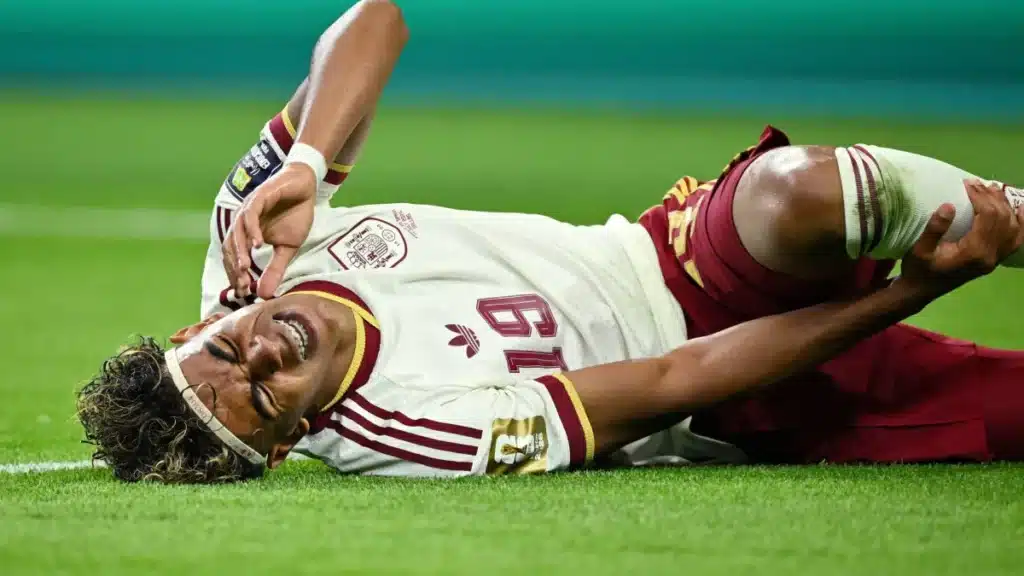
The Spain penalty against France became the first major refereeing incident of the 2026 FIFA World Cup semifinal when Lucas Digne caught Lamine Yamal while attempting to clear the ball inside the French penalty area.
Referee Iván Barton immediately pointed to the penalty spot. Following the standard VAR check, the decision stood, and Mikel Oyarzabal converted the penalty in the 22nd minute to give Spain the lead.
From a refereeing perspective, the penalty was the correct decision.
What Happened in the France vs Spain Penalty Incident?
The incident developed when the ball dropped inside France’s penalty area and Digne attempted to clear it.
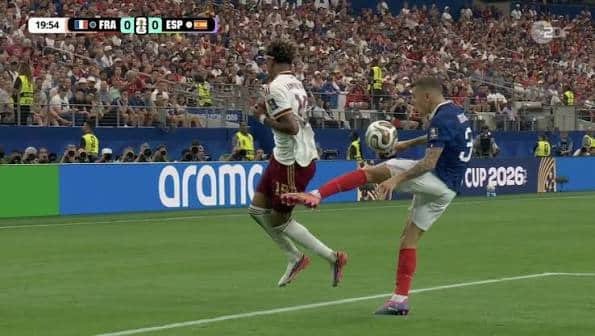
The French defender appeared focused on the ball and did not recognise that Yamal was challenging from behind him. As Digne raised his leg to play the ball, he missed the clearance and made clear contact with Yamal’s thigh.
Yamal had positioned himself close enough to challenge for the ball and was entitled to compete for possession. Digne’s lack of awareness did not remove his responsibility for the contact.
The referee recognised the offence immediately and awarded Spain a penalty. Reports from the match described Digne as losing sight of Yamal before catching the Spanish forward during the attempted clearance.
Why the Spain Penalty Against France Was Correct
The relevant section is IFAB Law 12, which states that a direct free kick is awarded when a player carelessly, recklessly or with excessive force kicks, trips or challenges an opponent.
When one of those offences occurs inside the defending team’s penalty area, the restart becomes a penalty kick.
Digne did not need to intend to foul Yamal. Intent is not required for a careless kicking offence.
The referee only needed to determine whether Digne’s attempt to play the ball resulted in illegal contact with his opponent.
In this case, the key facts were clear:
Digne did not make effective contact with the ball.
His raised leg made contact with Yamal.
The contact occurred inside France’s penalty area.
The contact prevented Yamal from continuing to challenge for possession.
Those elements support a penalty under Law 12.
Does Digne’s Lack of Awareness Matter?
No.
Defenders often argue that they did not see the attacker or that they were only attempting to clear the ball. Neither explanation automatically removes the offence.
Players remain responsible for the way they challenge for the ball.
A defender who swings a leg without recognising an opponent’s position can still commit a careless foul. The action does not have to be deliberate.
Digne’s challenge was best classified as careless because he failed to show the necessary attention when attempting to play the ball.
A careless challenge results in a direct free kick or penalty but does not require a disciplinary card.
That is why awarding the penalty without necessarily cautioning Digne was a defensible application of the Laws.
Was Yamal Entitled to Challenge for the Ball?
Yes.
Yamal did not have to wait for Digne to complete his attempted clearance.
The Spanish forward was entitled to move toward the ball and compete for possession, provided he did not foul the defender first.
The fact that Digne had his back to Yamal does not give the defender exclusive ownership of the space.
Once Digne missed the ball and kicked his opponent, the referee had a clear basis for the penalty.
Was There a Handball by Lamine Yamal Before the Foul?
This became the most important secondary question after replays appeared to show the ball close to Yamal’s arm before Digne made contact.
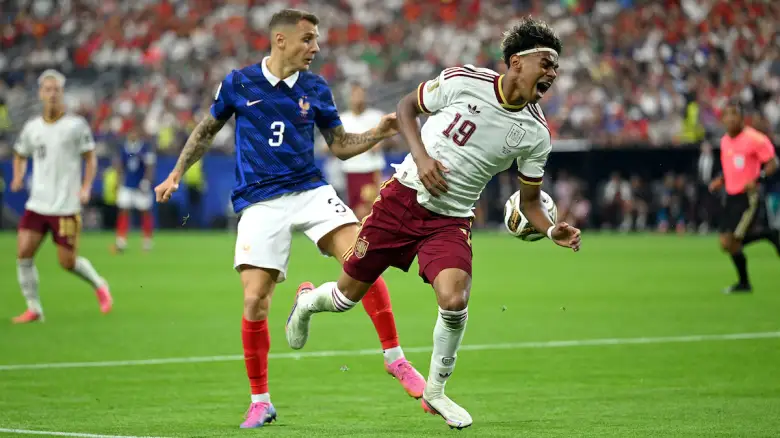
Some viewers argued that a possible handball should have cancelled the penalty. Match coverage noted that the incident was examined because of uncertainty over whether Yamal had used his arm while controlling the ball.
However, contact between the ball and an arm is not automatically a handball offence.
Under Law 12, the referee must consider whether the player deliberately handled the ball or made the body unnaturally bigger with the position of the arm.
There is also an important distinction between an accidental attacking handball immediately before a goal and accidental arm contact before a player wins a penalty.
The strict provision that disallows a goal when the scorer accidentally handles the ball immediately beforehand does not mean every accidental touch by an attacker must cancel a penalty incident.
To overturn the penalty, VAR would need clear evidence that Yamal had committed a punishable handball offence before Digne’s challenge.
The officials evidently did not find that threshold. The reported review concluded that the arm contact was not sufficient to invalidate the penalty.
Why VAR Did Not Send Barton to the Monitor
VAR checks every penalty decision.
An on-field review is not automatically required just because an incident is important or controversial.
The video officials only recommend a review when they identify a possible clear and obvious error in the referee’s decision or a serious missed incident.
In this case, the replay supported the central facts of the on-field decision. Digne attempted to clear the ball, missed it and made contact with Yamal inside the area.
VAR also had to examine the possible handball in the attacking phase. Once the video officials concluded that there was no clear punishable handball and no clear error in the foul decision, the correct procedure was to complete the check without sending Barton to the monitor.
The absence of an on-field review does not mean VAR ignored the incident. It means the video officials found no clear basis to overturn the referee.
Should Lucas Digne Have Received a Yellow Card?
Not necessarily.
A foul and a yellow card are separate decisions.
If Barton considered the challenge careless, the penalty alone was sufficient.
A yellow card would be required if the action were reckless, stopped a promising attack under the relevant disciplinary criteria or involved another cautionable element.
Although Digne’s foot was raised, the available description of the incident supports a mistimed and careless attempt to clear rather than a reckless challenge made with disregard for Yamal’s safety.
The penalty was therefore required, but a caution was not automatic.
Did Yamal Put Himself in Danger?
An attacker challenging for a loose ball does not automatically become responsible for being kicked.
Yamal’s movement was a normal attempt to reach the ball.
The responsibility remained with Digne to complete his clearance without illegally contacting the opponent.
It would only become an offence by Yamal if he challenged carelessly, recklessly, used a raised boot dangerously or otherwise infringed against Digne first. The available replays and match reports did not establish such an offence.
Iván Barton’s Refereeing Process
Barton’s handling of the incident was strong.
He identified the contact in real time and made an immediate decision rather than delaying unnecessarily.
The VAR team then checked both the foul and the possible attacking handball.
The on-field decision was maintained because the available evidence did not show a clear and obvious error.
This is how the referee and VAR relationship is supposed to operate.
The referee makes the initial decision.
VAR checks the footage.
VAR intervenes only when the decision is clearly wrong.
In this case, the system supported a correct on-field call rather than replacing the referee’s judgement.
Why the Decision Looked More Controversial in Slow Motion
Slow-motion footage can sometimes exaggerate contact or make a natural football action appear more deliberate.
The correct approach is to consider the incident at normal speed as well as through the most useful replay angles.
At normal speed, Digne’s action was clearly an attempted clearance. It was not a deliberate kick at Yamal.
However, normal speed also showed that the defender arrived incorrectly, failed to play the ball and caught the opponent.
That combination points to a careless foul rather than no offence.
The fact that the foul was accidental does not make the penalty incorrect.
VAR Verdict
The Spain penalty against France was correctly awarded.
Lucas Digne attempted to clear the ball but failed to play it cleanly and kicked Lamine Yamal inside the penalty area.
Under IFAB Law 12, that is a direct free kick offence committed inside the box and therefore a penalty.
The possible contact between the ball and Yamal’s arm was worth checking, but the footage did not establish a clear punishable handball that required the on-field decision to be overturned.
VAR was therefore correct to complete its check without recommending an on-field review.
Decision: Correct penalty to Spain.
Law applied: IFAB Law 12, careless kicking or challenging offence.
VAR intervention: Not required because there was no clear and obvious error.
Disciplinary action: No yellow card was necessarily required if the challenge was judged careless rather than reckless.
Incident rating: 9/10 for Iván Barton and the VAR team.
The officials identified the foul correctly, checked the possible handball and reached a decision fully supportable under the Laws of the Game.

0 Comments
Join the conversation with respect. Comments are moderated and must follow our community rules.
Want to join the discussion?
Please log in or create an account to comment and reply. This keeps the conversation cleaner and safer.