
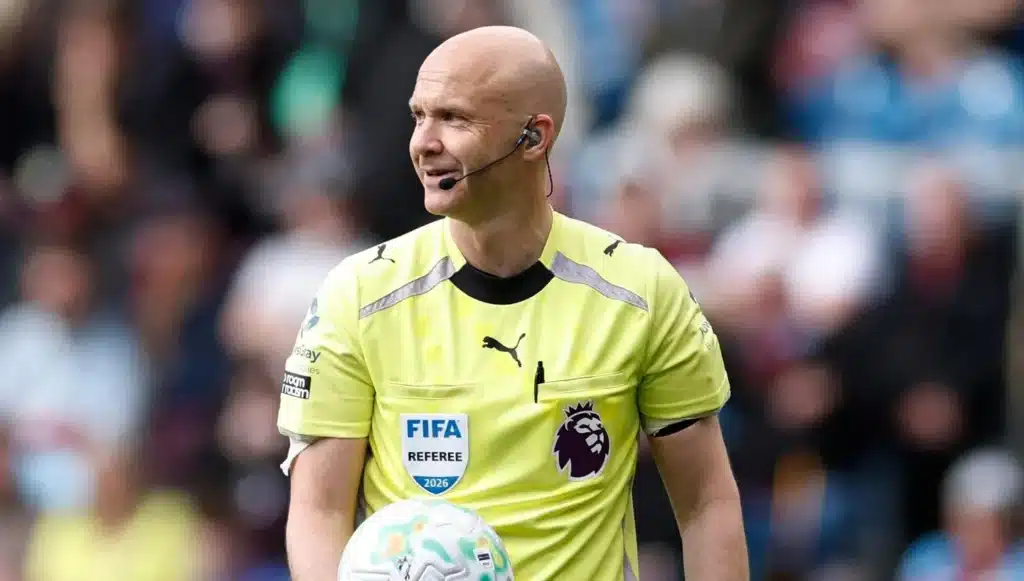
Anthony Taylor has retired from elite refereeing, ending one of the longest and most significant officiating careers in modern English football.
The 47-year-old stepped away after more than two decades and 831 matches. His final appointment was the World Cup round-of-16 meeting between Portugal and Spain, bringing his career to an end on one of football’s biggest stages.
Taylor’s departure leaves the Premier League with more than an empty place on its referee list. It removes one of the small group of officials regularly trusted with title races, major rivalries, domestic finals and high-pressure European fixtures.
There is no formal position called “the Premier League’s number one referee,” and Pro Ref does not appoint officials according to a published hierarchy. Nevertheless, every competition develops a group of senior referees who are repeatedly considered for its most difficult matches.
Taylor was unquestionably part of that group.
Michael Oliver now appears to be the most established senior official in English football. Behind him, Chris Kavanagh, Darren England, Sam Barrott and Jarred Gillett each offer different qualities and different levels of experience.
The question is not simply who will inherit Taylor’s fixtures. It is whether English refereeing has enough depth to replace his influence without becoming too dependent on one remaining senior official.
Why Anthony Taylor’s retirement matters
Taylor refereed 668 matches in English professional football, including 432 Premier League fixtures across 16 seasons. He also took charge of every major English domestic showpiece, including the 2015 League Cup final, the 2015 Community Shield, the 2017 and 2020 FA Cup finals and the 2018 Championship play-off final.
His international career was equally substantial. Taylor spent 14 years on the FIFA International List and handled 163 international appointments. He worked at the 2022 and 2026 World Cups, EURO 2020 and EURO 2024, as well as the 2020 UEFA Super Cup, the 2021 Nations League final, the 2022 Club World Cup final and the 2023 Europa League final.
Those numbers matter because elite refereeing experience cannot be created quickly.
A referee can understand the Laws of the Game, pass every fitness test and perform strongly in ordinary Premier League matches, but controlling a title decider or a major derby requires another level of emotional management.
The official must handle:
- Constant player pressure
- Technical-area confrontation
- Tactical fouls
- Mass appeals
- Major penalty decisions
- VAR interventions
- International media scrutiny
- The final stages of a match when every decision carries greater weight
Taylor accumulated that experience over hundreds of appointments. His replacement will not be found by simply promoting one referee and giving him the same number of high-profile matches.
Why Anthony Taylor decided to retire
Taylor said that working at the elite level had been an immense privilege, but also referred to the intense pressure and constant scrutiny faced by top referees.
That scrutiny has become a defining feature of modern officiating. Every major decision is examined from numerous angles, repeated in slow motion and debated by supporters, former players and broadcasters within seconds.
Taylor experienced criticism throughout his career, sometimes fairly and sometimes excessively. Like every long-serving referee, he made mistakes. He also continued to receive major domestic, UEFA and FIFA appointments because refereeing organisations trusted his physical level, decision-making and ability to manage high-pressure matches.
Howard Webb described Taylor as one of English football’s most successful officials and highlighted not only his on-field work but also his professionalism and support for younger referees.
That final point is important. Taylor’s retirement affects more than match appointments. The Premier League is also losing an experienced figure from its internal refereeing environment.
Is there an official Anthony Taylor replacement?
No referee will be officially announced as the Anthony Taylor replacement.
Pro Ref’s appointment policy states that officiating teams are selected at the discretion of the relevant management group, with oversight from the Chief Refereeing Officer. Appointments consider practical, operational and performance factors, while conflicts of interest can also make particular officials ineligible for certain matches.
Referee performance is also assessed through a Key Match Incidents panel that reviews major on-field and VAR decisions. The panel includes former players and coaches, as well as representatives from the Premier League and Pro Ref.
This means the referee who receives the biggest matches will not necessarily be the person with the highest public profile. Appointments should reflect current performance, availability, experience, team conflicts and the specific demands of each fixture.
However, patterns still develop. The official repeatedly appointed to title races, major derbies and late-stage cup matches naturally becomes viewed as the leading domestic referee.
After Taylor’s retirement, five names stand out.
The leading candidates after Anthony Taylor
| Referee | Strongest quality | Main question for 2026/27 |
|---|---|---|
| Michael Oliver | Elite domestic and international experience | Can England avoid relying too heavily on him? |
| Chris Kavanagh | Consistent major-match profile | Can he become the long-term all-purpose leader? |
| Darren England | Strong domestic trust | Can he build on his FA Cup final appointment? |
| Sam Barrott | Greatest upward momentum | Is he ready for regular elite fixtures? |
| Jarred Gillett | On-field and VAR expertise | Will his influence be greater in the middle or video room? |
Michael Oliver: the immediate senior figure
Michael Oliver is the clearest answer if the question is who currently stands at the top of the English refereeing hierarchy.
Oliver already had extensive Premier League and Champions League experience before Taylor retired. During the 2025/26 season, he continued to receive important domestic appointments and worked major UEFA fixtures, including Real Madrid against Bayern Munich.
His strengths are well established. Oliver generally has a calm physical presence, strong movement and the confidence to make major decisions without appearing overwhelmed by the occasion.
He also understands the rhythm of elite matches. Top referees cannot punish every contact or allow every physical challenge. They must recognise when intervention is necessary and when allowing play to continue benefits the match.
For the beginning of 2026/27, Oliver is therefore the most logical senior referee for the Premier League’s biggest fixtures.
However, that creates a separate problem.
Pro Ref cannot simply transfer Taylor’s most difficult appointments to Oliver. International commitments, declared conflicts, physical workload and previous appointments all restrict how often one referee can be used.
English football needs a deeper leadership group, not only a single leading name.
The VAR Verdict assessment
Current position: Leading senior referee
Oliver is the immediate answer, but he should not have to carry the entire elite schedule. The real test for Pro Ref is whether other officials can move closer to his level of responsibility.
Chris Kavanagh: the strongest long-term candidate
Chris Kavanagh may be the most realistic candidate to become the Premier League’s long-term leading referee.
He was regularly appointed throughout the closing stages of the 2025/26 Premier League campaign and also continued working in the Champions League. That combination of domestic and European exposure is essential for any referee expected to replace Taylor’s influence.
Kavanagh’s strongest performances usually come when his foul recognition is consistent and he establishes a clear disciplinary threshold early. He rarely needs to become the dominant personality in a match, which can be an advantage.
The next step is not simply receiving more fixtures. It is receiving more of the fixtures in which one major decision can define the title race, relegation battle or public discussion for an entire week.
Those matches test more than technical accuracy. They test whether the referee remains calm after a controversial decision and whether the rest of the match continues under control.
The VAR Verdict assessment
Current position: Best long-term candidate
Oliver begins the season as the senior figure, but Kavanagh has the clearest pathway to becoming England’s main all-purpose referee over the next several seasons.
Darren England: trusted with the FA Cup final
Darren England received one of the strongest possible signs of domestic trust when he was appointed to referee the 2026 FA Cup final between Chelsea and Manchester City.
A cup-final appointment does not automatically make someone the country’s leading referee, but it demonstrates that the appointing body believes the official can manage a match with major sporting, commercial and public importance.
England also appeared regularly in Premier League appointments during the closing months of the 2025/26 season, working both as an on-field referee and within VAR teams.
His dual experience can be valuable. A referee who understands the video operation room should have a clearer awareness of which incidents are likely to produce checks and how communication with the VAR should be managed.
The risk is that versatility can prevent an official from developing a clear identity. To become one of the Premier League’s leading referees, England must be recognised primarily for consistently strong performances in the middle rather than only for his experience in both roles.
The VAR Verdict assessment
Current position: Established domestic contender
The FA Cup final appointment places England firmly in the conversation. A strong 2026/27 campaign could move him closer to the top of the domestic hierarchy.
Sam Barrott: the referee with the greatest momentum
Sam Barrott may be the most interesting name in the discussion.
He received regular Premier League matches during the second half of 2025/26 and has been appointed to referee the 2026 Community Shield between Arsenal and Manchester City.
The Community Shield is not equivalent to an FA Cup or Champions League final, but it is a highly visible season-opening appointment involving two leading clubs. It gives Barrott an opportunity to begin 2026/27 under immediate scrutiny.
Barrott’s rise also reflects the direction of English refereeing. Pro Ref wants officials to progress more dynamically through its development pathway, with high-performing referees receiving opportunities across the Premier League and Championship.
His challenge will be maintaining the same decision-making standard when the difficulty increases.
A referee may look composed in a relatively controlled match and then face a completely different test in a derby involving tactical fouls, repeated dissent and several penalty-area incidents.
The leading officials are not those who never experience controversy. They are those who recover properly when controversy arrives.
The VAR Verdict assessment
Current position: Highest-potential rising referee
Barrott should not be rushed into every major fixture, but he has the clearest upward momentum. The 2026/27 season could establish him as a regular member of the Premier League’s leading group.
Jarred Gillett: major influence through VAR and on-field work
Jarred Gillett offers something different from the other candidates.
He combines Premier League refereeing experience with a strong profile as a video official. FIFA selected him for a VAR role at the 2026 World Cup, following previous international video appointments.
Gillett also continued to receive Premier League appointments during 2025/26, both in the middle and as part of VAR teams.
That makes him one of the most technologically experienced officials in the English system.
However, replacing Taylor’s influence requires more than VAR expertise. The leading Premier League referee must be trusted to control the biggest matches physically and emotionally from the centre of the pitch.
Gillett’s future role may therefore depend on how Pro Ref balances his on-field appointments with his specialist value in the video operation room.
The VAR Verdict assessment
Current position: Influential hybrid official
Gillett may become one of England’s most important officials without necessarily becoming its undisputed leading on-field referee.
What about Craig Pawson and the other experienced officials?
Craig Pawson, Paul Tierney, Stuart Attwell, Andy Madley, Simon Hooper and John Brooks remain significant members of the professional officiating group.
Pawson has considerable major-match experience, while Attwell and Tierney are frequently used in senior VAR roles. Madley, Hooper and Brooks have all handled demanding Premier League fixtures.
They will remain important because Taylor’s appointments cannot be divided only between Oliver and the younger candidates.
The season is too long, the workload is too demanding and the number of potential conflicts is too high.
A successful referee group needs different profiles:
- Senior officials for the largest fixtures
- Reliable referees for consistently difficult league matches
- VAR specialists
- Developing officials gaining controlled exposure
- Experienced fourth officials capable of managing technical areas
The real measure of English refereeing will not be whether one person becomes as recognisable as Anthony Taylor. It will be whether the entire panel becomes more dependable.
The new Pro Ref structure changes the competition
Taylor’s retirement comes at the beginning of a major organisational change.
Professional Game Match Officials has been renamed Professional Game Referees, or Pro Ref. The former Select Group 1, Select Group 2 and supplementary list have been merged into a single Professional Referee Group serving primarily the Premier League and EFL Championship.
The stated purpose is to create greater competition and flexibility, allowing high-performing officials to receive appointments based on readiness rather than being restricted by the old group structure.
In theory, this means Taylor’s retirement does not require a direct one-for-one promotion. Several referees can receive larger opportunities, while an official performing strongly in the Championship can move into Premier League matches more quickly.
That is a sensible approach, but it also creates pressure.
Greater flexibility must not become unpredictable appointment policy. Referees need enough matches at the correct level to develop confidence and consistency. Moving officials between competitions should be based on performance, not simply filling gaps in the schedule.
How will the Premier League be refereed in 2026/27?
The Premier League has confirmed that it will continue using a high threshold for on-field fouls and VAR interventions.
The league’s stated principles include maintaining physicality, reducing unnecessary VAR intervention, improving review speed and taking a stronger approach to time-wasting and disruptive behaviour. Referees will also place greater emphasis on impactful holding, challenges on goalkeepers and simulation.
The league will also introduce VAR reviews for clearly incorrect second yellow cards that result in a dismissal. However, it does not intend to adopt the optional expansion allowing VAR to correct wrongly awarded corners.
These priorities make leadership within the referee group even more important.
When a competition uses a relatively high intervention threshold, the on-field referee must make confident decisions. VAR will not automatically rescue every questionable call.
The most trusted officials will be those who can combine:
- Accurate foul recognition
- Strong positioning
- Consistent disciplinary control
- Effective communication
- Confidence around penalty-area incidents
- Correct use of advantage
- Calm cooperation with VAR
- Resistance to player and crowd pressure
This is where Taylor’s experience will be hardest to replace.
Who should receive the biggest matches?
Based on the current hierarchy, Michael Oliver should begin 2026/27 as the primary senior referee for the Premier League’s most demanding appointments.
Chris Kavanagh should receive more title-race and major rivalry fixtures, allowing Pro Ref to determine whether he can become the long-term leader of the group.
Darren England’s FA Cup final appointment should be followed by further high-level domestic matches. Sam Barrott should continue progressing, but his development must remain measured rather than accelerated simply because Taylor has retired.
Jarred Gillett should remain influential across both on-field and VAR appointments, while officials such as John Brooks, Tom Bramall and Farai Hallam should be given opportunities based on performance.
The key is balance.
Too much caution prevents the next generation from developing. Too much promotion exposes officials before they are ready.
The VAR Verdict opinion
Anthony Taylor cannot be replaced by one referee.
Michael Oliver is the obvious senior figure and should currently be regarded as England’s leading active official. He has the domestic authority and international experience required for the most difficult appointments.
But the Premier League’s long-term future should not depend on Oliver alone.
Chris Kavanagh is our strongest candidate to become the next sustained leader of the group. He has the experience, current appointment profile and European exposure necessary to take the next step.
Sam Barrott is the most exciting development candidate. His Community Shield appointment provides another important test, but he should be judged across a full season rather than one showpiece match.
Darren England deserves serious consideration after receiving the FA Cup final. Jarred Gillett will remain particularly important because modern refereeing increasingly depends on officials who understand both the pitch and the video room.
Our expected 2026/27 hierarchy is therefore:
- Michael Oliver: current senior leader
- Chris Kavanagh: strongest long-term successor
- Darren England: established major domestic contender
- Sam Barrott: fastest-rising candidate
- Jarred Gillett: leading hybrid referee and VAR specialist
This is an editorial assessment, not an official Pro Ref ranking.
Anthony Taylor’s refereeing legacy
Taylor’s career will always produce debate.
Some supporters will remember strong performances in major finals. Others will remember controversial decisions involving their clubs.
That is unavoidable for any referee who works more than 800 professional matches.
The fairest way to assess his legacy is through the level of trust repeatedly placed in him.
Different domestic and international refereeing organisations selected Taylor for World Cups, European Championships, domestic finals and major UEFA matches. Those appointments were made over many years and under different performance structures.
He did not reach that level by avoiding criticism. He reached it by continuing to perform under criticism.
Taylor’s most important legacy may therefore be durability.
Elite referees must remain physically prepared, mentally resilient and technically current while football becomes faster and public analysis becomes more intense.
Taylor managed that for more than two decades.
Final verdict
Anthony Taylor retires after a career that included 831 matches, 432 Premier League appointments and 163 international fixtures.
His departure removes one of England’s most experienced and trusted referees at a time when the professional refereeing structure is being rebuilt.
Michael Oliver is now the obvious senior figure. Chris Kavanagh appears best placed to become the long-term leader, while Darren England, Sam Barrott and Jarred Gillett will all play important roles in the new hierarchy.
But the Premier League should not search for another individual version of Taylor.
It should build a deeper group of referees capable of sharing the most difficult appointments without a significant drop in authority, accuracy or match control.
That will be the real test of Pro Ref’s new structure.
Anthony Taylor’s career is over. The competition to shape the next era of English refereeing has already begun.

0 Comments
Join the conversation with respect. Comments are moderated and must follow our community rules.
Want to join the discussion?
Please log in or create an account to comment and reply. This keeps the conversation cleaner and safer.