
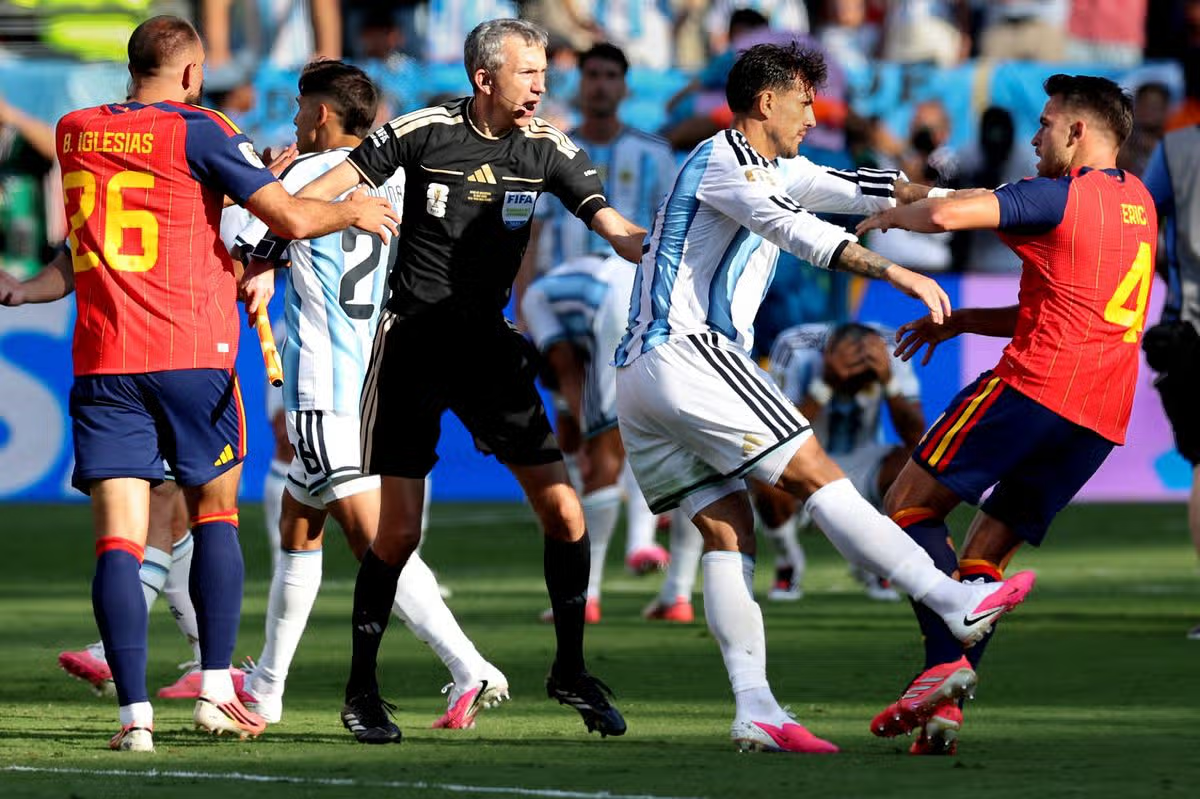
More than 100,000 supporters have signed an online petition demanding that FIFA replay the 2026 World Cup final between Spain and Argentina.
The campaign was launched after Spain defeated Argentina 1-0 in extra time at New York New Jersey Stadium on July 19. Ferran Torres scored the decisive goal in the 106th minute, while Argentina finished the match with ten players following Enzo Fernández’s dismissal near the end of normal time.
The World Cup final replay petition, created by Argentine supporter Gisela Sánchez, had passed 101,000 signatures by July 25. It alleges that Slovenian referee Slavko Vinčić produced a biased performance and asks FIFA to investigate the decisions made during the match.
However, the petition has not provided verified evidence of corruption, bribery or deliberate manipulation. The accusations are based largely on interpretations of match clips circulating on social media. Euronews similarly reported that the organiser had presented no confirmed evidence beyond videos she believed showed decisions favouring Spain.
The campaign has therefore created two separate questions.
The first is whether Vinčić made serious refereeing mistakes.
The second is whether disputed refereeing decisions, even if one or more were wrong, would give FIFA sufficient grounds to invalidate the result and order another World Cup final.
Those are not the same question.
Why are Argentina supporters demanding a replay?
The petition argues that the final was influenced by refereeing decisions rather than decided fairly on the pitch.
The most heavily discussed incident was Enzo Fernández’s dismissal in second-half stoppage time. Fernández had already been cautioned for dissent when he made a late challenge on Spain defender Pau Cubarsí. Vinčić showed a second yellow card and then the red card, leaving Argentina with ten players before extra time began.
Supporters have also questioned the referee’s overall disciplinary threshold, claiming that Spanish players were treated more leniently during confrontations and physical challenges.
However, any fair analysis must examine the match as a whole rather than collecting only decisions that appeared to hurt Argentina.
Contemporary match analysis described Vinčić as using a relatively lenient threshold, particularly during the first half. Alexis Mac Allister could have been cautioned for an early foul on Dani Olmo, while Argentina were repeatedly allowed to disrupt Spain’s passing rhythm through physical challenges. Leandro Paredes was later booked for barging Rodri and was described as fortunate to remain on the field until after the final whistle.
That does not prove every decision was correct. It does show that the claim of one-directional refereeing is difficult to support.
Was Enzo Fernández’s red card correct?
Fernández’s dismissal is the most important decision to examine because it directly changed the numerical balance before extra time.
The first caution was reportedly issued for dissent. The second followed his late challenge on Cubarsí. The referee judged the tackle reckless and therefore deserving of a yellow card. Because Fernández had already been cautioned, the second yellow produced an automatic dismissal.
A reckless challenge is one in which a player acts with disregard for the danger or consequences to an opponent. A yellow card is required.
The significance of the match does not change that standard.
Referees are sometimes accused of “ruining a final” by dismissing a player, but the responsibility does not automatically belong to the official. A player who has already been cautioned must understand that another reckless offence can result in removal from the match.
Based on the available descriptions and footage analysis, the second yellow was supportable.
It was not a direct red card for serious foul play. Vinčić did not decide that Fernández had used excessive force or endangered Cubarsí’s safety to the level required for a straight dismissal. He judged the challenge reckless, issued the corresponding caution and then applied the mandatory consequence of a second yellow.
Former referee Eduardo Iturralde González also assessed the challenge as a yellow-card offence rather than a direct red card. That interpretation supports the sanction Vinčić actually used.
Could VAR have cancelled the second yellow?
Under the 2026/27 VAR protocol, a clearly incorrect second caution that results in a player being sent off can be reviewed.
This is a new and important power. VAR still cannot search for every missed possible yellow card, but it can prevent a player from being dismissed because of a clearly wrongful second caution.
Therefore, Fernández’s dismissal was reviewable if the video officials believed the second yellow was clearly wrong.
There was no intervention to overturn it.
That does not prove the decision was perfect, but it indicates that the VAR team did not identify clear evidence that the challenge failed to meet the yellow-card threshold.
A debatable caution is not enough. The error must be clear.
Did Vinčić show too much leniency earlier in the match?
This is where criticism of the referee is more reasonable.
Vinčić appeared determined to keep the final flowing and avoid an early series of cautions. That can be a sensible approach in an emotional match, but it creates risks.
When referees tolerate repeated physical offences during the opening stages, players begin testing the boundary. Challenges become later, confrontations increase and the official may eventually need to use several cards in a short period to restore control.
Mac Allister’s early challenge on Olmo was identified as a possible missed yellow card. Argentina’s physical approach was allowed to continue close to the limit, while Paredes could also have faced stronger disciplinary action.
This suggests that Vinčić’s largest weakness may have been excessive tolerance rather than bias against Argentina.
A referee can make an error by waiting too long to caution players. But that type of match-management error does not invalidate the result.
It is also difficult to argue that a lenient threshold disadvantaged Argentina when Argentina were among the principal beneficiaries of that leniency.
Should a Spanish player have been sent off?
One allegation concerned Marc Cucurella allegedly covering his mouth while confronting Lionel Messi.
The 2026 World Cup used a new competition provision allowing a player to be sent off for covering the mouth during a confrontation when the action is used to conceal discriminatory behaviour. FIFA and IFAB introduced the measure before the tournament.
However, merely placing a hand near the mouth is not automatically a red card. The action must occur in the relevant confrontational context and be connected to the attempt to conceal discriminatory conduct.
Reports from Spain said television replays did not establish the alleged offence. Iturralde González explained that serious verbal misconduct could have led to a dismissal if it had been detected, but the available footage did not support the accusation being made against Cucurella.
Without verified audio, a reliable match-official report or clear video evidence, it would be irresponsible to claim that Vinčić ignored a mandatory red-card offence.
Was Ferran Torres’ winning goal legal?
Torres scored the decisive goal in extra time after Pedro Porro delivered from the right and Nico Williams won the duel before pulling the ball back.
No reliable post-match report has identified an offside, attacking foul or handball that should have cancelled the goal. The sequence was allowed to stand after the normal VAR checking process, and Spain completed a 1-0 victory.
This is important because a replay argument becomes much weaker when the winning goal itself was legal.
Argentina had been reduced to ten players, but the dismissal was the result of two cautionable offences. Spain did not score through an uncorrected offside or a clearly illegal attacking action.
The final result followed from a valid goal during a match in which Argentina had created very little attacking threat.
Spain recorded 20 shots to Argentina’s two, while Argentina did not produce their first attempt until late in extra time.
Statistics do not settle every refereeing debate, but they challenge the suggestion that the match was decided only by Vinčić.
Is there evidence that Slavko Vinčić was corrupt?
No verified evidence has been presented.
The petition uses extremely serious language, but an allegation does not become credible because many people sign it.
To establish corruption, there would need to be reliable evidence such as:
- Financial records
- Improper communications
- Witness testimony
- A confirmed conflict of interest
- Evidence of deliberate manipulation
- Findings from a formal integrity investigation
Disagreeing with yellow cards, fouls or added time does not prove any of those things.
Both Euronews and subsequent reporting noted that the petition had not substantiated its corruption claims.
There is also an important distinction between three accusations:
- The referee made a mistake.
- The referee performed badly.
- The referee deliberately manipulated the match.
The first two can be assessed through football analysis. The third requires evidence that extends far beyond match footage.
The VAR Verdict does not believe corruption claims should be repeated as fact without that evidence.
Does an online petition have legal authority over FIFA?
No.
A Change.org petition can create media attention and demonstrate public anger, but it is not a formal sporting protest.
The number of signatures does not create a regulatory obligation for FIFA to investigate, invalidate or replay a match. Reporting on the campaign has similarly noted that the petition carries no legal or sporting authority.
A formal challenge would normally need to come from a participating member association through the procedures and deadlines established by the competition regulations.
The Argentine Football Association has not supported the replay demand.
AFA president Claudio Tapia instead said Spain were superior, won fairly and deserved recognition. Argentina coach Lionel Scaloni also rejected suggestions that the referee had determined the result.
That position is highly significant.
The organisation that represented Argentina in the competition is asking supporters to accept the result rather than preparing a formal case to overturn it.
Can FIFA ever order a football match to be replayed?
Yes, but only in exceptional circumstances.
The most important distinction is between:
- A referee making a judgement error
- A referee incorrectly applying the Laws of the Game
A judgement decision could involve whether contact was sufficient for a penalty, whether a challenge was reckless or whether a player had committed handball.
People may disagree with the referee’s interpretation, but the referee is authorised to make that judgement.
A technical error occurs when the referee applies the wrong procedure after deciding what happened.
For example, the referee might award a restart that the Laws do not permit or fail to follow a mandatory process.
That distinction explains one of football’s best-known replay precedents.
The Uzbekistan vs Bahrain replay precedent
In 2005, FIFA invalidated a World Cup qualifying match between Uzbekistan and Bahrain and ordered it to be replayed.
Uzbekistan converted a penalty, but an attacking teammate entered the penalty area too early. Under the Laws applicable to that situation, the penalty should have been retaken.
Instead, the referee awarded an indirect free kick to Bahrain.
FIFA classified that as a technical error because the official had applied the wrong restart under the Laws of the Game. Uzbekistan had also filed a formal protest. The original result was declared void and the match was replayed.
That case is very different from supporters believing that a yellow card was too harsh or that a foul should have been awarded.
FIFA did not order the replay simply because the referee’s judgement was poor. It acted because the referee followed an objectively incorrect legal procedure.
Why ordinary referee mistakes normally do not lead to replays
Law 5 states that the referee’s decisions regarding facts connected with play, including whether a goal is scored and the result of the match, are final.
The referee also cannot change a restart after play has resumed or after signalling the end of the match and leaving the field, except for limited situations defined within the Laws and VAR protocol.
This finality is essential.
If every disputed penalty, red card or handball could produce a replay, thousands of matches would remain legally uncertain after the final whistle.
Almost every losing team could identify a decision it believes was wrong. Television analysis would effectively become another stage of the competition.
Football therefore separates post-match referee assessment from the validity of the result.
A referee can receive a poor internal mark, lose future appointments or be judged to have made a major error without the match being replayed.
When might a replay be possible?
A replay becomes more realistic in circumstances such as:
A match is abandoned
The Laws state that an abandoned match is replayed unless the competition regulations or organisers decide otherwise. If one team caused the abandonment, that team may instead forfeit the match.
The Spain–Argentina final was completed, so this does not apply.
A technical misapplication of the Laws
The Uzbekistan–Bahrain case demonstrates that an objective procedural error can justify invalidating a match.
There is no confirmed evidence that Vinčić applied an incorrect restart or misunderstood a mandatory Law during the final.
An ineligible participant or serious competition breach
A competition organiser may act when a team fields an ineligible player or violates a fundamental tournament rule. That would be an administrative issue rather than a disagreement over refereeing judgement.
No such claim has been established in relation to the final.
Proven manipulation or corruption
If reliable evidence showed that a match had been manipulated, FIFA could investigate and impose major sporting and disciplinary consequences.
No verified evidence of manipulation has been produced in this case.
Could FIFA review Vinčić’s performance without replaying the final?
Yes.
Every elite referee is assessed after a match. FIFA can examine:
- Key match incidents
- Foul recognition
- Disciplinary control
- Positioning
- Advantage
- Communication
- VAR cooperation
- Match management
A FIFA referee committee could conclude that Vinčić missed a caution or managed a confrontation poorly.
That would affect the referee’s assessment and possibly future appointments.
It would not automatically affect Spain’s title.
This is the most likely distinction supporters overlook: reviewing the referee and reopening the match result are separate processes.
What has FIFA said?
FIFA has given no indication that the final result will be reviewed or that a replay is under consideration.
Its confirmed post-final investigation has focused instead on the altercations involving Argentina and Spain players and staff after the final whistle.
FIFA’s official World Cup coverage continues to recognise Spain as the 2026 world champion.
Unless new evidence emerges, the sporting result is final.
Why the petition still matters
The petition is unlikely to produce a replay, but that does not mean it is completely meaningless.
More than 100,000 signatures show that a significant group of supporters remain dissatisfied with the transparency of elite refereeing.
Football authorities often explain controversial incidents poorly. Supporters see a check occurring but hear little about the reasoning behind the final decision.
That information gap allows selective clips, false claims and corruption accusations to spread rapidly.
FIFA could reduce that problem by publishing a technical review of the final’s major decisions or releasing relevant referee and VAR communication.
Transparency would not convince every supporter, but it would allow the debate to focus on the Laws rather than speculation.
The VAR Verdict opinion
The VAR Verdict does not believe there are credible grounds to replay the 2026 World Cup final.
Slavko Vinčić did not produce a flawless performance. His lenient opening threshold created avoidable inconsistency, and some early cautions could have been given sooner.
However, the most decisive disciplinary incident, Enzo Fernández’s dismissal, was supportable under the Laws.
Fernández had already been cautioned and then committed another reckless challenge. Vinčić was required to show the yellow card if he judged the tackle reckless. The fact that it was a World Cup final did not permit him to ignore the offence.
VAR had the authority to correct a clearly incorrect second-yellow dismissal. It did not identify the decision as clearly wrong.
Spain’s winning goal has not been shown to involve an offside, handball or attacking foul. There is also no verified evidence of corruption or deliberate bias.
Most importantly, the complaints relate to referee judgement rather than an objective technical misapplication of the Laws.
That distinction is decisive.
Football matches cannot be replayed every time a large group of supporters disagrees with disciplinary decisions. An online petition is an expression of opinion, not proof that the competition was invalid.
FIFA should still be transparent. Publishing a formal technical explanation of the major incidents would protect both the referee and the credibility of the competition.
But transparency and replay are different remedies.
The correct response to a debatable refereeing performance is analysis and accountability, not automatically cancelling the result.
Final verdict
The World Cup final replay petition has passed 100,000 signatures, but it has almost no realistic chance of forcing FIFA to stage Spain against Argentina again.
FIFA can order a replay in extraordinary circumstances, including an abandoned match or a confirmed technical misapplication of the Laws. The 2005 Uzbekistan–Bahrain case remains the clearest example.
The 2026 final does not currently meet that standard.
The match was completed. Spain’s goal was valid. Fernández’s second yellow was supportable. No verified evidence of corruption has been produced, and the Argentine Football Association itself has accepted the result.
Supporters are entitled to question Vinčić’s performance.
They are not entitled to present an unproven corruption allegation as fact.
Spain remain the 2026 world champions, and unless genuine new evidence emerges, the final will not be replayed.


0 Comments
Join the conversation with respect. Comments are moderated and must follow our community rules.
Want to join the discussion?
Please log in or create an account to comment and reply. This keeps the conversation cleaner and safer.