
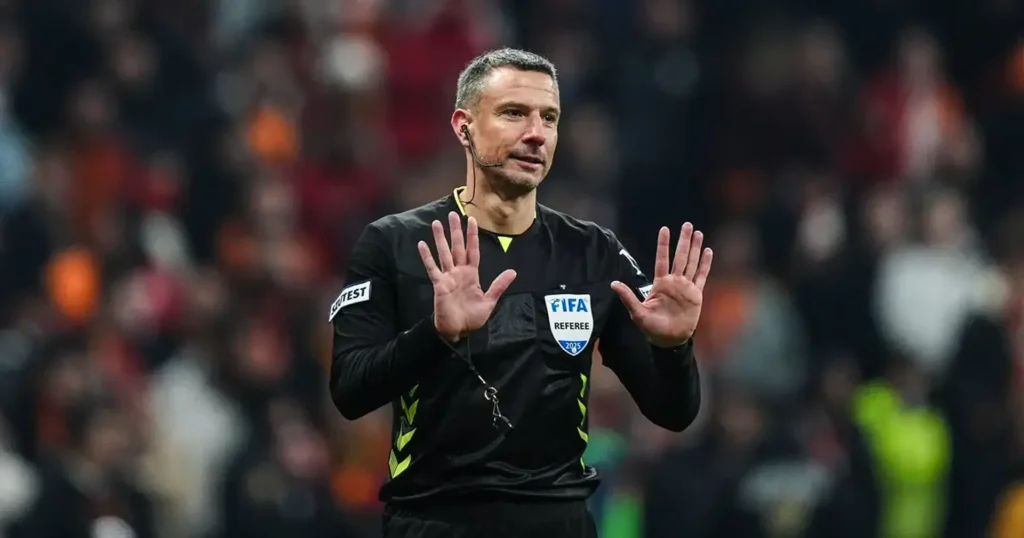
Slavko Vinčić has officially ended his refereeing career only eight days after taking charge of the 2026 FIFA World Cup final between Spain and Argentina.
The Slovenian Football Association confirmed that the 46-year-old had completed his historic career at the highest possible level. Vinčić’s final match was Spain’s 1–0 extra-time victory over Argentina at New York New Jersey Stadium on July 19. He became the first Slovenian referee to control a World Cup final.
The timing of the Slavko Vinčić retirement immediately attracted attention. The final included Enzo Fernández’s dismissal, a series of physical confrontations and a mass altercation after the final whistle that FIFA is now investigating.
However, there is currently no verified evidence that criticism of his performance forced Vinčić to retire.
The official announcement presents the decision as the conclusion of a distinguished career rather than a reaction to the controversy surrounding the final. Vinčić leaves after reaching the biggest appointment available to an international referee and completing 16 seasons at the highest level of European football.
Why did Slavko Vinčić retire?
Neither Vinčić nor the Slovenian Football Association has publicly connected his retirement to the criticism that followed Spain against Argentina.
The federation described him as one of the greatest officials in Slovenian history and emphasised that he had finished his career “at the top of the world.” Reports covering the announcement said the decision had been formally confirmed one week after the final.
At 46, Vinčić was approaching the stage when many elite referees consider retirement. The physical requirements of modern refereeing, regular international travel and the mental pressure created by constant scrutiny make long careers increasingly difficult.
Ending immediately after a World Cup final also offers a rare opportunity to leave at the highest possible point.
Most referees never receive a World Cup appointment. Even fewer control the final. FIFA said Vinčić became only the 23rd referee in history to take charge of the tournament’s decisive match.
Retirement after that achievement can therefore be understood as a planned conclusion rather than an escape from criticism.
The timing will still create speculation
Although there is no evidence that the controversy caused the decision, the timing makes questions unavoidable.
Vinčić’s final match was not a quiet or straightforward contest. Argentina played with a highly physical approach, Fernández was dismissed after receiving a second yellow card in stoppage time, and a confrontation broke out after Spain secured the trophy in extra time. FIFA subsequently appointed a disciplinary and ethics prosecutor to investigate the disorder.
Some supporters criticised Vinčić for allowing too much contact during the early stages. Others believed Argentina players should have received additional cautions before Fernández was eventually dismissed.
The referee was also criticised from the opposite direction, particularly by Argentina supporters who argued that Fernández’s second caution was too severe.
This demonstrates the difficulty of assessing a World Cup final referee. A relatively lenient threshold can allow the game to flow, but it can also encourage players to test the boundaries and make later disciplinary decisions appear inconsistent.
Vinčić’s retirement will inevitably be connected to that debate, but a chronological connection is not proof of cause.
Unless the referee or federation says otherwise, it would be misleading to claim that he retired because of pressure from Argentina supporters, the final replay petition or FIFA’s disciplinary investigation.
How did Vinčić perform in the World Cup final?
Vinčić’s performance was neither the disaster described by some critics nor a completely flawless display.
His principal challenge was managing the physical intensity. Argentina repeatedly disrupted Spain’s possession and transitions, while several confrontations required strong communication and disciplinary control.
The most significant on-field decision came in the 93rd minute. Fernández, who had already been cautioned, made another challenge that Vinčić judged reckless. The second yellow card automatically resulted in a red card, leaving Argentina with ten players before extra time. The dismissal remained in place after the video-officiating process.
The decision was supportable under Law 12. A player who commits another cautionable offence after already being booked must be dismissed. The importance of the match does not give the referee permission to ignore a reckless challenge.
The more reasonable criticism concerns Vinčić’s earlier match management. When an official adopts a high threshold for cautions, players need to understand exactly where the limit lies. If similar actions later produce different sanctions, confidence in the referee’s consistency begins to weaken.
Our assessment is that Vinčić allowed too much during parts of the match but correctly handled the decisive Fernández incident.
Spain’s winning goal was also allowed to stand after the normal checking process, and no confirmed refereeing error has invalidated the result.
Did the World Cup final controversy influence his retirement?
There is no confirmed evidence that it did.
The Slovenian federation’s announcement celebrated Vinčić’s achievements and described the World Cup final as the conclusion of his historic journey. It did not suggest that he was leaving because of criticism, disciplinary pressure or dissatisfaction from FIFA.
FIFA had selected Vinčić for the final because of his performances throughout the tournament. Pierluigi Collina explained before the match that performance was the main factor in the appointment.
That is significant.
FIFA did not choose Vinčić as an inexperienced or experimental option. He was selected after several major tournament performances and years of work at the highest UEFA level.
The post-match investigation also concerns the conduct of players and staff after the final whistle. It is not an announced investigation into Vinčić’s integrity or a review of Spain’s victory.
Claims that he was “forced out” would therefore go beyond the available evidence.
A career built on UEFA’s biggest matches
The World Cup final was the final achievement in a career that already included several of European football’s most prestigious appointments.
Vinčić refereed the 2022 Europa League final between Eintracht Frankfurt and Rangers. Two years later, he was selected for the 2024 Champions League final between Borussia Dortmund and Real Madrid at Wembley. He also worked at EURO 2020, EURO 2024 and the 2022 World Cup in Qatar.
At EURO 2024, he controlled the semi-final between France and Spain. FIFA also selected him for the 2025 Club World Cup before appointing him to the 2026 World Cup.
These appointments show the level of trust Vinčić had earned.
UEFA and FIFA do not select referees for major finals based only on one strong season. Officials are assessed over years through match control, positioning, physical fitness, disciplinary management, communication and cooperation with VAR.
A single controversial match can affect public perception, but it does not erase the body of work that produced repeated elite appointments.
The importance of his Slovenian refereeing team
Vinčić consistently credited assistant referees Tomaž Klančnik and Andraž Kovačič for their role in his success.
Before the World Cup final, he described refereeing as a team effort and said his achievements would not have been possible without them. The pair accompanied him during his biggest international appointments, including the final in New Jersey.
That is an important part of his legacy.
Modern elite refereeing is no longer centred only on the person carrying the whistle. Assistant referees, fourth officials and video officials all contribute to the final decisions.
Vinčić’s career demonstrates how a stable officiating team can progress together through domestic football, UEFA competitions and international tournaments.
His retirement could therefore also mark the end of one of Europe’s most established referee teams.
From Slovenia to the World Cup final
Vinčić’s appointment was historic for Slovenian football.
Slovenia had produced internationally respected referees before him, most notably Damir Skomina, but Vinčić became the country’s first official to referee the World Cup final. FIFA also confirmed that he was the 23rd referee overall to receive the appointment.
That achievement has importance beyond one individual career.
Smaller football nations do not always receive the same number of elite appointments as countries with larger domestic leagues. Reaching a World Cup final requires consistent performances strong enough to overcome those structural differences.
Vinčić’s success gives future Slovenian officials evidence that the highest international level is achievable.
It also places pressure on the Slovenian referee-development system to produce the next generation capable of maintaining that presence in UEFA and FIFA competitions.
Who replaces Vinčić among UEFA’s elite referees?
There will be no direct replacement.
UEFA maintains a group of elite referees and makes appointments based on form, experience, neutrality, fitness and the specific demands of each match.
Vinčić’s retirement nevertheless removes an official trusted with Champions League knockout matches, European finals and international tournaments.
His departure follows another significant retirement, with Anthony Taylor also ending his elite career after the World Cup. The loss of two experienced referees creates opportunities for the next group but also removes hundreds of matches of combined experience.
UEFA will need to continue developing referees who can handle:
- Champions League knockout matches
- European finals
- National-team tournaments
- High-pressure VAR interventions
- Matches involving intense player dissent
- Games with major political and national attention
The next elite official will not be created by one promotion. Experience must be developed gradually through increasingly difficult appointments.
What made Vinčić an elite referee?
Vinčić’s main strengths were calmness, physical positioning and a willingness to manage matches without unnecessary intervention.
At his best, he allowed physical football while maintaining control. He did not normally seek to dominate matches through frequent whistles or theatrical communication.
That approach helped him earn major appointments, but it also created his principal weakness.
A referee who allows a high level of physicality must be extremely consistent. One missed caution can make every later card appear unfair. A lenient threshold can also permit frustration to build until the match becomes more difficult to control.
The World Cup final provided an example of both sides of that style.
The game was not destroyed by constant stoppages, but the referee’s tolerance contributed to a match in which several players pushed the limits and tensions eventually exploded after full-time.
Did Vinčić retire at the right time?
From a career perspective, it is difficult to identify a better moment.
He had already refereed the Champions League final, Europa League final, European Championship knockout matches and two World Cups. His final appointment was the biggest match in international football.
Remaining for another season could have added more Champions League fixtures, but it could not have provided a higher achievement than the World Cup final.
Retiring now also allows Vinčić to leave while still considered an active elite official rather than waiting until declining fitness or fewer appointments gradually moved him out of the leading group.
The controversy will remain part of the discussion because it happened in his final match. But it should not define a career built over more than a decade at international level.
What could Vinčić do next?
The Slovenian federation has not yet detailed a confirmed long-term role for Vinčić.
Experienced former referees commonly move into positions involving referee development, match observation, education, mentoring or administration. That would allow Vinčić to transfer his knowledge to younger officials without continuing the physical demands of elite matches.
His experience would be particularly valuable in areas such as:
- Preparing referees for UEFA appointments
- Managing international pressure
- Building stable referee teams
- Communicating with VAR
- Handling major finals
- Maintaining fitness across long tournaments
Whether he chooses an official role or moves away from refereeing remains to be seen.
The VAR Verdict opinion
Slavko Vinčić’s retirement should not be presented as evidence that he was punished or driven out by the World Cup final controversy.
There is no verified information supporting that conclusion.
His final performance deserves balanced analysis. He allowed excessive physicality at times and could have used cautions earlier to establish clearer control. However, Enzo Fernández’s dismissal was supportable, Spain’s winning goal was valid, and the post-match disorder was primarily the responsibility of the players and staff involved.
Vinčić’s larger career must also be considered.
A referee does not receive the Europa League final, Champions League final, European Championship semi-final and World Cup final by accident. Those appointments reflect repeated confidence from UEFA and FIFA.
He made mistakes, as every referee does. He was also one of the most trusted officials of his generation.
The World Cup final may not have been his strongest performance, but it was an appropriate final chapter for a career that had already reached every major level available to a European referee.
Final verdict
The Slavko Vinčić retirement brings one of modern European refereeing’s most successful careers to an end.
Vinčić retires at 46, eight days after becoming the first Slovenian to referee a World Cup final. His career included the 2022 Europa League final, the 2024 Champions League final, two World Cups and major European Championship appointments.
The timing will continue to generate speculation because the Spain–Argentina final included a dismissal, disciplinary controversy and post-match disorder.
But speculation is not evidence.
Nothing officially released indicates that criticism forced him to stop. The more reasonable conclusion is that Vinčić chose to finish at the highest point possible after achieving the appointment every referee dreams about.
His final match was imperfect.
His career was historic.

0 Comments
Join the conversation with respect. Comments are moderated and must follow our community rules.
Want to join the discussion?
Please log in or create an account to comment and reply. This keeps the conversation cleaner and safer.