
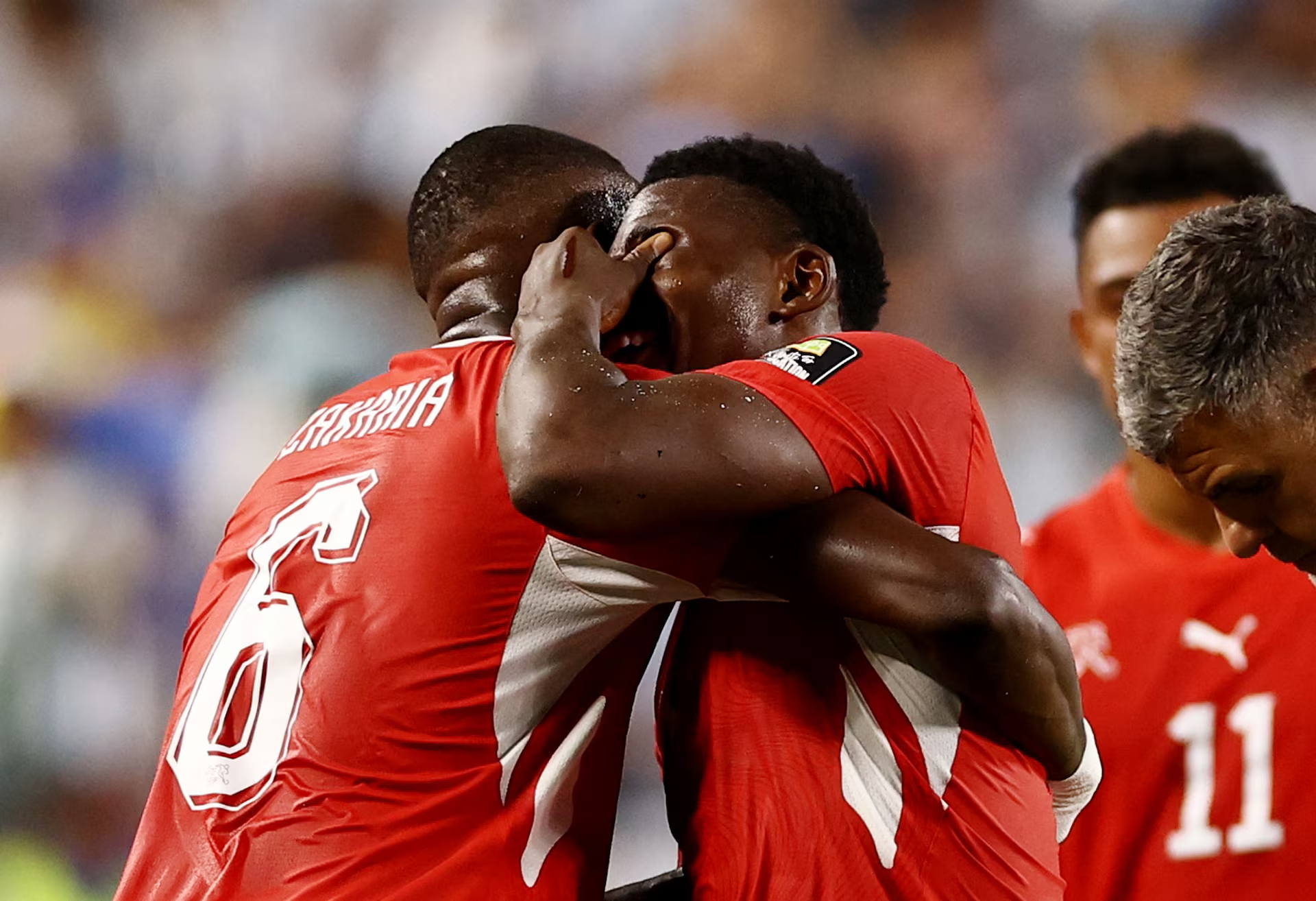
The Breel Embolo VAR error that influenced Switzerland’s World Cup quarter-final defeat to Argentina has now been officially acknowledged by the International Football Association Board.
IFAB, the organisation responsible for football’s Laws of the Game, has confirmed that Embolo should not have been sent off during Switzerland’s 3-1 extra-time defeat. The intervention incorrectly allowed VAR to change the original offence from a foul by Leandro Paredes into simulation by Embolo.
The decision left Switzerland with ten players at a crucial stage of the match and quickly became one of the most controversial refereeing incidents of the 2026 World Cup. IFAB’s clarification now confirms that the VAR team went beyond what the current protocol permits.
What happened during Argentina vs Switzerland?
The incident occurred in the 72nd minute with the score level at 1-1.
Breel Embolo went to ground following a challenge involving Argentina midfielder Leandro Paredes. Portuguese referee João Pinheiro initially decided that Paredes had committed a foul and showed the Argentine player a yellow card.
VAR then intervened under the mistaken identity section of the protocol. After reviewing the footage, the officials concluded that Paredes had not fouled Embolo and that the Swiss forward had instead attempted to deceive the referee.
Paredes’ yellow card was cancelled. Embolo was then shown a yellow card for simulation.
Because Embolo had already been cautioned earlier in the match, the new booking became his second yellow card and resulted in his dismissal. Switzerland were forced to play the remainder of normal time and all of extra time with ten players.
Switzerland had equalised through Dan Ndoye only five minutes before the dismissal and were enjoying their strongest period of the match. They survived until extra time, but Julián Álvarez scored in the 112th minute before Lautaro Martínez completed Argentina’s 3-1 victory nine minutes later.
Why was the Breel Embolo VAR error incorrect?
The central problem was not necessarily whether Embolo’s fall could be considered simulation. The problem was whether VAR had the authority to review and change that particular decision.
Under the mistaken identity rule, VAR may intervene when the referee has correctly identified an offence but has punished the wrong player for committing that same offence.
For example, if two players from the same team are standing close together and the referee cautions the wrong one, VAR can identify the player who actually committed the offence.
However, VAR cannot use mistaken identity to completely replace one offence with another.
In the Embolo incident, the referee’s original decision was that Paredes had fouled Embolo. VAR did not simply identify a different player who had committed that foul. It changed the entire nature and direction of the decision by cancelling the Paredes foul and introducing a separate simulation offence against Embolo.
IFAB’s 2026/27 explanation states that only the identity of the player responsible for the offence can be reviewed under mistaken identity. The offence itself cannot be independently reviewed and changed.
That distinction means the intervention went beyond correcting an identity mistake. It became a complete reassessment of an ordinary yellow-card incident.
Why did Embolo’s second yellow not make it reviewable?
The updated VAR protocol allows officials to review a clearly incorrect second yellow card when that caution directly produces a red card.
However, that rule applies when the referee has already shown a player an incorrect second yellow card. VAR may then recommend cancelling that caution and the resulting dismissal.
It does not allow VAR to search for a missed second-yellow offence that the referee did not originally punish.
IFAB’s official guidance makes this difference clear. VAR may correct a clearly incorrect second caution that has already been shown, but it cannot intervene simply because a player may have committed an unseen offence worthy of another yellow card.
Pinheiro had originally cautioned Paredes, not Embolo. The review therefore could not be justified as correcting an incorrect second yellow shown to the Swiss forward.
Instead, VAR used the mistaken identity provision to create a new caution for Embolo. According to IFAB’s clarification, that use of the protocol was not permitted.
Did IFAB confirm that Embolo did not dive?
No. This is an important distinction.
IFAB’s clarification does not necessarily establish that Embolo was fouled or that his actions could not be interpreted as simulation. It establishes that VAR was not authorised to change the original decision in that manner.
A referee watching the incident live could have decided that Embolo simulated and shown him a yellow card. If that had been Pinheiro’s original decision, Embolo’s dismissal would have followed from an on-field judgement.
But once the referee awarded a foul against Paredes, VAR needed a valid reviewable category before it could intervene. An ordinary first yellow card for a midfield foul is not automatically reviewable.
The Breel Embolo VAR error was therefore primarily a protocol error. VAR may have believed it was correcting an incorrect football decision, but it did so through a review process that the Laws did not currently allow.
IFAB could consider expanding the rule
IFAB has indicated that the use of mistaken identity to punish clear simulation during the World Cup received a positive response in some refereeing circles.
The law-making body will consider the idea as part of its wider review of the VAR protocol. However, IFAB also stressed that officials cannot use the provision in this expanded way until that review is completed and a formal change is approved.
That opens a larger debate about whether VAR should be permitted to punish obvious simulation even when the incident does not involve a goal, penalty or direct red card.
Supporters of a wider protocol may argue that clear diving should not escape punishment when video evidence is available. Critics will respond that allowing VAR to review ordinary yellow-card incidents would create more interruptions and encourage the video officials to re-referee matches.
Whatever decision IFAB eventually makes, the permitted limits must be clearly written and consistently communicated before they are used in major competitions.
How much did the decision affect Switzerland?
It is impossible to prove that Switzerland would have won with eleven players, but the dismissal clearly changed the conditions of the match.
Switzerland had just equalised and were beginning to threaten Argentina regularly. After Embolo’s red card, Murat Yakin’s team had to abandon much of its attacking approach and protect the 1-1 score with ten players.
They managed to reach extra time but were eventually overwhelmed late in the match. Argentina coach Lionel Scaloni later acknowledged that his side had benefited from the circumstances created by the dismissal.
Yakin strongly criticised the decision immediately after the match, arguing that the application of the rule had destroyed Switzerland’s momentum. IFAB’s subsequent clarification supports his central complaint that the intervention should not have taken place.
Could Argentina vs Switzerland be replayed?
IFAB’s admission does not overturn Argentina’s victory or automatically create grounds for a replay.
Law 5 states that decisions connected with play, including the result of a match, are final. A later acknowledgement that a referee or VAR decision was incorrect does not normally change the recorded result.
Argentina’s 3-1 victory therefore remains official.
The clarification is still significant because it changes how similar incidents must be handled in future matches. VAR officials should not use mistaken identity to turn an opponent’s foul into simulation unless IFAB formally expands the protocol.
What the incident means for VAR
The case highlights one of VAR’s biggest continuing problems. Technology may provide a clearer image of what happened, but officials must still have legal authority to review the incident.
A technically accurate interpretation of a replay does not automatically produce a correct VAR intervention.
Every review must pass two separate tests. The officials must identify what happened, and they must determine whether the incident belongs to a reviewable category.
In the Embolo case, the VAR team believed that the referee had punished the wrong side. But instead of correcting the identity of the player responsible for the same offence, the review replaced one offence with another.
That difference may sound technical, but it protects football from VAR becoming involved in every disputed foul, yellow card and possible act of simulation.
The VAR Verdict
Original decision: Yellow card to Leandro Paredes for a foul on Breel Embolo.
VAR intervention: Paredes’ yellow card was cancelled and Embolo was cautioned for simulation.
Final outcome: Embolo received a second yellow card and was sent off.
Correct protocol: VAR should not have changed the original offence through the mistaken identity provision.
Verdict: Incorrect VAR intervention.
The Breel Embolo VAR error does not prove that Argentina would have lost the quarter-final, and it does not erase their victory. It does, however, confirm that Switzerland were reduced to ten players following a review that was not authorised under the current VAR protocol.
IFAB’s admission provides clarity, but it has arrived too late for Embolo and Switzerland. The challenge now is ensuring that experimental interpretations are never applied in a World Cup knockout match before the Laws clearly permit them.

0 Comments
Join the conversation with respect. Comments are moderated and must follow our community rules.
Want to join the discussion?
Please log in or create an account to comment and reply. This keeps the conversation cleaner and safer.