
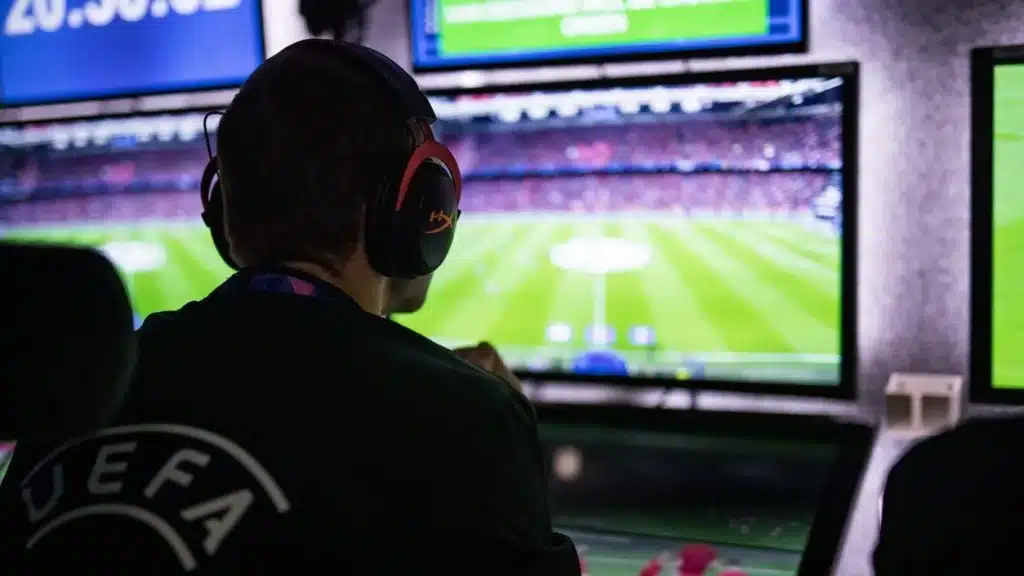
UEFA has announced a significant change in the way VAR should operate across European football during the 2026/27 season, instructing video officials to avoid re-refereeing matches and to intervene only when an on-field decision is clearly and obviously wrong.
The UEFA VAR reset was agreed following a meeting between UEFA’s refereeing leadership and the chief refereeing officers of all 55 European national associations. An IFAB representative also attended the meeting, which focused on achieving greater consistency in how the Laws of the Game are interpreted across domestic leagues and UEFA competitions.
UEFA’s message is direct: the referee must remain at the centre of decision-making, while VAR should act only as support in genuinely clear situations.
The announcement comes at an important moment. The 2026 World Cup produced intense debate over the expanding influence of video officials, the interpretation of mistaken identity, lengthy checks and the risk of VAR replacing one subjective judgement with another.
UEFA did not directly criticise FIFA or identify individual World Cup incidents in its announcement. However, the timing and wording strongly suggest that European football wants a more restrained and clearly defined VAR model before the Champions League, Europa League, Conference League and domestic competitions move deeper into the new season. This is an inference from UEFA’s announcement rather than an accusation made by UEFA itself.
What did UEFA announce?
Chief refereeing officers from every UEFA member association met with UEFA refereeing officials in Nyon to discuss the application of the 2026/27 Laws of the Game.
According to UEFA, the associations unanimously supported a more consistent European approach. The meeting covered new measures intended to reduce delays, improve match flow and clarify when VAR should become involved.
Roberto Rosetti, UEFA’s director of refereeing and chair of the meeting, described the agreement between UEFA and the 55 national associations as a significant step toward greater consistency.
The central objective is to make decisions easier for players, clubs and supporters to understand. UEFA believes the Laws must be applied with greater clarity and fewer unexplained differences between competitions.
The most important VAR instructions were:
- VAR should intervene only for a clear and obvious error or serious missed incident.
- VAR must not re-referee the match.
- Subjective decisions should not be examined microscopically for long periods.
- The on-field referee must remain the main decision-maker.
- The mistaken identity rule must be applied in line with IFAB’s official interpretation.
- Referees and captains should cooperate more closely to improve behaviour and respect.
These are not entirely new principles. They already exist inside the VAR protocol. What is significant is UEFA’s decision to re-emphasise them collectively across all 55 associations before the 2026/27 European season develops further.
UEFA says VAR must not re-referee matches
The strongest line in UEFA’s announcement was its insistence that VAR is not intended to re-referee football matches.
VAR may assist only when the referee has made a blatantly incorrect decision or missed a clear, match-changing incident. The video official is not supposed to search for a marginal reason to replace an on-field judgement that was already reasonable.
This distinction is essential.
Many refereeing decisions are factual. Offside position, whether the ball crossed a boundary line and the location of an offence can often be established through images or technology.
Other decisions remain subjective. These include:
- Whether contact was sufficient for a foul
- Whether a challenge was careless, reckless or excessively forceful
- Whether a handball position was unjustifiable
- Whether an attacker’s action affected a defender
- Whether a defender’s contact clearly caused an opponent to fall
In subjective situations, two experienced referees may reach different but supportable conclusions.
VAR was not created to replace every supportable decision with the video official’s preferred interpretation. Its role is to correct a decision only when the original judgement falls outside the range of reasonable refereeing outcomes.
The UEFA VAR reset is therefore less about introducing an entirely new system and more about returning VAR to its original purpose.
Why lengthy reviews are a warning sign
UEFA also criticised what it described as lengthy, microscopic reviews.
Its position is that when officials require numerous slow-motion angles, repeated frame-by-frame analysis and several minutes of discussion, that often indicates the original decision was not clearly and obviously wrong.
That does not mean every long review automatically produces the wrong outcome. Some incidents are complex, while offside technology or communication problems can cause unavoidable delays.
However, the clear-and-obvious threshold becomes difficult to defend when a VAR needs several minutes to discover the supposed error.
A genuinely clear error should normally become apparent quickly.
For example, if replay footage immediately shows that a defender made no contact with an attacker who was awarded a penalty, intervention is justified.
By contrast, if the VAR must examine six angles to decide whether light contact was enough to cause a fall, the on-field decision may be better left unchanged.
UEFA’s wording sends an important instruction to video officials: do not confuse detailed analysis with proof of a clear mistake.
What “clear and obvious” should mean in 2026/27
The phrase “clear and obvious” has become one of the most controversial parts of VAR.
Supporters often ask how a decision can be clear when a review takes several minutes. Others question why VAR refuses to correct an apparent error simply because the mistake is considered subjective.
UEFA’s new guidance attempts to restore a practical definition.
A decision should be considered clearly wrong when the available evidence demonstrates that the referee’s conclusion was blatantly incorrect, rather than merely debatable.
Examples could include:
- A penalty awarded despite no contact
- A clear foul missed inside the penalty area
- A player sent off after being mistaken for a teammate
- A dangerous challenge incorrectly punished only as a minor offence
- A goal allowed after an obvious attacking handball
- A player clearly onside being incorrectly judged offside
VAR should be much more cautious when the evidence supports several reasonable interpretations.
This approach protects the referee’s authority while still allowing technology to correct major errors.
How the World Cup controversies influenced the debate
UEFA’s announcement does not expressly state that the new direction is a reaction to the World Cup.
Nevertheless, the European meeting followed a tournament in which VAR’s authority, protocol boundaries and increasingly broad interpretations became major subjects of discussion.
One of the central questions was whether VAR should be allowed to correct an outcome that appears unfair when the incident does not fit neatly within an authorised review category.
The wider debate exposed two competing philosophies.
The first says VAR should use available video evidence to reach the fairest possible football decision.
The second says VAR must remain strictly limited because correcting every apparent injustice would turn video officials into the real referees.
UEFA’s announcement clearly leans toward the second philosophy.
The on-field referee remains responsible for subjective decisions. VAR is available to correct unmistakable errors, not to conduct a second full assessment of every important incident.
That does not mean UEFA wants fewer correct decisions. It means UEFA believes correctness must be balanced with authority, consistency and the flow of the game.
UEFA clarifies the mistaken identity rule
Mistaken identity was one of the most sensitive topics discussed at the meeting.
The 2026/27 Laws expanded VAR’s ability to intervene when the referee penalises the wrong team and consequently cautions or dismisses the wrong player. IFAB states that VAR can assist when the wrong player from either team receives the disciplinary sanction.
However, the protocol still contains an important limitation.
VAR may correct the identity of the offender, but it cannot use mistaken identity as unlimited permission to reassess the underlying offence.
IFAB’s updated explanation states that when a referee has clearly misidentified the player responsible, only the offender’s identity can normally be reviewed. The offence itself cannot simply be replaced with another subjective offence unless it independently belongs to a reviewable category.
UEFA said its member associations received instructions that follow IFAB’s clarification exactly.
This is highly significant after recent disputes over whether mistaken identity can be stretched to correct a broader perceived injustice.
UEFA’s position appears to be that officials must follow the written category narrowly rather than creating a more expansive interpretation during matches.
New VAR powers still apply
A more restrained approach does not mean UEFA is removing the VAR changes approved for 2026/27.
The updated Laws allow VAR to assist in three additional circumstances when the evidence is clear:
- A red card resulting from a clearly incorrect second yellow card
- Mistaken identity involving a player from either team
- A clearly incorrect corner-kick award, when the competition adopts the option and the correction can be made immediately without delaying the restart
These changes were approved by IFAB and took effect from July 1, 2026.
Incorrect second yellow cards
VAR can now intervene when a clearly wrong second caution results in a player being sent off.
This is an important expansion because a dismissal after two yellow cards affects a match just as significantly as a direct red card.
However, the rule is not permission for VAR to search for missed second-yellow offences. It allows officials to correct a clearly incorrect dismissal that has already occurred.
Mistaken identity involving either team
The previous wording focused on the referee cautioning the wrong player from the offending team.
The updated protocol can also apply when the referee penalises the wrong team and therefore gives the card to the wrong player.
UEFA’s message is that this provision must be used in accordance with IFAB’s exact explanation rather than expanded through tournament-specific interpretation.
Incorrect corner kicks
Competitions may allow VAR to correct a clearly wrong corner-kick award, but only when the correction is immediate and does not delay the restart.
When the corner is taken quickly, VAR cannot bring play back merely because replay footage later shows that a goal kick should have been awarded.
UEFA has not stated in this announcement that every UEFA competition will necessarily adopt the corner-kick option. The wording confirms the IFAB competition option, but adoption must be communicated separately for individual competitions.
Will Champions League VAR change?
The practical impact should become visible in the Champions League.
Supporters should expect video officials to be more selective with subjective interventions. On-field reviews should be recommended only when the referee’s original decision is clearly unsustainable.
The changes may be most noticeable in:
- Penalty decisions involving limited contact
- Handball judgements
- Red-card challenges
- Fouls during the attacking phase before a goal
- Contact involving goalkeepers
- Possible interference during offside incidents
UEFA’s objective is not necessarily to reduce the total number of interventions by a fixed percentage.
The objective is to improve the quality of interventions and eliminate reviews that exist only because the VAR personally prefers a different decision.
Champions League VAR officials should therefore ask two separate questions:
- Would I have made a different decision?
- Was the referee’s decision clearly and obviously wrong?
Only the second question justifies intervention.
UEFA’s public explanations could become more important
During the 2025/26 Champions League, UEFA published technical explanations for selected VAR incidents.
Those explanations included the reason a penalty was awarded or cancelled, why a goal was disallowed and why a red card was recommended. UEFA said the material was prepared by refereeing experts and intended to improve understanding of significant decisions.
Continuing and expanding that approach would support the new UEFA VAR strategy.
When a review appears inconsistent, supporters need more than the final decision. They need to understand:
- What the referee initially decided
- Which evidence VAR identified
- Why the threshold for intervention was met
- Which Law or protocol category applied
- Why similar-looking incidents may produce different outcomes
UEFA has said that further guidance and initiatives will be communicated in the coming weeks.
Publishing more technical explanations would be one of the strongest ways to turn the new philosophy into greater public confidence.
New measures against time-wasting
VAR was not the only subject of the meeting.
UEFA and its 55 associations also agreed to enforce IFAB’s new measures against deliberate delays more strictly and consistently. The changes cover goal kicks, throw-ins, substitutions and injury stoppages.
Five-second countdowns
When a team deliberately delays a throw-in or goal kick, the referee can begin a visible five-second countdown.
Failure to take a throw-in can result in possession being awarded to the other team. An excessively delayed goal kick can result in a corner for the opposition.
Ten seconds for substitutions
A player being substituted must normally leave the field within ten seconds of the substitution board being displayed or the referee giving the signal.
When the player delays, the substitute may be prevented from entering until the first stoppage after one minute has passed following the restart.
One-minute injury rule
When a player receives assessment or treatment on the field, or causes play to be stopped because of an injury, the player must normally leave and remain off the field for one minute after the restart.
Certain exceptions continue to apply, including some goalkeeper situations and injuries caused by offences punished with cards.
Together, these measures show that UEFA wants referees to protect match flow through clear sporting consequences rather than relying only on added time.
Stronger referee and captain cooperation
UEFA also wants to strengthen the captain-only communication approach introduced at Euro 2024.
The principle encourages the referee to communicate important decisions with team captains while discouraging several players from surrounding the match official.
UEFA said the approach is intended to foster greater respect for referees and improve cooperation on the field.
This could become especially important during VAR delays.
A referee who can explain to the captains what is being reviewed may reduce confusion, confrontation and pressure while the process is ongoing.
However, communication must remain efficient. The captain protocol should not create another lengthy interruption after the VAR review has already finished.
Is UEFA moving away from FIFA’s VAR model?
It is too early to claim that FIFA and UEFA are operating entirely different VAR systems.
Both organisations remain subject to the same Laws of the Game and IFAB protocol. FIFA is also one of the central members of IFAB’s decision-making structure.
However, competition organisers can develop different operational philosophies within the same protocol.
FIFA may favour broader intervention when video evidence can correct an apparent injustice. UEFA’s latest message places stronger emphasis on restraint, the clear-and-obvious threshold and the authority of the referee.
That difference may create visibly different VAR experiences even when the written protocol is the same.
A broad interpretation asks:
Can VAR correct this outcome?
UEFA’s narrower interpretation asks:
Is this unquestionably a reviewable and clearly incorrect decision?
The second approach should produce fewer subjective interventions, although it may also leave some debatable on-field decisions unchanged.
Will fewer interventions improve VAR?
Reducing unnecessary interventions could solve several important problems.
Faster matches
Fewer microscopic checks should reduce delays and uncertainty.
Greater referee authority
Players may be less likely to expect every decision to be changed remotely.
More predictable thresholds
Supporters may begin to understand that VAR will not intervene merely because a decision is controversial.
Fewer marginal reversals
The system should avoid overturning one supportable subjective decision in favour of another.
However, there is also a risk.
When officials become too cautious, clear mistakes may remain uncorrected because the VAR is afraid of being accused of re-refereeing.
The success of the UEFA VAR reset will therefore depend on finding the correct balance. VAR must be restrained without becoming passive.
The best system is not the one with the fewest interventions. It is the one that intervenes in the right incidents.
The VAR Verdict
UEFA’s announcement is a necessary response to growing confusion over VAR’s role.
The technology was introduced to correct major mistakes. Over time, some reviews have become increasingly technical, lengthy and difficult to distinguish from a complete reassessment of the referee’s judgement.
UEFA is now attempting to restore a simpler hierarchy:
The referee makes the decision.
VAR checks the incident.
VAR intervenes only when the decision is clearly wrong.
That philosophy is consistent with the written protocol and should improve match flow when applied correctly.
The most important part of the announcement is not a new review category. It is UEFA’s warning that lengthy, microscopic analysis often indicates that the original decision was not clearly incorrect.
Our verdict: The UEFA VAR reset is the right direction. European football needs faster and more selective reviews, clearer mistaken-identity limits and greater respect for on-field decisions. However, UEFA must support the new approach with public explanations and consistent examples, or the phrase “clear and obvious” will continue to mean different things in different matches.
The 2026/27 season will show whether UEFA has genuinely changed the way VAR operates or simply repeated principles that officials have struggled to apply consistently.

0 Comments
Join the conversation with respect. Comments are moderated and must follow our community rules.
Want to join the discussion?
Please log in or create an account to comment and reply. This keeps the conversation cleaner and safer.