
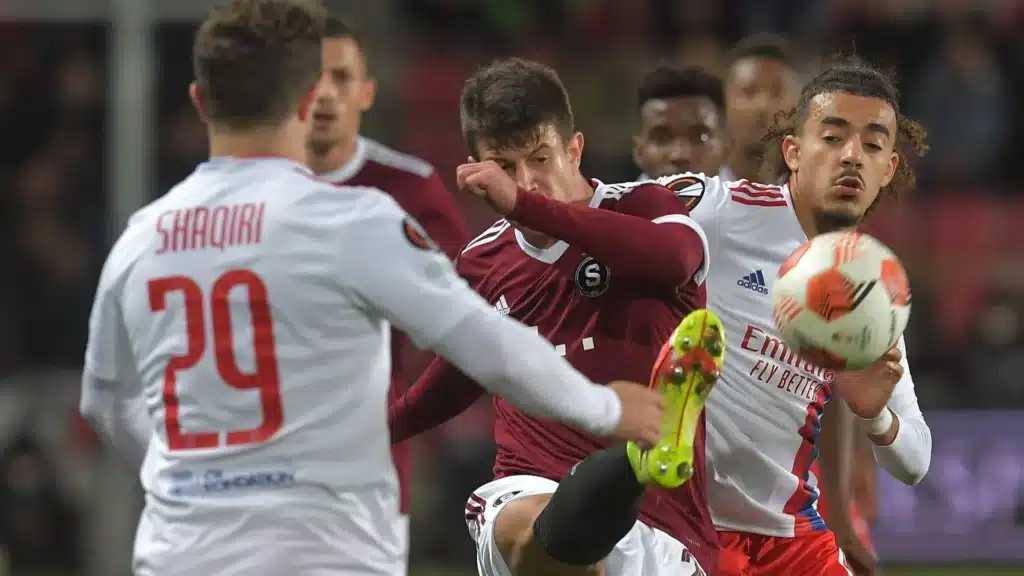
Our latest Champions League referee review examines the penalties, VAR intervention, second-yellow dismissal and other important officiating decisions from Tuesday’s third qualifying-round first legs.
Eight matches were played on August 4, with Sparta Prague’s 2–1 victory over Lyon producing the night’s most significant sequence of video-review decisions. A Sparta goal was disallowed following a VAR check, while Lyon were later awarded a penalty that Corentin Tolisso failed to convert.
Penalties were also awarded in Mjällby against Slovan Bratislava, Ararat-Armenia against Celje and Union Saint-Gilloise against Bodø/Glimt. Hapoel Beer-Sheva, meanwhile, protected a 1–0 advantage after Matan Baltaxa was dismissed for a second caution.
The eight results were:
Mjällby 1–2 Slovan Bratislava
Ararat-Armenia 2–1 Celje
Levski Sofia 1–0 Kairat Almaty
Hapoel Beer-Sheva 1–0 Crvena Zvezda
GNK Dinamo 5–0 Kauno Žalgiris
Olympiacos 0–0 NEC Nijmegen
Union Saint-Gilloise 3–3 Bodø/Glimt
Sparta Prague 2–1 Lyon
These were eight of the ten third-round first legs. Aarhus against Sabah and Fenerbahçe against Sturm Graz are scheduled for Wednesday, August 5.
Important note about this referee review
This analysis is based on UEFA’s official match information and publicly available live-commentary records.
UEFA had not published detailed technical VAR explanations for Tuesday’s qualifiers at the time of writing. Some match logs confirm that a penalty, red card or VAR intervention occurred without showing every broadcast angle or explaining the referee’s reasoning.
For that reason, factual decisions such as offside can be assessed more confidently than subjective incidents involving tackles, holding or physical contact. Where the available evidence is incomplete, our verdict is clearly marked as provisional.
Sparta Prague 2–1 Lyon: goal disallowed after VAR review
The most eventful refereeing performance of the night came in Prague.
Sparta appeared to take the lead in the 19th minute when Jonatan Braut Brunes found the net. However, the goal was overturned after a VAR review because John Mercado had been caught offside during the attacking sequence.
The video intervention followed the correct protocol. Offside is primarily a factual decision, meaning VAR can correct the on-field outcome once the relevant position and involvement are established.
The important question is not simply whether Mercado was standing in an offside position. An offside offence occurs only when a player in that position becomes involved by playing the ball, challenging an opponent, blocking an opponent’s line of vision or otherwise gaining an advantage.
The match record confirms that Mercado was judged offside before Brunes scored. Without access to UEFA’s calibrated line or complete replay sequence, we cannot independently measure the position. However, there is no evidence in the available reporting that the intervention involved a subjective or controversial interpretation.
Referee verdict
VAR intervention: Correct procedure
Final decision: Goal disallowed for offside
Our assessment: Supportable factual decision
Lyon awarded a penalty but Tolisso misses
Lyon received a major opportunity to restore their lead in the 65th minute.
The match record states that Adam Sevínský conceded the penalty after fouling Loïs Openda inside the area. Tolisso took the kick but sent his attempt over the crossbar.
A penalty is correct when a defender commits a direct-free-kick offence inside their own penalty area. The central considerations would have been whether Sevínský challenged Openda carelessly and whether the relevant contact occurred inside the box.
The fact that a player falls after contact is not automatically enough. Referees must distinguish between a genuine foul, normal physical competition and contact initiated or exaggerated by the attacker.
The available event record describes the incident as a foul by Sevínský, but it does not provide enough visual detail to determine the intensity, sequence or precise nature of the contact.
There was no reported VAR reversal. That suggests the video team found no clear evidence that the penalty decision was wrong, although the absence of an intervention should not be treated as independent proof that every subjective judgement was perfect.
Referee verdict
On-field decision: Penalty to Lyon
Penalty taker: Corentin Tolisso
Outcome: Missed
Our assessment: Supportable, but a definitive technical verdict requires the full replay angles
Did the referee apply double punishment?
No red card followed the Lyon penalty.
That is important because supporters sometimes assume that every penalty for stopping an attacker must also produce a dismissal.
A red card for denying an obvious goalscoring opportunity depends on several factors, including:
- The distance between the offence and the goal
- The attacker’s direction of movement
- The likelihood of controlling the ball
- The position and number of defenders
- Whether the defender genuinely attempted to play the ball
The match record does not identify the incident as a denial of an obvious goalscoring opportunity. On the available information, there is no basis for arguing that a red card was automatically required.
Sparta then scored through Mercado in the 69th minute and held on for a 2–1 victory.
Hapoel Beer-Sheva 1–0 Crvena Zvezda: second-yellow red card
Hapoel Beer-Sheva faced a difficult final half-hour after Matan Baltaxa was dismissed in the 58th minute.
The match record identifies the dismissal as a second yellow card for a bad foul. Hapoel were already leading through Zahi Ahmed’s 38th-minute goal and managed to protect that advantage despite playing with ten men.
This incident is particularly interesting because of the new 2026/27 VAR protocol.
VAR can now assist when a referee issues a clearly incorrect second yellow card that results in a red card. However, the video official cannot search for a missed second-yellow offence that the referee failed to punish. The new power exists only to prevent an incorrect dismissal.
That means Baltaxa’s second caution was eligible for a VAR check.
The threshold remained high. The VAR was not deciding whether the challenge was slightly harsh or whether another referee might have allowed play to continue. Intervention would have been justified only if the second caution was clearly incorrect.
No reversal followed, and Hapoel continued with ten players.
Referee verdict
Decision: Second yellow and red card
VAR review category: Available under the 2026/27 protocol
Outcome: Dismissal remained
Our assessment: No confirmed error, but the footage is required to judge whether the challenge was genuinely reckless
Why VAR did not review the first yellow card
The new protocol does not allow the video official to reopen a player’s first caution simply because that earlier booking later contributes to a dismissal.
VAR checks the incident that produced the second yellow and resulting red card.
This protects the match from being re-refereed retrospectively. Otherwise, every dismissal for two cautions could require officials to review both offences, potentially taking the match back many minutes.
Baltaxa’s dismissal could therefore be cancelled only if the second caution itself was clearly wrong.
Mjällby 1–2 Slovan Bratislava: Nick Walsh awards penalty
Mjällby took the lead in the 61st minute when Elliot Stroud converted a penalty awarded by Scottish referee Nick Walsh.
Slovan Bratislava responded through Suleiman Camara in the 78th minute before substitute Manasse Kianga scored the winner in the fourth minute of added time.
Walsh was assisted by Scottish VAR Andrew Dallas, with Duncan Nicolson serving as assistant VAR.
The publicly available commentary confirms the penalty but does not identify the precise offence, player responsible or nature of the contact. It would therefore be irresponsible to describe the decision as clearly correct or clearly wrong based only on the match timeline.
There was no reported on-field review or significant post-match refereeing complaint in the sources examined at publication time.
Referee verdict
Decision: Penalty to Mjällby
Outcome: Stroud scored
VAR: Andrew Dallas
Our assessment: No evidence of a clear error, but not enough visual information for a final technical verdict
The match was especially important for Walsh because it followed the controversy surrounding Rangers’ rejected penalty appeal against Dundee United. However, the two incidents must be judged independently.
A referee should not alter their threshold because a previous penalty decision attracted criticism.
Ararat-Armenia 2–1 Celje: early penalty for the visitors
Celje opened the scoring in Yerevan when Svit Sešlar converted a penalty in the 22nd minute.
Ararat-Armenia equalised through Artur Serobyan before half-time, and França completed the comeback with the winning goal in the 70th minute.
Slovakian referee Ivan Kružliak controlled the match, with Germany’s Benjamin Brand working as VAR and Anojen Kanagasingam as assistant VAR.
As with the Mjällby penalty, the basic match record confirms the award without clearly identifying the exact offence.
The penalty was not subsequently cancelled, and there was no additional red-card sanction. This suggests that the incident was treated as a standard direct-free-kick offence inside the area rather than serious foul play or denial of an obvious goalscoring opportunity requiring dismissal.
Referee verdict
Decision: Penalty to Celje
Outcome: Sešlar scored
Our assessment: No confirmed VAR mistake; complete footage is needed for a stronger judgement
Union Saint-Gilloise 3–3 Bodø/Glimt: penalty during six-goal thriller
Union Saint-Gilloise and Bodø/Glimt produced the highest-scoring match of the evening.
Patrick Berg gave Bodø/Glimt the lead before Raul Florucz equalised. Ole Didrik Blomberg then converted a 29th-minute penalty to restore the Norwegian club’s advantage.
Florucz levelled again before half-time. Promise David appeared to have won the match for Union in the 88th minute, but Odin Bjørtuft equalised in added time.
The match was refereed by Irfan Peljto, with Ivan Bebek acting as VAR.
The penalty arrived shortly after Kevin Mac Allister was cautioned, but the event timeline does not clearly establish whether that caution was directly connected to the penalty incident. We should not assume that the yellow card was issued for the offence that produced the spot kick.
No monitor review or subsequent cancellation is identified in the public match record.
Referee verdict
Decision: Penalty to Bodø/Glimt
Outcome: Blomberg scored
Our assessment: Supportable final outcome, but the precise foul cannot be assessed from the available written record
Levski Sofia 1–0 Kairat Almaty: quiet night until stoppage time
Levski Sofia defeated Kairat with a dramatic Serginho goal in the second minute of added time.
The publicly available event record contains no penalty, red card or VAR-overturned goal. Serginho was cautioned shortly after scoring, but the booking was recorded as a separate bad-foul incident rather than excessive celebration.
From an officiating perspective, this was one of the quieter matches of the night.
The major challenge for the referee was managing a tense goalless contest without allowing tactical fouls, protests or late-game pressure to damage control.
Referee verdict
Major VAR intervention: None recorded
Penalty controversy: None recorded
Red cards: None
Our assessment: No significant debatable decision identified
Olympiacos 0–0 NEC: no major VAR controversy
Olympiacos and NEC Nijmegen finished goalless in Piraeus.
The match log records several fouls, offside decisions and handball offences, but no penalty, red card or disallowed goal. Willum Willumsson received a late yellow card, while Dani García was also cautioned during the second half.
José María Sánchez was the referee, supported by VAR Cesar Soto Grado and assistant VAR Alejandro Muñiz Ruiz.
There is no evidence in the available match record of a major VAR controversy.
Referee verdict
Major intervention: None
Match-changing error identified: No
Our assessment: Controlled performance with no publicly reported critical incident
GNK Dinamo 5–0 Kauno Žalgiris: straightforward result
Dinamo Zagreb produced the most convincing victory of the evening, defeating Kauno Žalgiris 5–0.
Miha Zajc, Scott McKenna, Mateo Lisica, Luka Stojković and Lukas Kačavenda scored the goals as Dinamo established a commanding first-leg advantage.
The match was refereed by Belgium’s Erik Lambrechts, with Clay Ruperti appointed as VAR and Bert Put as assistant VAR.
No major penalty, red-card or goal controversy was identified in the sources reviewed.
Referee verdict
Major VAR intervention: None reported
Debatable match-changing decision: None identified
Our assessment: The scoreline was determined by Dinamo’s dominance rather than officiating controversy
Which decision was the most important?
The overturned Sparta Prague goal was the clearest and most consequential VAR intervention.
Had the goal stood, Sparta would have taken an early lead. Instead, the score remained 0–0 before Lyon moved ahead shortly before half-time.
The decision also demonstrated the difference between factual and subjective VAR reviews.
Offside review: VAR establishes position and involvement using evidence.
Penalty review: VAR must decide whether the referee’s subjective judgement was clearly and obviously wrong.
The disallowed goal therefore provides a more definitive VAR outcome than the penalties awarded in Prague, Sweden, Armenia and Belgium.
Was Lyon’s penalty the most debatable incident?
Potentially, but a meaningful verdict requires the full broadcast footage.
The event record states that Openda was fouled by Sevínský. That supports the penalty, but it does not show whether the defender played the ball, whether the contact was careless or whether Openda initiated the collision.
This is an important principle for referee analysis.
A written match log can confirm what was decided. It cannot always prove whether the decision was technically correct.
The same limitation applies to the Mjällby, Celje and Bodø/Glimt penalties.
Did UEFA’s VAR reset change anything?
UEFA recently reminded its national associations that VAR should not re-referee matches and should intervene only for blatantly incorrect decisions or clearly missed incidents.
Tuesday’s matches largely followed that restrained model.
There was one confirmed goal reversal for factual offside. The other major decisions remained with the on-field referees, and no long sequence of publicly recorded subjective reversals dominated the night.
That does not prove that every decision was correct. It shows that the video officials generally respected the intervention threshold rather than replacing every on-field judgement with their own preference.
Champions League Referee Review: Final Verdict
Tuesday’s Champions League qualifiers produced several important decisions but no confirmed refereeing scandal.
The clearest VAR intervention came in Sparta Prague against Lyon, where an early Sparta goal was correctly subjected to review and disallowed for offside.
Lyon later received a penalty after Openda was fouled, but Tolisso missed. The available record supports the decision, although complete footage is necessary before declaring the contact unquestionably punishable.
Baltaxa’s second-yellow dismissal in Hapoel Beer-Sheva’s victory over Crvena Zvezda was another significant moment. Under the new protocol, VAR could have intervened had the second caution been clearly incorrect. The card remained, suggesting that the video team found no obvious reason to cancel the dismissal.
The penalties awarded to Mjällby, Celje and Bodø/Glimt were all allowed to stand, but the public text records do not provide enough detail for definitive contact analysis.
Best VAR decision: Sparta Prague goal disallowed for offside
Most debatable decision: Lyon’s penalty against Sparta Prague
Most important disciplinary decision: Baltaxa’s second-yellow red card
Quietest refereeing performances: Olympiacos–NEC and Dinamo–Kauno Žalgiris
Overall assessment: A busy night, but no verified major VAR failure
The strongest conclusion from this Champions League referee review is that video officials intervened decisively for an objective offside while leaving subjective penalty and disciplinary decisions unchanged unless the clear-error threshold was met.

0 Comments
Join the conversation with respect. Comments are moderated and must follow our community rules.
Want to join the discussion?
Please log in or create an account to comment and reply. This keeps the conversation cleaner and safer.