
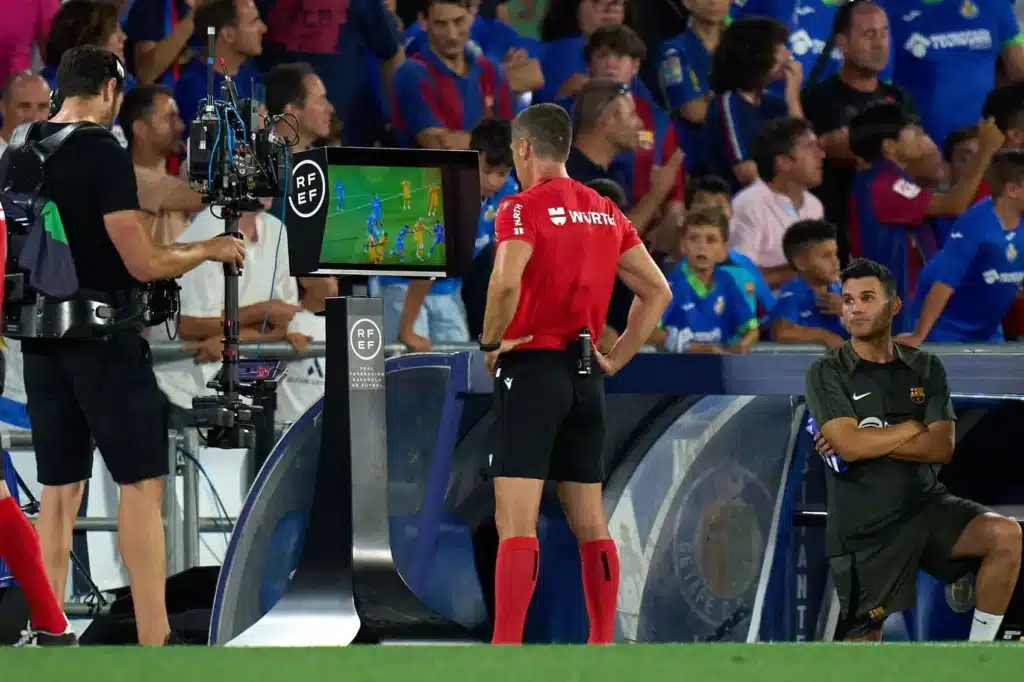
The La Liga new rules for the 2026/27 season have officially been published, introducing expanded VAR powers, strict limits on substitutions, stronger punishments for time-wasting and a controversial trial aimed at preventing tactical goalkeeper injuries.
Spain’s Technical Committee of Referees, known as the CTA, released its detailed guidance on August 4. The measures will apply across Spanish football and are based on the updated 2026/27 Laws of the Game, additional IFAB protocols and competition-specific instructions for referees.
Several changes were already tested internationally, but they will now become part of the weekly refereeing reality in La Liga.
A player taking too long to leave during a substitution could prevent their replacement from entering. A delayed goal kick could become a corner for the opposition. VAR will be permitted to correct certain second-yellow dismissals, mistaken identity and clearly incorrect corner awards.
The most unusual measure concerns goalkeeper injuries. When play is stopped for certain goalkeeper injuries, the team may be required to temporarily remove an outfield player.
La Liga new rules at a glance
The most important changes for 2026/27 are:
| New rule | Consequence |
|---|---|
| Ten-second substitution limit | The replacement may be delayed for at least one minute |
| Goalkeeper injury trial | An outfield player may have to leave temporarily |
| One-minute injury rule | Treated players normally remain off for one minute |
| Delayed throw-in | Possession changes to the opposing team |
| Delayed goal kick | Opposition receives a corner |
| Clearly wrong second yellow | VAR can cancel the resulting red card |
| Mistaken identity | VAR can correct which player receives the card |
| Incorrectly awarded corner | VAR can correct it immediately |
| Accidental penalty double touch | A scored penalty is retaken |
| DOGSO advantage followed by a goal | No disciplinary card is required |
The reforms are designed principally to improve match flow, reduce tactical delays and close several gaps in the previous VAR protocol.
Players have ten seconds to leave during substitutions
Substituted players must leave the field within ten seconds of the substitution board being displayed or the referee authorising the change.
The player should normally leave through the nearest boundary line unless the referee provides different instructions for safety, security or injury reasons.
When the player fails to leave within ten seconds, the substitution is not cancelled. The departing player must still leave, but the replacement cannot immediately enter.
The substitute must wait until the first stoppage after one minute of actual playing time has passed following the restart. This means the team could temporarily continue with ten players because its substituted player deliberately took too long to exit.
For multiple substitutions, the timing begins when the final change is displayed or authorised. Each departing player must then leave within the permitted period.
Will every slow substitution be punished?
No.
The rule is aimed at deliberate time-wasting rather than situations where a player genuinely cannot leave quickly.
Referees can consider:
- The player’s distance from the boundary
- A genuine injury
- Crowd or security concerns
- Obstacles around the technical area
- Instructions given by the referee
- Whether the player is intentionally slowing down
The important difference is that referees now have a specific sporting consequence available. Instead of relying only on a yellow card or added time, the team can be forced to play temporarily without the incoming substitute.
La Liga introduces a goalkeeper injury trial
The most controversial of the La Liga new rules is designed to discourage teams from using goalkeeper injuries as unofficial tactical timeouts.
When play is stopped because a goalkeeper requires treatment in a situation covered by the trial, the coach must nominate an outfield player to leave the pitch. That player remains off until at least one minute of actual playing time has passed following the restart.
When the coach does not nominate a player within ten seconds, the team captain may be required to leave automatically.
The goalkeeper remains on the field after treatment because teams cannot normally be required to play without a goalkeeper. The temporary disadvantage is instead transferred to an outfield player.
Why has this rule been introduced?
Goalkeepers have increasingly been accused of going down with injuries when coaches want to:
- Interrupt an opponent’s momentum
- Give players tactical instructions
- Allow teammates to rest
- Break up a period of pressure
- Avoid using an official timeout that football does not provide
It is often impossible for the referee to prove that an injury is fake. Medical complaints cannot simply be ignored, especially where a goalkeeper’s safety may be involved.
The new trial does not require the referee to accuse the goalkeeper of simulation. It creates an automatic consequence that removes the tactical benefit of stopping the match.
Exceptions to the goalkeeper injury rule
The temporary removal of an outfield player will not apply in every goalkeeper injury situation.
Reported exceptions include:
- An injury caused by an offence requiring a free kick and immediate treatment
- A collision between the goalkeeper and an outfield player where both require attention
- A bleeding injury
- Situations where the medical problem clearly requires urgent treatment
These exceptions are intended to ensure that teams are not unfairly punished after genuine collisions or fouls.
The practical challenge will be consistency. Referees and medical staff must distinguish between an ordinary treatment stoppage covered by the trial and a situation qualifying for an exception.
Injured outfield players must remain off for one minute
The broader injury rule has also changed.
An outfield player who receives assessment or treatment on the field, or whose injury causes play to be stopped, must normally leave and remain outside the field until one minute has passed after the restart.
The minute is measured using actual playing time rather than simply beginning as soon as the player crosses the touchline.
The rule should discourage players from going down to stop an attack, interrupt the rhythm or create an unofficial break before immediately returning.
Exceptions remain, including certain goalkeeper incidents, serious injuries and injuries caused by physical offences for which the opponent is cautioned or sent off. A player who wins a penalty and is designated to take it may also remain in appropriate circumstances.
A delayed goal kick can now become a corner
Referees will use a visible five-second countdown when they believe a team is deliberately delaying a goal kick.
The countdown does not automatically begin immediately after every goal kick is awarded. The referee first determines that the restart is being unfairly delayed.
The official then whistles, clearly signals that play should restart and counts down five seconds with a raised hand.
When the ball is still not in play at the end of the countdown, the opposition receives a corner from the nearest side.
This is a potentially severe punishment. A team trying to waste a few seconds could surrender an attacking set piece close to its own goal.
Is the player also booked?
Not automatically.
The corner is considered the main punishment. A yellow card should normally be shown only when the player or a teammate continues excessively delaying the new restart after the corner has been awarded.
This avoids creating two punishments for one ordinary delay while preserving the referee’s ability to caution extreme behaviour.
A delayed throw-in changes possession
The same five-second principle applies to throw-ins.
When a team deliberately delays taking a throw, the referee can begin the visible countdown. If the ball has not entered play after five seconds, the throw-in is awarded to the opposition from the same location.
The referee does not need to wait until the player is holding the ball.
The countdown can begin when a player deliberately delays by:
- Walking slowly to retrieve the ball
- Standing in the wrong position
- Repeatedly changing the intended thrower
- Leaving the ball for a teammate
- Refusing to prepare for the restart
However, when the player is already beginning the throwing action as the countdown ends, the referee can allow the restart rather than applying the punishment mechanically.
VAR can now correct a clearly wrong second yellow card
One of the biggest VAR changes concerns dismissals resulting from second yellow cards.
Previously, VAR could review a direct red card but could not normally intervene when a player was sent off after receiving a second caution.
Under the new protocol, VAR can assist when the second yellow is clearly incorrect and directly produces a red card.
For example, intervention may be appropriate when:
- Replays show the player made no contact
- The referee cautioned the wrong player
- The opponent clearly committed the offence
- The player legally won the ball
- The supposed handball did not occur
The VAR is not being asked whether the caution was slightly harsh. The decision must be clearly wrong.
Can VAR review the first yellow card?
No.
The first caution cannot be reopened simply because the player is later dismissed.
Only the incident producing the clearly incorrect second caution and resulting red card enters the new review category. This prevents VAR from returning to an unrelated decision made earlier in the match.
VAR also cannot search for second-yellow offences that the referee missed. The power exists to cancel an incorrect dismissal, not to identify every possible caution that was not shown.
VAR can correct mistaken identity involving either team
VAR can intervene when the referee correctly identifies that an offence occurred but shows the resulting yellow or red card to the wrong player.
The expanded wording applies where the incorrectly identified player belongs to either team.
A typical example would be:
- One defender commits a handball
- The referee awards the free kick
- A different defender receives the yellow card
- VAR identifies the actual offender
- The card is transferred to the correct player
However, the mistaken-identity category does not allow VAR to reassess the original offence freely.
VAR can correct who committed the offence, but not use mistaken identity as an excuse to replace the referee’s judgement about whether an offence occurred. The offence can be reviewed separately only when it also belongs to another authorised VAR category, such as a penalty, goal or red-card incident.
Incorrect corner awards can be corrected immediately
Spanish football will also use VAR to correct certain clearly incorrect corner decisions.
The correction must be obvious and completed immediately without delaying the restart. If the attacking team takes the corner quickly, VAR cannot stop play later and return to the original decision.
Possible examples include:
- The ball clearly came off the attacker last
- The ball crossed the touchline rather than the goal line
- Replays immediately show that no defender touched it
- The assistant referee’s view was blocked
VAR should not examine several angles for a marginal deflection.
The rule is intended for immediate factual corrections, not long reviews of every corner. When the evidence is not available within seconds, the original decision should remain.
Why the corner rule could become controversial
Supporters may welcome the removal of goals scored from obviously incorrect corners.
However, the expansion creates a difficult question: why should VAR correct a corner but not every wrongly awarded throw-in or free kick that eventually leads to a goal?
The answer is based on immediacy and risk.
Corners create an immediate goalscoring opportunity and usually allow enough preparation time for a rapid check. Extending VAR to all restarts would require video officials to re-referee huge parts of every match.
The success of the new corner rule will therefore depend on speed. A ten-second factual correction may improve fairness. A lengthy search for a tiny touch would damage the match flow the wider reforms are intended to protect.
Attacking offences before set pieces receive greater attention
VAR guidance has also been clarified for offences committed by attackers immediately before a corner or free kick is taken.
An attacking player may commit holding, blocking, violent conduct or another offence while the ball is not yet in play. In certain situations, VAR can intervene when that action continues into the restart or has a direct and immediate impact on a major outcome.
Intervention may be considered where the offence:
- Helps the attacking team score
- Prevents a defender from challenging
- Creates an immediate goalscoring opportunity
- Causes the defending team to concede a penalty
- Causes a defender to receive a red card
- Stops the defending team from recovering possession
This does not mean every block or touch before a corner becomes reviewable.
Set pieces contain constant physical contact. VAR must focus on clear, influential actions rather than examining every arm position in slow motion.
Accidental double touches at penalties
The penalty law now formally incorporates the clarification introduced after several controversial double-touch incidents.
When a penalty taker accidentally contacts the ball twice and the ball enters the goal, the penalty is retaken.
When the accidental double touch occurs and the ball does not enter, the taker does not receive another attempt. During normal play, the restart is determined under Law 14; during a shoot-out, the kick is recorded as missed.
The rule applies to accidental actions, such as the standing foot slipping and touching the ball immediately after the kicking foot.
A deliberate second touch remains a separate offence and does not produce a retake.
New clarification for goal-kick handball incidents
The Spanish guidance also addresses a confusing restart situation.
When a goalkeeper clearly plays the ball from a goal kick and a teammate then deliberately handles it inside the penalty area, a penalty can be awarded because the ball has already entered play.
The defender cannot claim that they were merely preparing to take the original goal kick after the goalkeeper has already played it.
The key question is whether the goalkeeper’s first action legally restarted play.
When the goalkeeper has touched the ball only to position it rather than taking the restart, the referee may reach a different conclusion. Clear communication and awareness will be essential.
Referees can apply advantage after an incorrect restart
The Laws now expressly confirm that advantage can be applied when a restart is taken incorrectly but the opposition immediately obtains clear possession.
For example, a team might take a free kick or throw-in from the wrong position. If the opposition intercepts the ball and begins a promising attack, the referee can allow play to continue rather than stopping to order the restart again.
When no meaningful advantage develops, the referee can return to the infringement and require the correct restart.
The purpose is to prevent the team that made the error from benefiting because the referee stopped an attack that had already given the opponents possession.
No yellow card when DOGSO advantage produces a goal
A disciplinary change also affects denial of an obvious goalscoring opportunity.
When a defender commits a DOGSO offence, the referee applies advantage and the attacking team immediately scores, the offender will not be cautioned merely for the unsuccessful denial attempt.
The reasoning is straightforward: the offence did not ultimately deny the goal.
A card may still be required when the action independently deserves punishment for another reason, such as a reckless challenge, serious foul play or violent conduct.
Will the La Liga new rules reduce controversy?
Some changes should be relatively straightforward.
The ten-second substitution limit and five-second restart countdowns give referees visible, objective procedures. Players will know the consequences before deliberately delaying.
The VAR expansions are more complicated.
Correcting a player who received a clearly incorrect second yellow should improve fairness. Fixing mistaken identity is also logical. Immediate corner corrections could prevent goals resulting from obvious restart errors.
However, every new review category creates expectations.
Supporters may begin demanding VAR intervention for marginal second yellows, uncertain deflections and every act of contact before a corner. The CTA must make clear that the expanded jurisdiction does not remove the clear-error threshold.
The VAR Verdict
The La Liga new rules represent one of the most significant changes to Spanish refereeing in recent seasons.
The strongest measures are those that create direct sporting consequences for time-wasting. A delayed goal kick can become a corner, a delayed throw changes possession and a slow substitution can temporarily leave a team with ten players.
These punishments should be more effective than repeatedly adding time at the end of matches.
The goalkeeper injury trial will attract the greatest debate. It could stop tactical breaks, but referees must apply the exceptions carefully to avoid punishing genuine injuries.
Expanded VAR powers are also reasonable when used narrowly. A clearly wrong second-yellow dismissal should not survive simply because the original protocol excluded it. Mistaken identity should be corrected, while obviously incorrect corners can be changed when the process takes only seconds.
Our verdict: The direction is positive, but success will depend on consistency. Referees must enforce the time limits from the beginning of the season, while video officials must resist turning every new power into another long and microscopic review.
The changes are intended to make La Liga faster, fairer and easier to understand. They will fail if one referee begins the countdown immediately while another allows the same delay, or if VAR takes more time correcting corners than teams previously spent preparing to take them.

0 Comments
Join the conversation with respect. Comments are moderated and must follow our community rules.
Want to join the discussion?
Please log in or create an account to comment and reply. This keeps the conversation cleaner and safer.