
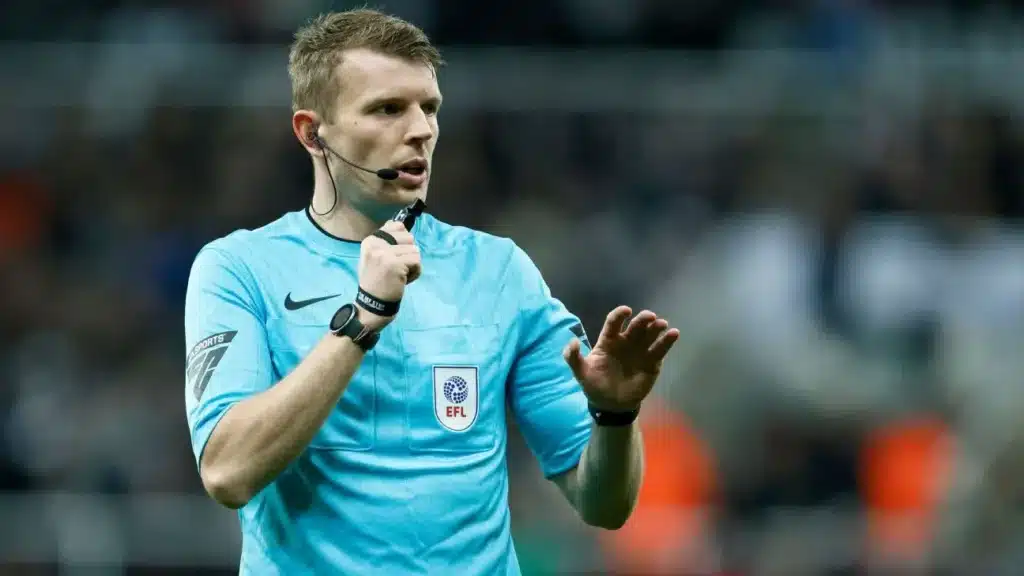
Liverpool vs Nottingham Forest referee Sam Barrott will take charge at Anfield on Saturday, with one of England’s most experienced officials, Michael Oliver, working behind him as VAR.
It is an interesting combination for Liverpool’s first home Premier League game of the new season. Barrott belongs to the newer generation of top-flight English referees, while Oliver has spent more than 15 years handling the biggest matches in the Premier League.
Liverpool come into the game after needing a 99th-minute Dominik Szoboszlai penalty to rescue a 2-2 draw at Newcastle. Nottingham Forest, meanwhile, lost their opening league match 1-0 at home to Leeds before Leeds beat them again in the League Cup in midweek.
For the officials, the challenge should be different from Liverpool’s chaotic opening match at St James’ Park. Forest are likely to spend long periods without the ball and try to make life uncomfortable for Liverpool. That means tactical fouls, penalty-area contact and transition management could become the important refereeing themes.
Who is the Liverpool vs Nottingham Forest referee?
The Premier League has officially appointed Sam Barrott for Saturday’s match.
The full officiating team is:
Referee: Sam Barrott
Assistant referee 1: Adam Nunn
Assistant referee 2: Wade Smith
Fourth official: Tim Robinson
VAR: Michael Oliver
Assistant VAR: James Mainwaring
Liverpool vs Nottingham Forest kicks off at 12:30 BST on Saturday, August 29 at Anfield. The appointment has been confirmed by both the Premier League and Liverpool.
Who is Sam Barrott?
Barrott is part of the newer group of Premier League referees, but he is no longer inexperienced at this level.
He made his Premier League debut in October 2023 and became a FIFA-listed referee in 2025. Since then, his number of top-flight appointments has increased quickly.
Last season was particularly significant.
Barrott refereed 24 Premier League matches in 2025/26, showing 88 yellow cards, one red card and awarding seven penalties. That works out at approximately 3.67 yellow cards per match.
Those numbers give us a useful picture of his style.
He is not at the extreme card-heavy end of the Premier League referee list. Stuart Attwell, for example, averaged 4.68 yellows last season. But Barrott is also not reluctant to punish tactical or reckless challenges when the match starts to become difficult.
The penalty number is interesting too.
Seven penalties in 24 matches means roughly one penalty every three to four appointments. That does not tell us he is looking for penalties, but it does show that he is comfortable making major decisions inside the area.
What is Barrott’s refereeing style?
Barrott generally looks more comfortable when he can allow the match to develop rather than constantly stopping play.
He is not the type of referee who needs every physical challenge to become a free kick.
That should be useful at Anfield, where Liverpool will want a quick game and Forest may look to disrupt that rhythm.
But allowing physical football is different from allowing tactical fouling.
That distinction could define his performance on Saturday.
If Liverpool beat Forest’s first defensive line and start running into open space, a relatively small trip can have a huge tactical effect. The physical force might be minimal, but if the intention is simply to stop a promising attack, the referee has to recognise that.
This is where card statistics alone tell us very little.
The best referees understand why a foul happened, not simply how hard the contact looked.
Liverpool’s record with Sam Barrott
Liverpool have a very strong Premier League record with Barrott.
Transfermarkt records three Premier League matches under him and three Liverpool victories.
Those games were:
Southampton 2-3 Liverpool — November 2024
Tottenham 3-6 Liverpool — December 2024
Liverpool 1-0 Everton — April 2025
Barrott has also handled Liverpool in domestic cup competition. His Liverpool assignments across competitions include the 5-2 FA Cup win over Norwich and the surprising 1-0 FA Cup defeat at Plymouth.
So while Saturday will not be his first experience of Anfield or of refereeing Liverpool, it is another step up in responsibility.
Liverpool-Forest has become a much more competitive fixture than it looked several years ago.
In fact, Liverpool have now lost their last two home league meetings with Nottingham Forest, something they had not done across the previous 30 league meetings at Anfield.
That alone should remove any idea that this will be a routine home assignment.
Nottingham Forest’s record under Barrott
Barrott also knows Forest well.
Transfermarkt’s broader club record lists 10 Nottingham Forest matches under Barrott, with five wins, three draws and two defeats across competitions.
His more recent Forest appointments include two notable victories from last season.
Barrott refereed Forest’s 3-0 home win against Tottenham in December 2025, a match in which he showed four yellow cards.
Then in January he took charge of Brentford 0-2 Nottingham Forest, a much quieter game with only one yellow card.
Those two matches are actually a good illustration of Barrott’s style.
He does not arrive with a target number of cards.
If the game is controlled, he can stay out of it.
If the match becomes physical, the cards increase.
That is exactly how refereeing should work.
Michael Oliver on VAR is an important appointment
The most eye-catching name on the officiating team may not actually be Barrott.
Michael Oliver will be on VAR.
Oliver remains one of England’s most experienced active officials and regularly referees major Premier League and UEFA matches.
Having him behind a younger referee such as Barrott gives the Premier League an experienced video official for potentially decisive penalty, red-card and goal decisions.
But that does not mean Oliver should become a second referee.
The best VAR performance on Saturday could involve almost no visible intervention.
Barrott has the whistle.
If he sees a subjective penalty-area challenge clearly and makes a defensible decision, Oliver should support him rather than searching through slow-motion replays for a different interpretation.
If Barrott clearly misses a penalty or direct-red-card offence, then Oliver needs to intervene.
That balance sounds simple. In practice, it remains one of VAR’s biggest problems.
Liverpool’s last match makes the penalty threshold worth watching
Liverpool’s opening game already produced one of the Premier League’s biggest referee debates of the season.
Stuart Attwell awarded Liverpool a stoppage-time penalty at Newcastle after Lewis Hall made knee-to-thigh contact with Victor Muñoz without touching the ball.
VAR supported the decision and Szoboszlai equalised in the 99th minute. Newcastle manager Matthias Jaissle described the penalty as soft, while the Premier League supported Attwell’s interpretation.
That incident makes Saturday’s penalty threshold interesting.
Liverpool supporters will understandably expect comparable contact to be judged consistently.
But Barrott cannot referee this match according to what happened at Newcastle.
He has to establish his own threshold and apply it equally at both ends.
If minor body contact is allowed in midfield, the same standard should normally exist inside the penalty area.
If a defender clearly trips an opponent without playing the ball, the fact that the offence results in a penalty cannot make Barrott afraid to whistle.
Consistency is the key.
Forest’s defensive approach could test Barrott
Forest’s opening defeat to Leeds showed a team still adapting under Oliver Glasner.
They lost 1-0 after Anton Stach scored from a free kick in the 88th minute, and Forest struggled to create enough clear attacking chances.
At Anfield, their approach is likely to be cautious.
That creates several refereeing challenges.
When a team spends long periods defending, repeated small fouls can become a strategy.
One defender fouls the winger.
Another midfielder stops the next transition.
A different player commits the third foul.
None of the individual challenges may look particularly serious, but together they can be designed to stop Liverpool building momentum.
Barrott needs to recognise those patterns.
Persistent infringement is not simply about one player committing five fouls.
A referee also has to understand when a team is repeatedly targeting the same opponent or using rotational tactical fouling.
Liverpool’s transitions could create DOGSO situations
Another area worth watching is what happens if Forest push higher.
Liverpool have enough pace to turn a turnover into a clear attacking opportunity within seconds.
A defender who is caught on the wrong side then has a difficult choice.
Let the attacker go or commit the foul.
This is where DOGSO decisions can become complicated.
The phrase “last man” is often used by supporters, but it does not actually define the Law.
The referee must consider:
distance to goal, direction of play, likelihood of controlling the ball and the position of other defenders.
A defender being the closest player to his own goalkeeper does not automatically mean every foul is a red card.
Barrott will need to understand the complete attacking situation.
Michael Oliver may also become important here because direct-red-card DOGSO decisions are reviewable by VAR.
Set pieces will require attention
Forest remain a physically strong team and can create problems from corners and free kicks.
That brings another familiar refereeing issue: holding.
At almost every Premier League corner, defenders and attackers make contact.
The referee cannot punish every hand on an opponent’s shirt.
But there is a point where normal positioning becomes prolonged holding or blocking that prevents an opponent from challenging for the ball.
This is particularly important because slow-motion VAR footage can make ordinary set-piece contact appear much worse than it looked in real time.
Barrott needs to establish the threshold.
Oliver needs to respect it unless something clear has been missed.
What should we expect from Sam Barrott?
Based on last season, we should not expect a referee trying to dominate the match.
Barrott’s 3.67 yellow-card average is relatively controlled by Premier League standards, while his seven penalties show that he is still prepared to make major decisions when necessary.
For this particular fixture, three areas stand out:
1. Tactical fouls against Liverpool’s transitions.
Forest cannot be allowed to repeatedly break up attacks without disciplinary consequences.
2. Penalty-area consistency.
After Liverpool’s controversial late penalty at Newcastle, every piece of contact inside the box will receive additional attention.
3. The relationship between Barrott and Oliver.
An experienced VAR supporting a younger referee can work very well, but only if the on-field referee remains the primary decision-maker.
The VAR Verdict pre-match view
This looks like a sensible appointment.
Barrott now has enough Premier League experience that Liverpool vs Nottingham Forest should not be considered an unusually large step for him.
His numbers suggest a referee who generally allows the game to breathe but is comfortable making major calls. His history with both clubs also means neither Liverpool nor Forest are unfamiliar territory.
Michael Oliver on VAR gives the officiating team additional experience, particularly if the match produces a difficult penalty or red-card situation.
But the most important thing Barrott can do is establish his standard early.
Anfield will react loudly to fouls on Liverpool players.
Forest will want to compete physically and disrupt Liverpool’s rhythm.
Barrott cannot referee according to the crowd, reputation or what happened in Liverpool’s previous game.
He has to judge what happens in front of him.
If he does that consistently, there is every chance the referee will barely be discussed after the final whistle.
For an official, that is usually the best possible outcome.

0 Comments
Join the conversation with respect. Comments are moderated and must follow our community rules.
Want to join the discussion?
Please log in or create an account to comment and reply. This keeps the conversation cleaner and safer.