
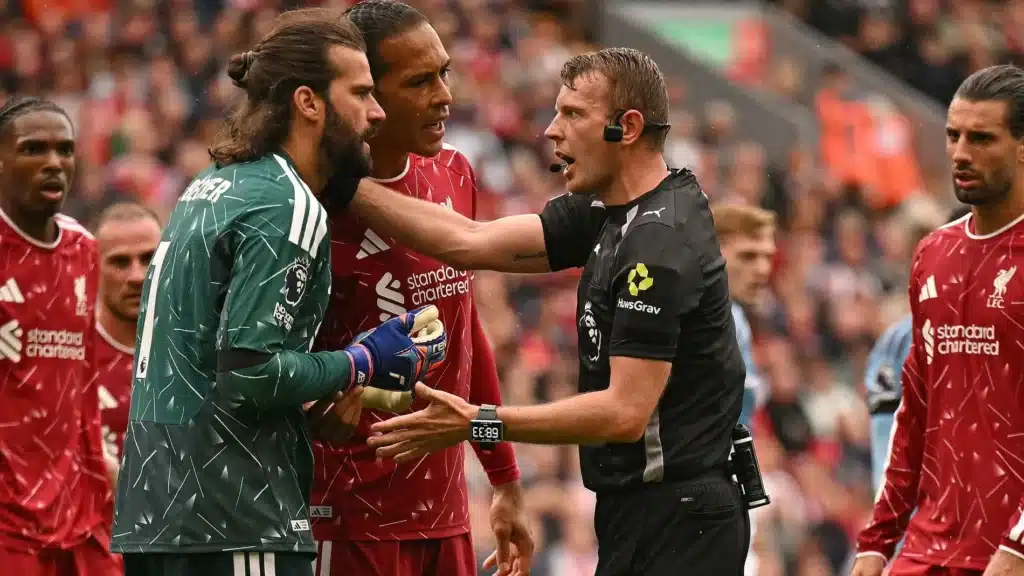
Liverpool’s 2-2 draw with Nottingham Forest produced one of those refereeing incidents where simply asking “was it a penalty?” does not tell the whole story.
The penalty itself was only the final part of a much more complicated sequence.
Liverpool had been waiting for more than two minutes to make a triple substitution. The ball went out of play several times, but the changes were not completed. Fourth official Tim Robinson appeared to be having problems with the electronic substitution boards.
Then Liam Delap took a quick Forest throw-in.
Neco Williams ran into the penalty area.
Alisson came out, missed the ball and made contact with Williams.
Referee Sam Barrott pointed to the spot.
Michael Oliver checked the decision from VAR and confirmed it.
Morgan Gibbs-White scored to put Forest 2-1 ahead.
Liverpool manager Andoni Iraola was furious, but his biggest complaint was not actually the penalty itself.
It was everything that happened immediately before it.
What exactly happened before the Forest penalty?
The timeline makes Liverpool’s frustration much easier to understand.
Liam Delap entered the match at 65:23.
Liverpool’s three intended substitutes were ready by approximately 65:43.
The ball then went out for a Forest throw at 66:23.
No Liverpool substitution was made.
Play restarted.
The ball went out again at 67:11.
Again, no substitution.
Television pictures showed fourth official Tim Robinson working with the electronic substitution boards while Iraola and Liverpool substitutes complained.
Then the ball went out for a third Forest throw at 67:38.
This time Delap restarted immediately.
His throw released Neco Williams down the left side.
Eight seconds later, Williams was inside Liverpool’s penalty area and Barrott had awarded Forest a penalty.
Gibbs-White eventually converted in the 70th minute.
Liverpool’s substitutions were finally completed after the goal.
Iraola’s argument was simple: if Liverpool had been allowed to make the substitutions they had been requesting, that exact attack would probably never have happened.
That does not automatically mean the referee made a legal error.
But it absolutely explains the anger.
Should the referee have stopped the game for Liverpool’s substitutions?
This is the hardest part of the entire incident.
Law 3 requires the referee to be informed before a substitution is made. The substitute can enter only during a stoppage, after the player being replaced has left and after receiving the referee’s signal.
Liverpool clearly wanted to make three changes.
Their substitutes were standing at the touchline.
And there were several stoppages when the substitutions might normally have happened.
However, Sky Sports also reported that Liverpool were still adjusting part of the planned change during the sequence, with Iraola apparently deciding to leave Jeremie Frimpong on and remove Alexis Mac Allister instead.
That detail matters.
A team wanting substitutions does not automatically give it the right to stop every restart. The officials have to know exactly which players are coming on and going off, and the substitution procedure has to be ready.
What is clear is that there was a technical problem involving the boards.
The VAR Verdict: Poor administration, but not enough evidence to call Barrott’s restart illegal ⚠️
This does not look good.
If the substitution information had been fully communicated and all three changes were ready, allowing three separate restarts while the fourth official struggled with equipment is difficult to defend from a game-management perspective.
But from the available evidence, we cannot say with certainty that Barrott was legally required to prevent the final Forest throw.
This looks more like an officiating administration failure than a clear breach of the Laws.
And it had a huge consequence.
Was Liam Delap’s throw-in illegal?
This is the incident Liverpool supporters immediately focused on after the penalty.
Replays appeared to show Delap moving quickly through the throw and possibly lifting one foot.
Under Law 15, the requirement is clear.
At the moment the ball is delivered, the thrower must:
face the field
use both hands
throw the ball from behind and over the head
have part of each foot on the touchline or on the ground outside the touchline
If one foot is already off the ground when the ball is released, it is a foul throw and possession should be awarded to the opposition.
So was Delap guilty?
The VAR Verdict: Not clearly proven ⚖️
The important moment is not what Delap’s feet do after the throw.
It is the precise instant the ball leaves his hands.
Former Premier League referee Graham Scott reviewed the incident and pointed out that Delap’s foot may only have left the ground after he released the ball.
If that is the case, the throw is legal.
This is why freeze-frames can be misleading.
A still image showing Delap with one foot in the air does not prove that foot was already raised when he delivered the ball.
From the available footage, we would not confidently label this a foul throw.
Verdict: Extremely close, but there is not enough clear evidence to say the throw was illegal.
But what if it WAS a foul throw?
This is where the VAR protocol becomes very important.
Even if a perfect camera angle showed that Delap definitely lifted his foot too early, Michael Oliver could not simply cancel the penalty because of it.
IFAB’s VAR protocol specifically states that restart decisions such as throw-ins and corners cannot be changed once play has restarted.
A foul throw is therefore primarily the responsibility of the on-field officials.
The assistant referee or Sam Barrott needed to identify it at the time.
Once Delap’s throw had been taken legally in the eyes of the officials and the attack developed, VAR’s review centred on the penalty incident itself.
The VAR Verdict: VAR was right not to review the throw ✅
This is an important distinction.
People often say:
“VAR checked the penalty, so surely it could see the foul throw too.”
Seeing something and having authority to correct it are not the same thing.
VAR has defined limits.
A throw-in restart is outside those limits once play has resumed.
That means this could theoretically be a missed on-field decision without being a VAR mistake.
Was the penalty on Neco Williams correct?
Now we get to the actual penalty.
Williams ran onto Delap’s throw and reached the ball before Alisson.
The Liverpool goalkeeper came out quickly.
Williams lifted the ball away.
Alisson did not play it.
Contact followed and Barrott immediately pointed to the penalty spot.
The Premier League later released the referee and VAR explanation.
Barrott’s assessment was that Alisson came out, failed to play the ball and cleared the attacker out.
VAR identified contact between Alisson’s right hand and Williams’ left foot before confirming the on-field decision.
The VAR Verdict: Penalty is supportable ✅
This is not as clear as a defender kicking straight through an attacker’s leg.
There is an argument that Williams has already sent the ball away from goal and that Alisson has very little opportunity to avoid the collision.
Former Premier League referee Mike Dean described it as close to a coming together and suggested the contact itself was fairly slight.
But Alisson does not play the ball.
Williams gets there first.
And the goalkeeper then makes contact which takes the attacker down.
Once Barrott gives the penalty, VAR would need strong evidence that the decision was clearly and obviously wrong.
That evidence simply is not there.
Our verdict: Penalty supportable. VAR correct to confirm.
Would every Premier League referee give it?
Possibly not.
Could VAR reasonably overturn it once Barrott has given it?
No.
That difference matters.
Could Williams actually have scored?
This does not decide whether it is a foul.
Williams’ attempted touch appears to be moving the ball away from goal when Alisson hits him.
Some Liverpool supporters therefore argued:
“He wasn’t going to score anyway.”
But a penalty offence does not require the attacker to have a guaranteed goalscoring opportunity.
If a goalkeeper carelessly fouls an attacker inside the penalty area, it can still be a penalty even if the attacker’s next touch is not perfect.
The quality of Williams’ opportunity becomes relevant if we are considering DOGSO and a possible red card.
It does not make a normal foul disappear.
Barrott did not send Alisson off, and there was no convincing reason he should have.
The real disciplinary decision was simply whether the challenge itself was a foul.
Why wasn’t Alisson sent off?
Because the situation did not meet the threshold for a direct red card.
Williams’ touch moved the ball away from the central goal area and the overall likelihood of an obvious immediate goal was reduced.
There was also nothing about Alisson’s challenge that suggested serious foul play or violent conduct.
The goalkeeper was trying to contest the ball, arrived late and committed the foul.
Penalty was enough.
Alisson was later booked for his reaction during the substitution controversy, but the penalty challenge itself did not require a red card.
Liverpool’s disallowed Wirtz goal: VAR was correct
The penalty sequence was not the only major VAR decision.
In the 32nd minute, Florian Wirtz scored what appeared to be Liverpool’s equaliser.
The goal was initially awarded.
VAR Michael Oliver checked the attacking phase and determined that Jeremie Frimpong had been in an offside position before providing the pass to Wirtz.
The goal was overturned.
The VAR Verdict: Correct overturn ✅
This is exactly the kind of factual decision VAR is well suited to correct.
If Frimpong was offside in the attacking phase directly leading to the goal, the goal cannot stand.
There is no meaningful subjective debate here.
Verdict: Correct VAR intervention.
So who actually made the biggest mistake?
Surprisingly, our answer is not Michael Oliver.
VAR did its job.
It correctly overturned Wirtz’s goal for offside.
It checked Alisson’s challenge and found no basis to overturn Barrott’s penalty.
It had no authority to go back and award Liverpool a throw-in because of a possible technical fault in Delap’s restart.
The biggest problem was the substitution sequence.
Liverpool wanted to make three changes.
The players were waiting.
The ball left the field several times.
The fourth official was visibly struggling with equipment.
Play was restarted repeatedly.
And the final restart directly created Forest’s penalty.
Iraola understandably argued afterwards that the penalty sequence simply would not exist if the changes had been completed.
That does not make the penalty itself incorrect.
It makes the officiating process before the penalty look unnecessarily messy.
Should officials have a backup when the electronic board fails?
Absolutely.
This incident exposes a very basic problem.
A Premier League substitution should not depend entirely on whether an electronic board is functioning.
The board helps communicate player numbers to everyone in the stadium.
It should not become an obstacle preventing a legitimate substitution from being completed.
Law 3 itself recognises situations where there is no board, referring to the referee’s signal as an alternative part of the procedure.
If a technical problem is preventing changes from being completed, officials need a fast manual backup.
Tell the referee.
Confirm the player numbers verbally.
Complete the substitutions.
Restart.
The game should not be affected because a piece of electronic equipment refuses to work.
Sam Barrott’s performance
This was always going to be a difficult appointment.
The main penalty decision was defensible.
The Wirtz offside was correctly resolved with VAR.
There was no major red-card error.
But the substitution incident damages the overall impression.
Even if the failure was primarily technical and involved the fourth official rather than Barrott personally, the refereeing team functions as a unit.
A match cannot simply continue through repeated stoppages while one team is visibly waiting to make multiple substitutions unless there is a clear procedural reason why those changes are not ready.
The VAR Verdict referee-team rating: 6.5/10
Wirtz goal overturned for offside: ✅ Correct
Delap throw-in: ⚖️ Questionable, but not clearly illegal
VAR review of throw: ✅ Correctly outside VAR protocol
Alisson penalty: ✅ Supportable
No red for Alisson: ✅ Correct
Substitution management: ❌ Poor
Was Nottingham Forest’s second goal legal?
This is ultimately the question Liverpool supporters care about.
Our answer is:
Yes, based on the decisions made on the field, the goal was legally scored.
There is no clear proof that Delap’s throw was illegal.
Even if it had been, VAR was unable to change a throw-in restart once play had resumed.
Alisson then committed a challenge that Barrott reasonably interpreted as a penalty.
VAR confirmed clear contact and had no basis for a clear-and-obvious overturn.
Gibbs-White converted.
The goal stands.
But Liverpool still have a legitimate complaint about how the officials handled their substitutions before the incident.
Both things can be true.
Final VAR Verdict
Liverpool can be frustrated without the penalty being wrong.
That is probably the fairest way to describe one of the strangest incidents of the Premier League weekend.
The Delap throw is extremely tight. Under Law 15, both feet must still have contact with the ground or touchline when the ball is delivered, but the available evidence does not clearly prove that his foot was already raised at release.
The penalty itself is defensible. Alisson misses the ball and makes contact with Williams.
VAR correctly stayed with the on-field decision.
The real problem happened before all of that.
Liverpool had been trying to make three substitutions for more than two minutes. There were multiple opportunities to complete them, yet technical issues with the fourth official’s equipment meant play kept restarting.
Then Forest took one of those restarts quickly and created the penalty.
That is poor game management, even if it does not provide a legal reason to erase the goal afterwards.
So our final verdict is:
Forest penalty: ✅ Supportable
Delap foul throw: ⚖️ Not proven
VAR: ✅ Followed protocol
Liverpool substitution complaint: ✅ Legitimate
Overall officiating process: ❌ Needed to be much cleaner
The penalty was not the biggest refereeing problem at Anfield.
The confusion that allowed the attack to happen was.

0 Comments
Join the conversation with respect. Comments are moderated and must follow our community rules.
Want to join the discussion?
Please log in or create an account to comment and reply. This keeps the conversation cleaner and safer.