
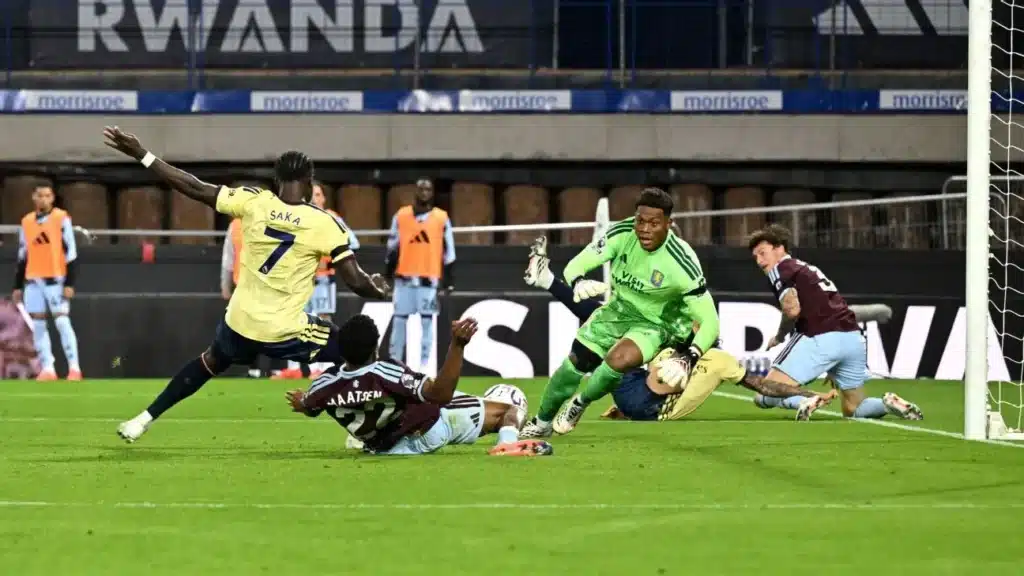
A day after Arsenal’s 1-0 victory at Villa Park, the Aston Villa vs Arsenal VAR discussion is more interesting than it looked immediately after the final whistle.
Jarred Gillett and VAR James Bell had one major factual decision to correct, several penalty-area appeals to assess and a physical match in which Gillett clearly chose a relatively high threshold for fouls and cards.
Bukayo Saka scored the only goal in the 59th minute as Arsenal made it two wins from two. Aston Villa improved significantly from their opening defeat but again failed to register a shot on target.
From an officiating perspective, however, the match was not quite as straightforward as the 1-0 scoreline suggests.
The key incidents were:
Ian Maatsen’s foul on Saka and the overturned Arsenal penalty
John McGinn’s high challenge on Riccardo Calafiori
Two opposing penalty appeals around the 68th minute
Maatsen’s late challenge on Bruno Guimaraes
The first of those was an excellent VAR correction.
The last remains much more debatable.
Saka penalty overturned: VAR got this exactly right
The clearest VAR intervention arrived in the 54th minute.
Saka got goal-side of Ian Maatsen and was brought down as he moved towards the penalty area. Gillett initially pointed to the spot.
The foul itself was not really in dispute.
The question was where it happened.
VAR James Bell checked the contact and established that Maatsen’s offence occurred just outside the penalty area. The penalty was therefore cancelled and Arsenal were awarded a direct free kick instead.
The VAR Verdict: Correct intervention ✅
This is exactly the type of decision VAR should correct quickly.
A direct-free-kick offence becomes a penalty only if the offence occurs inside the defender’s own penalty area.
The important point is the location of the foul, not where Saka eventually falls.
If contact begins and constitutes the foul outside the box, the restart is a free kick.
There was no need for a long subjective debate here.
Maatsen fouled Saka.
The foul was outside the area.
Free kick Arsenal.
VAR corrected a factual location error without trying to re-referee the nature of the challenge.
Why the referee’s original penalty was understandable
Gillett should not be heavily criticised for initially pointing to the spot.
The incident happened at speed, Saka was moving towards the penalty area and the final part of the collision carried him inside.
From the referee’s viewing angle, it was easy to interpret the offence as occurring on or beyond the penalty-area line.
Remember that the line itself belongs to the penalty area.
This is precisely where VAR adds value.
It was not searching for microscopic contact or offering a different interpretation of a subjective tackle.
It simply identified where the foul occurred.
Verdict: Gillett’s initial decision was understandable. Bell’s correction was excellent.
Arsenal scored three minutes later
Martin Ødegaard sent the resulting free kick narrowly wide, but Arsenal did not have to wait long for the breakthrough.
Eberechi Eze released Calafiori down the left and the Italian drove a low ball across goal. Saka arrived ahead of Maatsen and converted from close range in the 59th minute.
There was no meaningful VAR controversy around the goal.
That matters because sometimes a correct VAR decision that removes a penalty becomes a major narrative if the affected team fails to score.
Here, Arsenal responded almost immediately through normal open play.
McGinn’s high boot on Calafiori: should there have been a card?
An earlier incident deserves more attention than it received during the match.
John McGinn challenged for a high ball with Calafiori and his raised boot made contact with the Arsenal defender’s face.
Gillett awarded Arsenal the foul but did not show a card. McGinn was eventually booked much later for a separate challenge on Mikel Merino.
The VAR Verdict: Foul correct, yellow would have been better ⚠️
This was not an obvious red-card incident.
Calafiori lowered his head while attempting to play the ball, which is relevant when judging how dangerous McGinn’s action actually was.
But a boot making contact around an opponent’s face is still a significant challenge.
For us, a yellow card would have been the more appropriate disciplinary outcome.
The challenge was careless at minimum and arguably reckless because of the height of the boot and the location of the contact.
A straight red would have been excessive based on the available footage, but no card at all felt lenient.
Verdict: Foul correct. Missed yellow.
Gillett established a very high contact threshold
This became one of the themes of the match.
Gillett allowed a substantial amount of physical contact before deciding something had crossed the line.
The Guardian’s live report described him as being in a largely “laissez-faire” mood, particularly as Villa accumulated several physical challenges before McGinn was eventually booked in the 81st minute.
A high threshold is not automatically bad refereeing.
In fact, many supporters prefer matches where referees allow reasonable physical competition.
The problem comes when the threshold becomes inconsistent.
If a referee allows one type of holding or contact in midfield, players expect similar incidents to be judged the same way inside the penalty area.
That became important later.
Havertz vs Kamara: enough for a penalty?
Around the 68th minute, Ødegaard found Kai Havertz inside the Villa penalty area.
Boubacar Kamara appeared to tug the Arsenal forward as he tried to move towards goal.
Gillett allowed play to continue and James Bell did not recommend a review.
Seconds later, Villa attacked the other end and Maatsen appealed after contact from Ben White.
Again, nothing was given.
The VAR Verdict: Both no-calls supportable ✅
Neither incident provided strong enough evidence for VAR to become involved.
There was contact on Havertz, but not every piece of holding automatically creates a penalty.
Likewise, Maatsen’s appeal at the opposite end involved contact but did not clearly show White committing an offence that demanded a spot kick.
The important thing is that Gillett applied a similarly high threshold at both ends.
Havertz appeal: No penalty supportable.
Maatsen appeal: No penalty supportable.
This is where consistency helps a referee.
Villa wanted another penalty involving Maatsen
Maatsen was involved again in the 84th minute when he entered Arsenal’s penalty area between Declan Rice and Ben White and went down.
Gillett again rejected the appeal.
Replays did not show enough illegal contact to justify VAR intervention.
The VAR Verdict: Correct no penalty ✅
Two defenders being close to an attacker does not automatically mean the attacker has been fouled.
There has to be an identifiable trip, push, hold or other illegal challenge.
There was not enough here.
Correct decision to continue.
The most debatable incident came in stoppage time
The moment that deserves more discussion one day later arrived in the 98th minute.
Arsenal substitute Bruno Guimaraes attacked a cross inside the Villa penalty area.
Maatsen slid across him from behind and the Arsenal midfielder went down.
Gillett immediately rejected the penalty appeal.
VAR James Bell checked the incident and quickly supported the on-field decision.
Several live reports noted that Maatsen appeared to make contact with the ball. The Guardian described it as a sliding, scissor-style challenge in which the Villa defender reached the ball rather than Guimaraes first.
But that does not completely end the debate.
Winning the ball does not automatically mean no foul
This is one of football’s most persistent refereeing myths.
A defender can touch the ball first and still commit a foul.
The referee must judge the entire challenge.
If a player wins the ball but then follows through carelessly, recklessly or with excessive force into an opponent, touching the ball does not provide immunity.
That is why Maatsen’s challenge is more interesting than simply asking:
“Did he get the ball?”
He appears to reach it.
The harder question is whether his sliding action and follow-through unfairly took Guimaraes out afterwards.
Expert analysis has questioned the no-penalty decision
The incident continued to generate discussion after the match.
ESPN’s referee analysis argued that Arsenal should have been awarded a penalty, describing the challenge from behind as sufficient for Gillett to penalise and suggesting Bell should have recommended an on-field review.
Other match reports viewed it differently, emphasising that Maatsen got to the ball and describing the appeal as unsuccessful or even futile.
That disagreement tells us something important.
This was not comparable to the earlier Saka incident.
The Saka call was factual: outside or inside the penalty area.
The Guimaraes incident was subjective: was Maatsen’s overall challenge legal?
The VAR Verdict: Debatable, but Arsenal have a legitimate penalty argument ⚖️
For us, this is the most questionable decision of the match.
Maatsen gets the ball, which strongly supports Gillett’s original decision.
But the nature of the sliding challenge afterwards means the incident cannot simply be dismissed because of first contact with the ball.
There is a credible argument that Maatsen’s follow-through catches Guimaraes in a way that should be penalised.
Would we describe the no-penalty decision as an obvious VAR disaster?
No.
Would we have supported a penalty if Gillett had given one on the field?
Yes.
And that is precisely where the modern VAR threshold becomes important.
With no penalty given on the field, Bell needed to decide whether Gillett’s interpretation was clearly and obviously wrong.
He decided it was not.
With a high intervention bar, that is defensible.
Our verdict:
On-field decision: debatable.
Penalty argument: strong.
VAR non-intervention: defensible under the clear-and-obvious threshold.
This is the kind of incident where two reasonable referees can still reach different conclusions.
Would VAR have overturned it if Gillett had given the penalty?
Probably not.
That is worth emphasising.
If Gillett had pointed to the spot for Maatsen’s challenge on Guimaraes, the footage also provides enough support for that interpretation that VAR would likely have struggled to prove the penalty was clearly wrong.
This is one of the realities of subjective VAR.
Two apparently opposite outcomes can both survive review:
No penalty on field → VAR supports referee.
Penalty on field → VAR may also support referee.
That can frustrate supporters, but it reflects VAR’s intended role.
The video official is not supposed to ask:
“What decision would I personally make?”
The question is:
“Has the referee clearly made the wrong decision?”
Was Maatsen lucky overall?
Possibly.
The Villa left-back was at the centre of almost every major second-half incident.
He fouled Saka outside the area for the overturned penalty.
He made several further challenges on the Arsenal winger.
He appealed for penalties himself.
He produced the late challenge on Guimaraes.
And he finally received a yellow card in the 96th minute after another foul on Saka.
The individual yellow-card decision was correct.
The broader question is whether Gillett should have cautioned him earlier for repeated infringement.
That argument has some merit.
Persistent offences do not need to be spectacular tackles. A player who repeatedly stops the same opponent or repeatedly commits fouls can eventually require disciplinary action.
Given the number of Saka-Maatsen incidents, Gillett was generous before finally producing the card.
Tzolis’ yellow and the referee’s card consistency
Arsenal’s Christos Tzolis received the first yellow card after 29 minutes and was substituted at half-time.
Sky noted that he had been running the risk of a second yellow.
That makes Gillett’s later leniency towards some Villa challenges more noticeable.
A referee does not need to produce identical numbers of cards for both teams.
Cards are based on offences, not balance.
But once the referee establishes what constitutes a caution, similar levels of misconduct should produce similar outcomes.
Our overall feeling is that Gillett’s disciplinary threshold became slightly too generous as the game developed.
Did Kamara foul an Arsenal player before Buendia hit the bar?
There was also an interesting first-half sequence in the 12th minute.
Arsenal appealed for a foul by Boubacar Kamara during the build-up before Emi Buendia struck the crossbar.
Gillett allowed the move to continue and Buendia’s shot hit the woodwork.
Because the shot did not result in a goal, VAR had no goal to review.
Had Buendia scored, Bell could have checked whether there was a relevant attacking offence in the build-up.
That is another useful reminder of VAR’s limits.
A possible missed foul does not become reviewable simply because the resulting attack is dangerous.
James Bell’s VAR performance
Bell had two very different tests.
The first was straightforward.
Saka/Maatsen: foul location clearly outside the box. Correct the penalty.
The second was much more subjective.
Guimaraes/Maatsen: defender reaches the ball, but there is debate about the follow-through. Maintain the high clear-and-obvious threshold.
This is a useful example of what VAR should look like when used properly.
Not every check needs an on-field review.
Not every controversial decision needs to be changed.
But when there is an objective factual error, such as the exact location of a foul, VAR should intervene decisively.
Jarred Gillett’s overall performance
This was not a bad refereeing performance.
Gillett got the fundamental decisions mostly right and worked well with Bell on the clearest VAR moment.
There were no serious red-card mistakes.
Saka’s goal was clean.
Villa’s penalty appeals were generally weak.
The main criticism is his disciplinary threshold and the late Guimaraes incident.
McGinn could reasonably have been cautioned earlier for the high boot on Calafiori.
Maatsen also received considerable freedom before finally being booked.
And the Guimaraes penalty appeal remains genuinely debatable.
The VAR Verdict referee rating: 7/10
McGinn high boot on Calafiori: ⚠️ Foul correct, yellow preferable
Saka penalty initially awarded: ⚠️ Understandable live decision
VAR overturn to free kick: ✅ Correct
Havertz penalty appeal: ✅ No penalty supportable
Maatsen penalty appeal: ✅ No penalty supportable
Late Guimaraes penalty appeal: ⚖️ Debatable, strong Arsenal argument
VAR non-intervention on Guimaraes: ✅ Defensible under high threshold
Overall card management: ⚠️ Slightly too lenient
One day later, what is the biggest refereeing takeaway?
Immediately after the match, the obvious headline was that VAR had overturned Arsenal’s penalty.
One day later, that is actually the least controversial major decision.
Bell got it right.
Maatsen fouled Saka outside the area, so a free kick was the correct restart.
The more interesting discussion is the stoppage-time challenge on Guimaraes.
It demonstrates the difficult balance the Premier League is trying to achieve with a higher VAR intervention threshold.
If VAR intervenes every time another referee might prefer a penalty, football returns to the problem of video officials re-refereeing subjective incidents.
If VAR never intervenes unless a mistake is extraordinary, some genuine penalties will inevitably survive as no-calls.
The Maatsen-Guimaraes incident sits directly in that grey area.
Final VAR Verdict
Arsenal’s 1-0 win was not decided by a major refereeing error.
Saka’s winner was legitimate.
The penalty he appeared to win three minutes earlier was correctly downgraded to a free kick because Maatsen’s foul occurred outside the area.
Most of Villa’s penalty appeals did not meet the required threshold.
But Arsenal can reasonably ask questions about two areas of Gillett’s performance.
First, his card management was lenient, particularly with McGinn’s high challenge and Maatsen’s repeated fouling.
Second, Maatsen’s stoppage-time tackle on Guimaraes was much closer to a penalty than some initial match reports suggested.
Our final assessment:
Saka overturned penalty: ✅ VAR correct
Villa penalty appeals: ✅ Correctly rejected
McGinn high boot: ⚠️ Yellow card missed
Guimaraes late appeal: ⚖️ Genuine penalty debate
Major VAR error: ❌ None clearly established
Overall officiating: Solid, but not flawless
The most important distinction is this:
VAR clearly corrected one factual mistake.
It then chose not to overturn a subjective decision that remains debatable a day later.
That is not necessarily inconsistency.
It is the difference between what VAR can prove and what football can still argue about.

0 Comments
Join the conversation with respect. Comments are moderated and must follow our community rules.
Want to join the discussion?
Please log in or create an account to comment and reply. This keeps the conversation cleaner and safer.